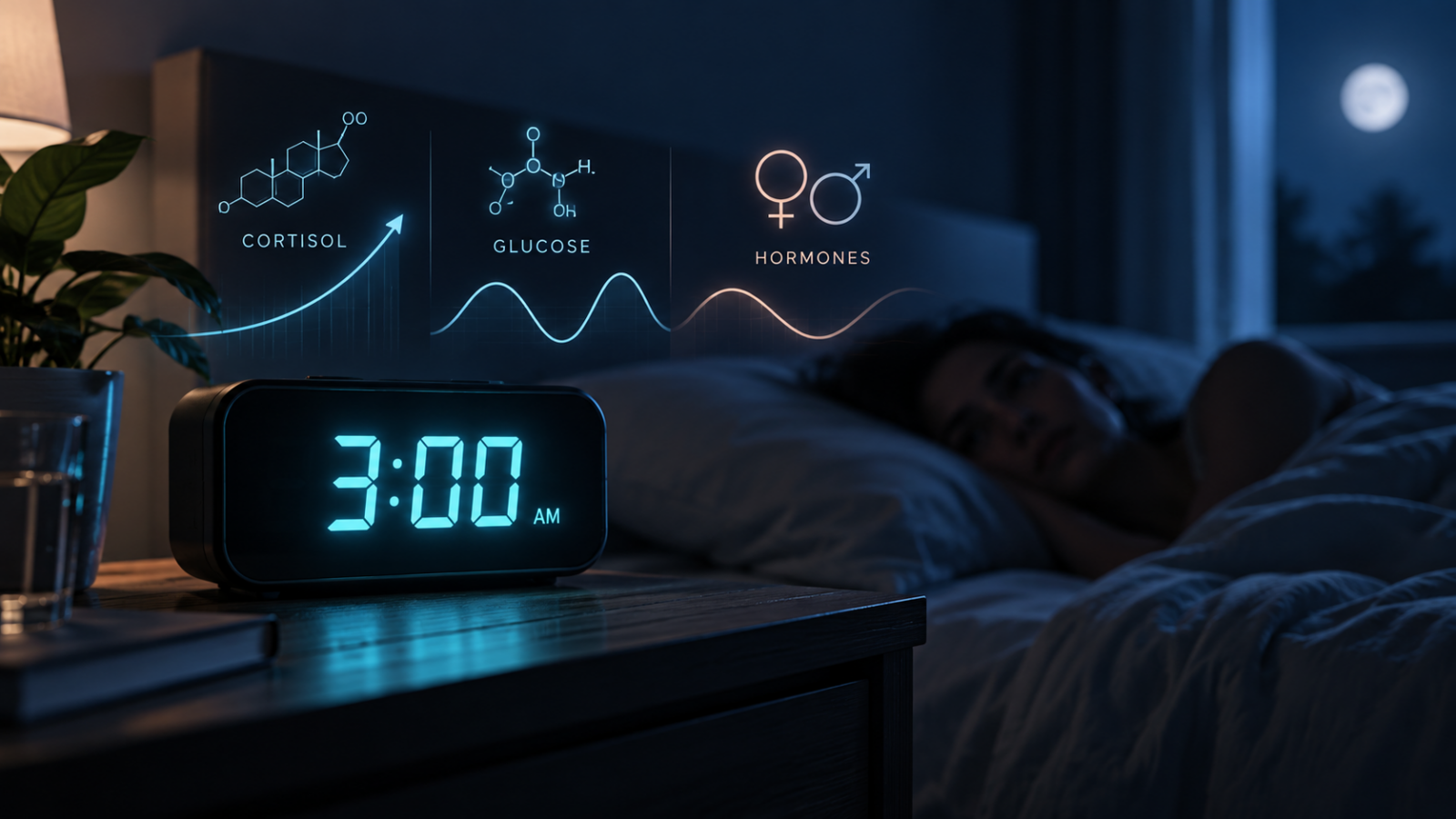

You can eat well, train consistently, track your calories, and still feel like weight management is becoming harder.
One variable often gets pushed to the bottom of the priority list:
Sleep.
When work gets busy, training gets serious, or life becomes stressful, sleep is usually the first thing people sacrifice.
Five hours becomes six.
Six starts feeling normal.
Caffeine gets you through the morning.
Then hunger increases, afternoon cravings show up, workouts feel harder, recovery slows, and losing body fat suddenly requires more effort than it used to.
That does not mean poor sleep somehow “breaks” your metabolism.
The reality is more interesting.
Insufficient sleep can affect appetite, food reward, insulin sensitivity, eating behavior, recovery, and body composition, creating an environment where gaining weight becomes easier and losing it becomes harder.
And for high-performing adults already balancing work, training, stress, and family demands, sleep debt can quietly become one of the biggest gaps in the plan.
What Is Sleep Debt?
Sleep debt describes the accumulated difference between the amount of sleep your body needs and the amount you consistently get.
If your body functions best with around eight hours but you repeatedly sleep six, you are operating with a recurring sleep deficit.
One short night usually is not the problem.
The pattern is.
Many adults eventually adapt psychologically to sleeping less. They stop thinking of themselves as sleep deprived because being tired has become their baseline.
Your physiology may not adapt quite as easily.
The American Academy of Sleep Medicine recommends that adults regularly obtain at least seven hours of sleep per night for optimal health.
Recent CDC data also show how common inadequate sleep has become. In 2024, about 30.5% of U.S. adults reported sleeping fewer than seven hours per 24-hour period.
How Sleep Debt Can Contribute to Weight Gain
The connection between sleep and body weight is not explained by one hormone.
It is the result of several overlapping systems.
1. Poor Sleep Can Make You Hungrier
One of the most consistent findings from controlled sleep studies is surprisingly simple:
People often eat more when they sleep less.
A meta-analysis of 41 randomized controlled trials found that sleep restriction increased subjective hunger and was associated with roughly 253 additional calories consumed per day compared with normal sleep conditions.
That difference may not sound dramatic.
But repeatedly eating an additional 200 to 300 calories because you are tired, hungry, and surrounded by convenient food can matter over time.
Importantly, the science is more nuanced than the common claim that poor sleep always raises ghrelin and lowers leptin.
Ghrelin helps regulate hunger, while leptin contributes to satiety signaling. Some individual studies have found changes in these hormones after sleep restriction, but controlled-trial evidence has not shown a completely consistent leptin-and-ghrelin response across populations.
The stronger takeaway is this:
Short sleep tends to increase hunger and calorie intake even when the exact hormonal response differs from person to person.
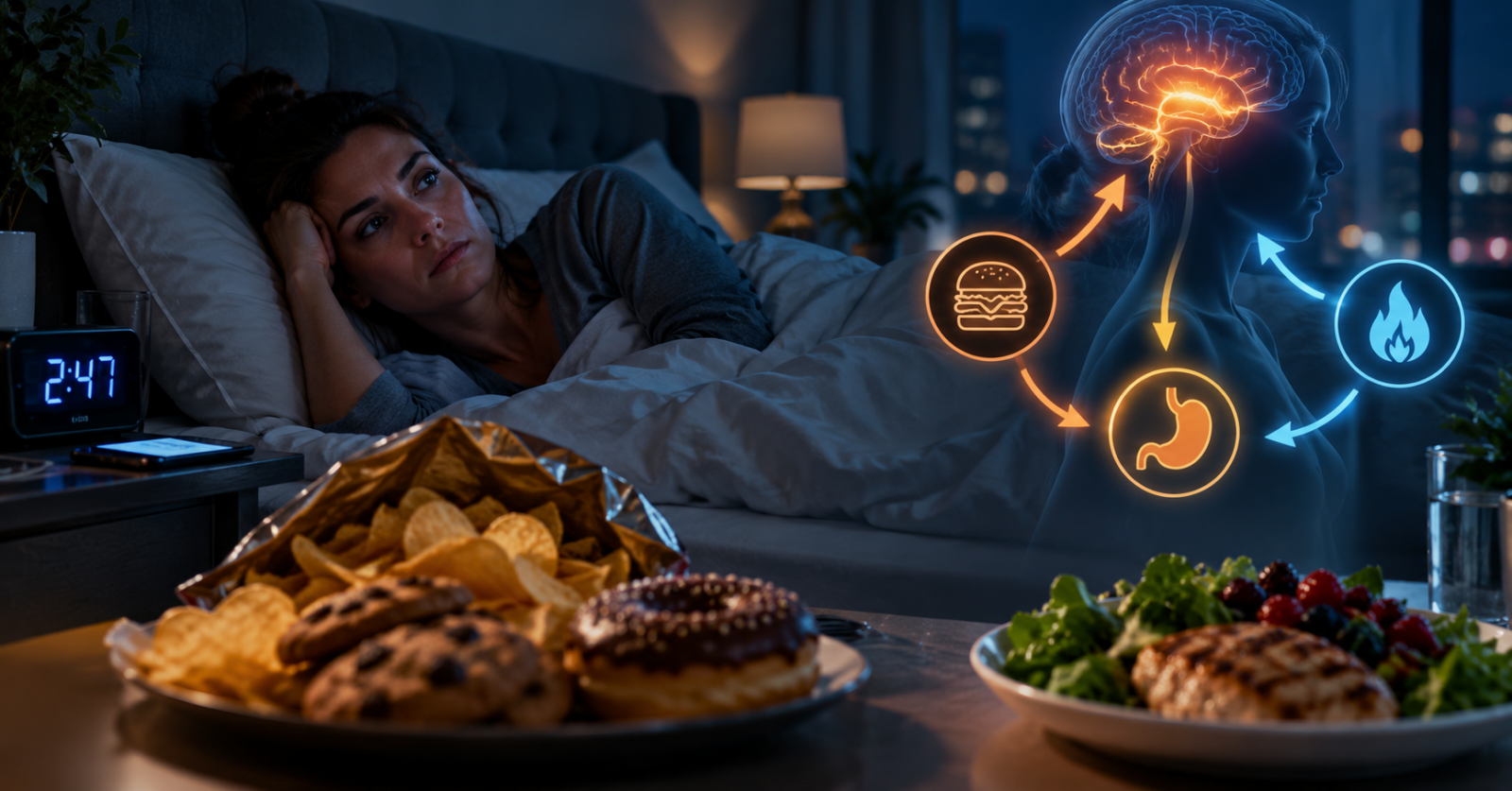
2. Being Tired Can Change What You Want to Eat
Sleep loss does not only influence how much you eat.
It can influence what sounds rewarding.
Studies have found increased food-reward signaling and greater difficulty resisting highly palatable foods during sleep restriction. One controlled study found that restricted sleep altered endocannabinoid signaling alongside increased hunger, appetite, and difficulty resisting snacks.
Another laboratory study found that restricting sleep from 8.5 to 5.5 hours increased calories consumed from snacks, particularly during evening and overnight hours.
This helps explain a familiar experience.
You may have every intention of eating the protein, vegetables, and meal you planned.
But after five hours of sleep and ten hours of work, suddenly the chips, dessert, takeout, or drive-through meal sounds much more appealing.
That is not simply a motivation problem.
Your sleep state can change the environment in which that decision is being made.
3. Sleep Loss Can Reduce Insulin Sensitivity
Sleep also interacts with glucose regulation.
Insulin helps move glucose from your bloodstream into tissues where it can be used or stored.
Reduced insulin sensitivity means your body needs more insulin to produce the same effect.
Randomized controlled studies have repeatedly found that even relatively short periods of sleep restriction can impair markers of insulin sensitivity. A meta-analysis of randomized trials examining sleep manipulation also found adverse effects on insulin sensitivity.
In one study of healthy young adults, several nights of moderate sleep restriction produced higher insulin responses and lower measures of insulin sensitivity compared with adequate sleep.
This does not mean one bad night will cause diabetes or immediate fat gain.
It means chronic poor sleep can become another stressor acting on metabolic health, particularly when combined with low activity, excess calorie intake, visceral fat, aging, or an existing tendency toward insulin resistance.
4. The Main Problem May Be Eating More, Not Burning Dramatically Less
People often say sleep deprivation “slows your metabolism.”
That can be misleading.
Controlled studies have not consistently shown a large drop in total daily energy expenditure after sleep restriction.
What often changes more clearly is energy intake.
In a randomized clinical trial published in JAMA Internal Medicine, 80 adults with overweight who habitually slept less than 6.5 hours per night were assigned either to continue their usual sleep or receive an intervention designed to extend sleep.
Those in the sleep-extension group increased sleep by approximately 1.2 hours per night and consumed about 270 fewer calories per day relative to the control group.
There was no significant difference in total energy expenditure between groups.
That is an important distinction.
Sleep may help weight management not because it magically accelerates calorie burning, but because being better rested can improve the biological and behavioral conditions that influence calorie intake.
5. Sleep Restriction May Influence Visceral Fat
Body weight is only part of metabolic health.
Where fat is stored matters too.
Visceral fat is stored deeper in the abdominal cavity around internal organs and is more strongly associated with cardiometabolic risk than subcutaneous fat alone.
In a randomized crossover study from Mayo Clinic, participants given only a four-hour sleep opportunity consumed more calories and gained more weight than during normal sleep.
Researchers also observed increases in abdominal fat, including visceral fat, during the sleep-restriction period.
The study was small and conducted under controlled conditions, so it should not be interpreted as proof that every person sleeping poorly will accumulate visceral fat.
But it adds to evidence that chronic sleep restriction may influence more than the number you see on the scale.
6. Poor Sleep May Change What You Lose During a Diet
This is particularly relevant if your goal is fat loss rather than simply weight loss.
In one randomized crossover study, adults followed the same calorie-restricted diet under two sleep conditions.
When participants had 8.5 hours of sleep opportunity, more of the weight they lost came from fat.
When sleep opportunity was restricted to 5.5 hours, the proportion of weight lost as fat decreased while loss of fat-free mass increased.
A later eight-week trial also found that adding repeated sleep restriction to a calorie deficit resulted in a smaller proportion of total weight loss coming from fat.
These studies were relatively small, so the exact numbers should not be generalized to everyone.
But the implication is important:
If you are dieting aggressively while consistently under-sleeping, the scale alone may not tell you whether your body composition is moving in the direction you want.
Sleep Debt Also Changes Recovery
Weight management does not happen independently of the rest of your life.
When recovery declines, training quality may decline too.
You might notice:
- Workouts feeling unusually difficult
- Lower strength or endurance
- More soreness
- Reduced motivation to exercise
- Less spontaneous daily movement
- Greater reliance on caffeine
- More hunger later in the day
- Difficulty sticking to planned meals
- Irritability or poor concentration
This is where sleep debt can become recovery debt.
Training creates stress.
Work creates stress.
Travel creates stress.
Dieting creates stress.
Life creates stress.
Sleep is one of the major opportunities your body gets to recover from all of it.
When that recovery window repeatedly gets cut short, simply adding more cardio or reducing calories further may make the overall situation worse.
Can You Catch Up on Sleep During the Weekend?
Sleeping longer after several short nights can certainly help you feel better.
But treating every weekend like a complete metabolic reset may not work as well as many people hope.
In an NIH-funded laboratory study, participants restricted to five hours of sleep gained weight, increased late-night eating, and experienced reductions in insulin sensitivity.
Allowing weekend recovery sleep did not completely prevent those metabolic changes once sleep restriction resumed.
That does not mean catching up on sleep is useless.
It means consistent adequate sleep is preferable to repeatedly cycling between deprivation and recovery.
How to Reduce Sleep Debt Without Overcomplicating It
You do not need a perfect wearable score every night.
Start with the fundamentals.
Keep Your Wake Time Consistent
A relatively stable wake time helps reinforce your circadian rhythm.
Sleeping until noon every weekend after waking at 6:00 a.m. all week may make returning to your normal schedule harder.
Give Yourself More Time to Sleep
If you currently sleep six hours, jumping immediately to nine may be unrealistic.
Try creating an additional 30 to 60 minutes of sleep opportunity and build from there.
The sleep-extension trial discussed earlier shows that relatively modest improvements in sleep can influence energy intake in habitual short sleepers.
Get Light Early in the Day
Morning daylight helps reinforce the circadian signals that support daytime alertness and nighttime sleepiness.
Be Strategic With Caffeine
Caffeine can improve alertness temporarily.
It cannot replace sleep.
If falling asleep is difficult, examine how much caffeine you consume and how late you consume it.
Create a Repeatable Wind-Down Routine
Your brain does not always transition instantly from email, social media, television, work stress, and bright light into deep sleep.
Create a buffer before bed.
Dim the lights.
Put work away.
Make the room cool, dark, and quiet.
CDC guidance similarly emphasizes regular sleep schedules, daytime light exposure, activity, and reducing artificial light near bedtime. CDC
Do Not Turn Fat Loss Into a Recovery Competition
If you are sleeping five hours, training six days per week, maintaining an aggressive calorie deficit, working long hours, and relying on stimulants to function, pushing harder may not be the answer.
Your body has a finite recovery budget.
Sometimes better progress begins by reducing the number of withdrawals.
When Poor Sleep Deserves More Than Sleep Hygiene
Sometimes poor sleep is not caused by staying up too late.
Consider discussing your sleep with a healthcare professional if you regularly experience symptoms such as:
- Loud snoring
- Waking up gasping or choking
- Severe daytime sleepiness
- Persistent insomnia
- Frequent nighttime awakenings
- Morning headaches
- Restless or uncomfortable legs at night
- Significant night sweats
- Sleep disruption related to perimenopause or menopause
- Persistent fatigue despite spending adequate time in bed
Conditions such as obstructive sleep apnea, insomnia, hormone changes, medication effects, stress disorders, and other medical issues can interfere with sleep quality even when you are giving yourself enough time in bed.
That is why “just sleep more” is not always useful advice.
The Bottom Line
Sleep does not replace good nutrition.
It does not replace strength training.
It does not eliminate the importance of energy balance.
But sleep affects the biological environment in which all of those things happen.
Chronic sleep restriction can increase hunger, increase calorie intake, alter food reward, impair insulin sensitivity, reduce recovery, and potentially affect how fat is distributed or how body composition changes during dieting.
If you keep responding to stalled fat loss by eating less and exercising more while sleeping five or six hours per night, you may be overlooking one of the most important variables in the equation.
Better recovery is not separate from your weight-loss strategy.
It is part of it.
At 1st Optimal, we look beyond the scale to evaluate the factors that can influence weight, energy, recovery, hormone health, glucose regulation, sleep, and body composition.
If your weight, energy, or recovery feels different despite doing many of the right things, a more complete evaluation may help identify what is being missed.
Ready to look deeper?
Book a Health Consult with 1st Optimal
Educational only. This article is not medical advice and does not replace evaluation, diagnosis, or treatment from a qualified healthcare professional.
Frequently Asked Questions
Can sleep debt really cause weight gain?
Sleep debt does not guarantee weight gain, but insufficient sleep can create conditions that make weight gain more likely. Controlled studies show that restricting sleep can increase hunger and calorie intake and reduce insulin sensitivity. Long-term body weight still depends on multiple factors, including energy intake, activity, genetics, medications, health conditions, hormones, and environment.
How many hours of sleep should adults get for weight management?
There is no specific number of hours proven to cause weight loss. However, the American Academy of Sleep Medicine recommends adults regularly get at least seven hours of sleep for overall health. Individual needs vary.
Does lack of sleep slow your metabolism?
It is more accurate to say that poor sleep can disrupt metabolic regulation rather than simply “slow metabolism.” Controlled research has consistently found increases in hunger and food intake, while changes in total energy expenditure are less consistent.
Does sleeping more help with weight loss?
For habitual short sleepers, improving sleep may support weight management. In one randomized trial, extending sleep reduced daily calorie intake by approximately 270 calories compared with maintaining habitual short sleep. Longer studies are still needed to determine the full long-term effect on weight loss.
Can poor sleep increase belly fat?
Controlled research has found increased abdominal and visceral fat during experimental sleep restriction. However, fat distribution is influenced by many additional factors, including genetics, age, sex hormones, activity, diet, and overall energy balance.
Can weekend sleep make up for poor sleep during the week?
Additional weekend sleep may reduce sleepiness, but research suggests it may not fully reverse the metabolic effects of repeatedly restricting sleep during the workweek. Consistency appears to matter.
References
- Tasali E, et al. Effect of Sleep Extension on Objectively Assessed Energy Intake Among Adults With Overweight in Real-life Settings. JAMA Internal Medicine. 2022.
- Zhu B, et al. Effects of sleep restriction on metabolism-related parameters in healthy adults: A comprehensive review and meta-analysis of randomized controlled trials. Sleep Medicine Reviews. 2019.
- Covassin N, et al. Effects of Experimental Sleep Restriction on Energy Intake, Energy Expenditure, and Visceral Obesity. Journal of the American College of Cardiology. 2022.
- Nedeltcheva AV, et al. Insufficient sleep undermines dietary efforts to reduce adiposity. Annals of Internal Medicine. 2010.
- Wang X, et al. Influence of sleep restriction on weight loss outcomes associated with caloric restriction. Sleep. 2018.
- Depner CM, et al. Ad libitum Weekend Recovery Sleep Fails to Prevent Metabolic Dysregulation During a Repeating Pattern of Insufficient Sleep and Weekend Recovery Sleep. Current Biology. 2019.
- American Academy of Sleep Medicine and Sleep Research Society. Recommended Amount of Sleep for a Healthy Adult.