

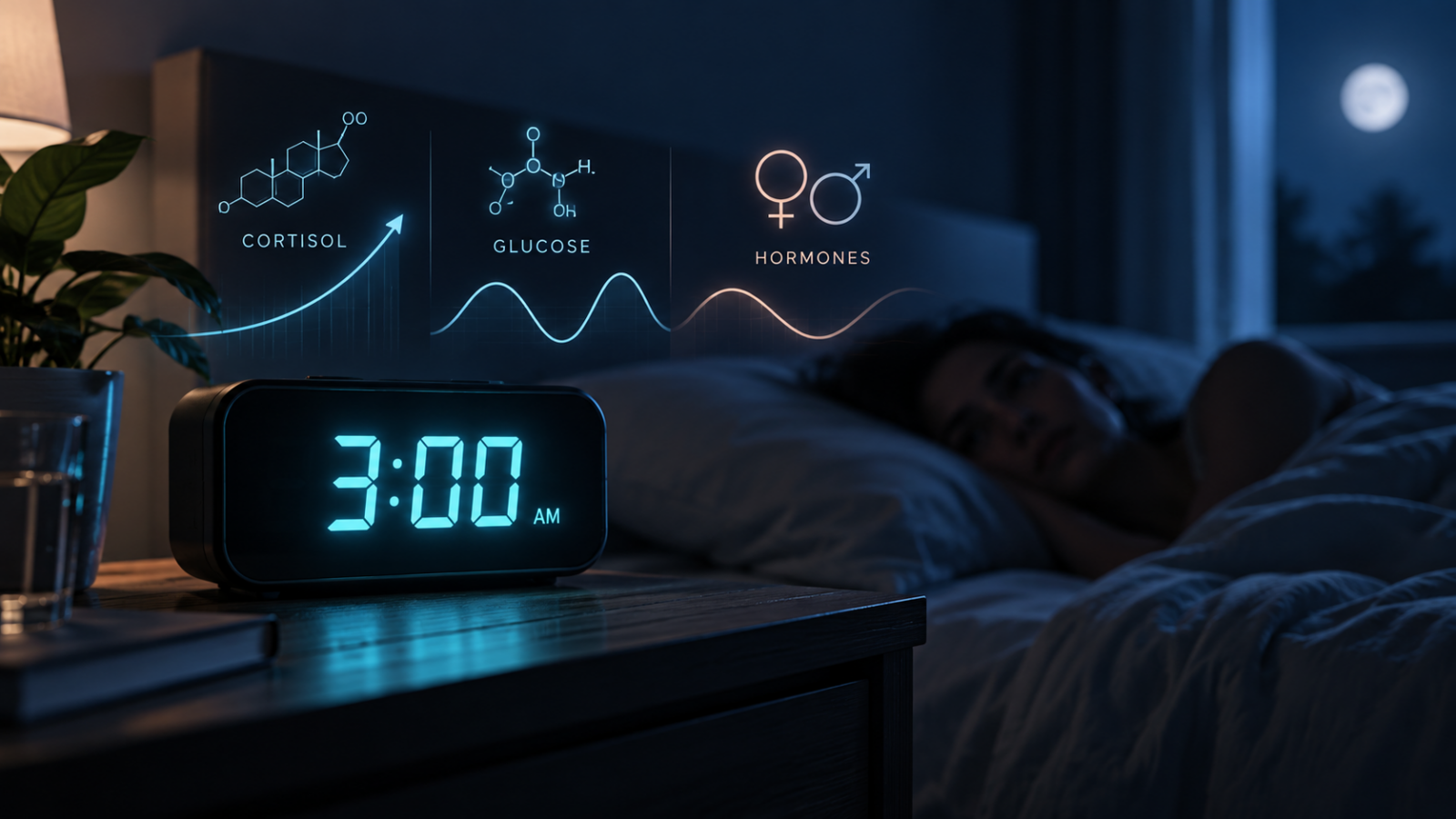
You fall asleep without a problem.
Then, seemingly like clockwork, your eyes open at 2:47 AM, 3:06 AM, or 3:30 AM.
You check the clock.
Your body feels tired, but your brain suddenly feels awake.
Maybe your heart is beating a little faster. Maybe you feel warm. Maybe your mind immediately starts running through tomorrow’s schedule.
And then comes the frustrating part.
You can’t fall back asleep.
If this happens regularly, it is tempting to blame one thing: cortisol, blood sugar, menopause, stress, or “adrenal fatigue.”
The reality is more complicated.
Repeatedly waking up around 3 AM can involve interactions between your circadian rhythm, stress-response system, glucose regulation, reproductive hormones, sleep environment, and underlying sleep disorders.
The time on the clock alone cannot diagnose the cause.
But understanding what is happening inside your body during the second half of the night can help explain why these awakenings become so common.
First: Waking Up During the Night Is Not Automatically Abnormal
Sleep is not one continuous unconscious state.
Throughout the night, your brain cycles repeatedly through different stages of non-REM and REM sleep. Brief awakenings can happen as you move between these stages, and many are so short that you never remember them.
The problem begins when those awakenings become frequent, prolonged, or difficult to recover from.
Instead of briefly waking and rolling over, you become fully alert.
That is when hormones, stress, temperature regulation, circadian timing, glucose metabolism, and behavioral habits may start playing a role.
Why Does 3 AM Seem to Be Such a Common Time to Wake Up?
There is nothing biologically magical about exactly 3:00 AM.
For someone who goes to bed between 9 PM and midnight, however, 3 AM often falls during the second half of the sleep period.
Several physiological changes are occurring during this window.
Your sleep architecture is shifting.
REM sleep becomes more prominent.
Your body is moving closer to its biological morning.
And one of the body’s most important wake-promoting hormones, cortisol, begins transitioning toward its morning rise.
That does not mean a “cortisol spike at 3 AM” is automatically waking you up.
The physiology is more nuanced.
Cortisol and the 3 AM Wake-Up
Cortisol is one of the body’s primary glucocorticoid hormones.
It helps regulate:
- Stress responses
- Blood pressure
- Immune activity
- Energy availability
- Glucose metabolism
- Circadian timing
- Alertness
Cortisol follows a strong daily rhythm controlled partly by the brain’s central circadian clock.
Under normal circumstances, cortisol concentrations decline in the evening, reach low levels during the early part of the night, and then rise as the body approaches its habitual waking period. Cortisol also increases further during the first hour after waking, a phenomenon known as the cortisol awakening response.
So cortisol is supposed to increase toward morning.
The issue is not simply that cortisol exists.
The question is whether your stress and circadian systems are operating at the right intensity and at the right time.
Stress Can Make Your Brain More Sensitive to Nighttime Awakening
Your hypothalamic-pituitary-adrenal, or HPA, axis coordinates much of your physiological response to stress.
When life becomes chronically demanding, whether because of work, training, emotional stress, inadequate recovery, illness, or insufficient sleep, your nervous system may become more prone to nighttime hyperarousal.
You may technically be exhausted while your brain remains highly responsive to internal and external signals.
This is one reason someone can feel:
“I’m completely tired, but I can’t stay asleep.”
Importantly, research does not support the popular idea that waking at 3 AM automatically means you have “adrenal fatigue.” The Endocrine Society states that adrenal fatigue is not a recognized medical condition, and a systematic review found no evidence supporting adrenal fatigue as a distinct diagnosis.
That does not mean chronic stress is irrelevant.
It means the physiology should be evaluated more accurately.
Poor Sleep Can Alter Cortisol Too
The cortisol-sleep relationship works in both directions.
Stress can disturb sleep.
But insufficient sleep can also change stress-hormone regulation.
A review of controlled sleep studies found that substantial sleep restriction can increase cortisol particularly during the late afternoon and evening, although changes in morning cortisol have been inconsistent across studies.
This can create a cycle:
Poor sleep → altered stress regulation → greater physiological arousal → more difficulty sleeping → more poor sleep
For high-performing adults who are constantly working, training, traveling, consuming caffeine, and operating under pressure, sleep disruption may therefore reflect the accumulated effect of the entire day rather than something happening only at 3 AM.
Can Blood Sugar Make You Wake Up at 3 AM?
This is another commonly discussed explanation.
And again, context matters.
Your body still needs energy while you sleep.
During fasting, hormones including glucagon, cortisol, growth hormone, and catecholamines help maintain adequate circulating glucose.
For people using insulin or certain glucose-lowering medications, nocturnal hypoglycemia is a legitimate concern.
The National Institute of Diabetes and Digestive and Kidney Diseases notes that blood glucose can fall during sleep. Nighttime hypoglycemia may be associated with sweating, nightmares, disrupted sleep, and feeling tired or confused after waking.
But repeatedly waking at 3 AM should not automatically be labeled a “blood sugar crash,” particularly in someone without diabetes or medications that increase hypoglycemia risk.
The Sleep-Glucose Relationship Goes Both Ways
Poor sleep can also make glucose regulation worse.
A meta-analysis of randomized controlled trials found that sleep restriction reduced measures of insulin sensitivity. Circadian misalignment and disruption of deeper sleep stages may also negatively affect metabolic regulation.
Another meta-analysis found that sleep restriction increased subjective hunger and calorie intake while reducing insulin sensitivity.
So the relationship can become another feedback loop:
Poor sleep → impaired insulin sensitivity → altered appetite and metabolic regulation → poorer sleep and recovery
This is one reason sleep deserves attention in any comprehensive metabolic-health strategy.
Could Your Evening Meal Be Contributing?
Meal timing and composition can influence how you feel overnight, although there is no universal “perfect” dinner for preventing 3 AM awakenings.
Possible contributors include:
- Eating a very large meal immediately before bed
- Heavy alcohol consumption
- Going to bed extremely hungry
- Highly irregular eating schedules
- Large swings in daily calorie intake
- Excessive dieting or under-fueling
- Eating patterns that worsen reflux
- Poor overall glucose control
If nighttime waking is accompanied by sweating, shakiness, unusual hunger, palpitations, or significant glucose fluctuations, discussing those symptoms with a healthcare professional is more useful than simply assuming you need a bedtime snack.
Women Over 35: Estrogen, Progesterone, and Nighttime Awakening
For women in their late 30s, 40s, and 50s, reproductive hormones deserve particular attention.
Sleep disruption becomes increasingly common during the menopausal transition.
Changes in estrogen and progesterone may influence:
- Temperature regulation
- Mood
- Circadian signaling
- Sleep architecture
- Vasomotor symptoms
- Night sweats
- Anxiety
- Sleep continuity
Research shows that nighttime awakenings are especially common during the menopause transition. Vasomotor symptoms such as hot flashes and night sweats can substantially contribute, while changing estradiol and follicle-stimulating hormone patterns may also be associated with sleep disturbances independent of hot flashes.
This can look like:
You fall asleep normally.
Then you wake suddenly between 2 and 4 AM feeling warm, restless, anxious, or inexplicably alert.
You may not even experience a dramatic hot flash.
For some women, sleep disruption is one of the earliest signs that their hormonal environment is changing.
That does not mean estrogen is automatically the cause or that hormone therapy is appropriate for everyone.
But persistent sleep changes during perimenopause deserve a more complete evaluation than simply being told to “reduce stress.”
What About Progesterone?
Progesterone and its neuroactive metabolites interact with brain signaling involved in relaxation and sleep.
During perimenopause, ovulation can become less predictable, which changes normal patterns of progesterone exposure.
At the same time, estrogen fluctuations, vasomotor symptoms, mood changes, and other factors are occurring.
This is why nighttime awakening during perimenopause is rarely explained by a single hormone.
Hormones function as a system.
Looking only at one isolated marker can miss the larger pattern.
Testosterone and Sleep in Men
Men are not immune to hormone-related sleep problems.
Sleep and testosterone have a bidirectional relationship.
Adequate sleep supports normal endocrine signaling, while chronically insufficient sleep and conditions such as obstructive sleep apnea may interfere with normal hormonal physiology.
But waking at 3 AM is not enough to diagnose low testosterone.
If poor sleep occurs alongside symptoms such as:
- Reduced libido
- Lower motivation
- Loss of strength
- Difficulty recovering from exercise
- Changes in body composition
- Persistent fatigue
then hormone evaluation may be one part of a broader assessment.
The goal should be to understand the complete picture rather than treating one laboratory number.
Do Not Ignore Sleep Apnea
One of the most important causes of repeated nighttime awakening has nothing to do with a mysterious hormone imbalance.
It is sleep-disordered breathing.
Obstructive sleep apnea can repeatedly interrupt sleep as breathing becomes restricted or temporarily stops.
You may not remember gasping for air.
Instead, you may simply notice:
- Frequent awakenings
- Snoring
- Dry mouth in the morning
- Morning headaches
- Daytime fatigue
- Poor concentration
- Elevated blood pressure
- Unrefreshing sleep despite spending enough time in bed
Sleep apnea can also activate the sympathetic nervous system, which makes the resulting awakening feel like a stress response.
Someone may therefore assume cortisol caused the awakening when the real issue began with impaired breathing.
Persistent nighttime awakening combined with loud snoring, witnessed breathing pauses, or excessive daytime sleepiness deserves medical evaluation.
Alcohol May Help You Fall Asleep but Hurt the Second Half of the Night
A common pattern looks like this:
A glass or two of alcohol makes you feel relaxed.
You fall asleep quickly.
Several hours later, you are wide awake.
Alcohol can initially have sedating effects, but that does not necessarily translate into restorative sleep throughout the night.
As alcohol is metabolized, sleep can become increasingly fragmented.
Alcohol may also worsen:
- Snoring
- Sleep apnea
- Temperature regulation
- Reflux
- Nighttime urination
If 3 AM awakenings happen much more often after drinking, that pattern is worth paying attention to.
Your Circadian Rhythm May Be Part of the Problem
Your body operates according to an internal approximately 24-hour biological clock.
Light exposure, meals, activity, sleep timing, and other behaviors help synchronize that clock.
Problems can emerge when your biological rhythm and lifestyle stop matching.
Examples include:
- Going to sleep at drastically different times each night
- Staying up extremely late on weekends
- Shift work
- Frequent international travel
- Bright screens late at night
- Very little morning sunlight
- Late-night work
- Irregular meal timing
Circadian misalignment affects more than sleep.
It can also influence hormonal and metabolic rhythms, including cortisol and insulin sensitivity.
Why You May Wake Up and Immediately Start Thinking
Sometimes the initial awakening is not the biggest problem.
What happens next is.
You wake briefly.
Then you look at the clock.
Your brain calculates:
“I only have three hours left.”
Then:
“I’m going to be exhausted tomorrow.”
Then you check your phone.
Then you answer an email.
Now an ordinary brief awakening has become 45 minutes of wakefulness.
Over time, your brain can begin associating your bed with frustration and alertness instead of sleep.
This is one reason behavioral approaches such as cognitive behavioral therapy for insomnia, or CBT-I, are frequently used for persistent insomnia, including sleep disturbance associated with menopause.
9 Things to Check If You Keep Waking Up Around 3 AM
If this pattern happens regularly, look at the entire system rather than searching for one “3 AM hormone.”
1. Your Total Sleep Opportunity
Most adults cannot consistently function at their best on five or six hours of sleep.
Chronic sleep restriction itself can negatively affect insulin sensitivity and stress-hormone regulation.
2. Your Caffeine Timing
Caffeine consumed later in the day may remain biologically active long after you stop feeling its obvious stimulant effect.
Experiment with moving your final caffeine intake earlier.
3. Your Alcohol Intake
Track whether awakenings become more common on evenings when you drink alcohol.
4. Your Stress Load
Do not evaluate only emotional stress.
Consider:
- Workload
- Financial pressure
- Relationship stress
- Excessive training
- Under-eating
- Travel
- Illness
- Poor recovery
- Constant digital stimulation
The body does not categorize stress as neatly as we do.
5. Your Evening Nutrition
Look for extreme restriction, very large meals, inconsistent eating patterns, or symptoms suggesting reflux or glucose dysregulation.
6. Your Menstrual and Hormonal Pattern
For women, track nighttime waking alongside:
- Cycle changes
- Hot flashes
- Night sweats
- Mood changes
- PMS changes
- Weight changes
- Brain fog
- Changes in libido
Patterns can provide useful context during perimenopause.
7. Signs of Sleep Apnea
Snoring, gasping, morning headaches, daytime sleepiness, and hypertension should not be ignored.
8. Your Sleep Environment
A bedroom that becomes too hot, noisy, bright, or uncomfortable can turn normal brief arousals into full awakenings.
9. Your Overall Health
Persistent nighttime waking can also occur alongside medical conditions, medication effects, pain, anxiety disorders, depression, reflux, urinary symptoms, thyroid disorders, restless legs syndrome, and other problems.
That is why testing should follow the clinical picture rather than assuming every 3 AM awakening is caused by cortisol.
What Testing Might Be Worth Discussing?
Not everyone who wakes during the night needs extensive laboratory testing.
But if your sleep changes are persistent and occur alongside fatigue, weight changes, abnormal menstrual cycles, temperature intolerance, metabolic problems, libido changes, or other symptoms, your healthcare provider may consider evaluating factors such as:
- Glucose regulation
- Hemoglobin A1c
- Thyroid function
- Iron status
- Reproductive hormones when clinically appropriate
- Medication effects
- Sleep apnea risk
- Menopause or perimenopause symptoms
Testing should be individualized.
More testing is not automatically better.
The goal is to identify clinically meaningful patterns that can actually change your treatment strategy.
What Can You Do Tonight?
Before buying another sleep supplement, start with the fundamentals.
Try to:
- Maintain consistent sleep and wake times
- Get outdoor light early in the day
- Keep your bedroom cool and dark
- Reduce bright light late at night
- Limit alcohol close to bedtime
- Move caffeine earlier
- Avoid repeatedly checking the clock
- Exercise regularly while allowing adequate recovery
- Eat enough to support your activity level
- Address persistent stress rather than simply trying to “push through”
- Get evaluated if snoring or sleep apnea symptoms are present
These habits may sound basic.
But sleep physiology responds strongly to consistency.
Supplements cannot fully compensate for a nervous system, circadian rhythm, or lifestyle that is continuously receiving conflicting signals.
When Should You Talk to a Healthcare Provider?
Consider getting evaluated if nighttime awakenings:
- Happen several nights per week
- Persist for weeks or months
- Significantly affect daytime function
- Are accompanied by intense sweating or palpitations
- Occur alongside major menstrual changes
- Are accompanied by snoring or breathing pauses
- Occur with unexplained weight change
- Are associated with significant anxiety or mood symptoms
- Begin after starting a new medication
- Occur alongside abnormal glucose readings
If you use insulin or medications capable of causing hypoglycemia and suspect nighttime low blood sugar, discuss it promptly with your medical team.
The Bottom Line
Waking up at 3 AM does not automatically mean your cortisol is “broken.”
It also does not automatically mean your blood sugar crashed or your adrenal glands are exhausted.
But repeated nighttime awakening can provide useful information.
Your cortisol rhythm, circadian clock, glucose regulation, reproductive hormones, stress load, sleep architecture, breathing, nutrition, and daily habits all interact.
The real question is not:
“Which hormone is waking me up at 3 AM?”
A better question is:
“What is disrupting my ability to maintain restorative sleep?”
That shift matters.
Because instead of chasing one hormone or supplement, you can investigate the complete system and address the factors actually affecting your recovery.
At 1st Optimal, we take that broader approach by looking at symptoms alongside functional testing, metabolic health, hormone health, lifestyle, sleep, nutrition, and recovery.
If you are tired of guessing why your sleep, energy, weight, or hormones feel different, book a Health Consult with 1st Optimal and start identifying what may be driving the pattern.
Frequently Asked Questions
Why do I keep waking up at 3 AM every night?
Repeated 3 AM awakenings can be associated with insomnia, stress and hyperarousal, circadian timing, menopause symptoms, alcohol, sleep apnea, environmental factors, medication effects, metabolic issues, or other medical conditions. The specific time alone cannot identify the cause.
Does high cortisol cause you to wake up at 3 AM?
Cortisol normally follows a circadian rhythm and rises as the body approaches its habitual waking period. Stress and disrupted sleep can influence HPA-axis activity, but waking at 3 AM does not prove that cortisol is abnormally high.
Can low blood sugar wake you up at 3 AM?
Yes, particularly in people using insulin or certain glucose-lowering medications. Nocturnal hypoglycemia can disturb sleep and may cause sweating or other symptoms. However, recurrent 3 AM waking in someone without diabetes should not automatically be assumed to represent low blood sugar.
Is waking up at 3 AM a sign of perimenopause?
It can be. Nighttime awakenings become more common during the menopause transition. Changing reproductive hormones and vasomotor symptoms such as hot flashes and night sweats may contribute.
Does waking up at 3 AM mean I have adrenal fatigue?
No. Adrenal fatigue is not recognized as an established medical diagnosis, and available scientific evidence does not support the idea that chronic stress “exhausts” the adrenal glands in this way.
Why am I wide awake after waking in the middle of the night?
Stress-related hyperarousal, clock-watching, anxiety about not sleeping, circadian factors, temperature changes, menopause symptoms, alcohol, sleep disorders, and other physiological signals can make a brief normal awakening turn into prolonged wakefulness.
References
- Liu PY, et al. Sleep and Circadian Regulation of Cortisol: A Short Review. Current Opinion in Endocrine and Metabolic Research. Evidence describes cortisol’s circadian nadir, morning rise, cortisol awakening response, and changes associated with sleep restriction.
- Sondrup N, et al. Effects of Sleep Manipulation on Markers of Insulin Sensitivity: A Systematic Review and Meta-Analysis of Randomized Controlled Trials. Sleep Medicine Reviews. 2022. Sleep restriction was associated with reduced insulin sensitivity.
- Zhu B, et al. Effects of Sleep Restriction on Metabolism-Related Parameters in Healthy Adults: A Comprehensive Review and Meta-Analysis of Randomized Controlled Trials. Sleep Medicine Reviews. 2019.
- National Institute of Diabetes and Digestive and Kidney Diseases. Low Blood Glucose (Hypoglycemia). Includes information about nocturnal hypoglycemia and its symptoms.
- Baker FC, et al. Optimizing Sleep Across the Menopausal Transition. Climacteric. 2023.
- Maki PM, Panay N, Simon JA. Sleep Disturbance Associated With the Menopause. Menopause. 2024.
- Cadegiani FA, Kater CE. Adrenal Fatigue Does Not Exist: A Systematic Review. BMC Endocrine Disorders. 2016.
- Endocrine Society. Adrenal Fatigue. The society notes that scientific evidence does not support adrenal fatigue as a medical condition.
Medical disclaimer: This article is for educational purposes only and is not intended to diagnose, treat, cure, or prevent any medical condition. Persistent sleep disruption, suspected hypoglycemia, breathing problems during sleep, or significant hormonal symptoms should be discussed with a qualified healthcare professional.