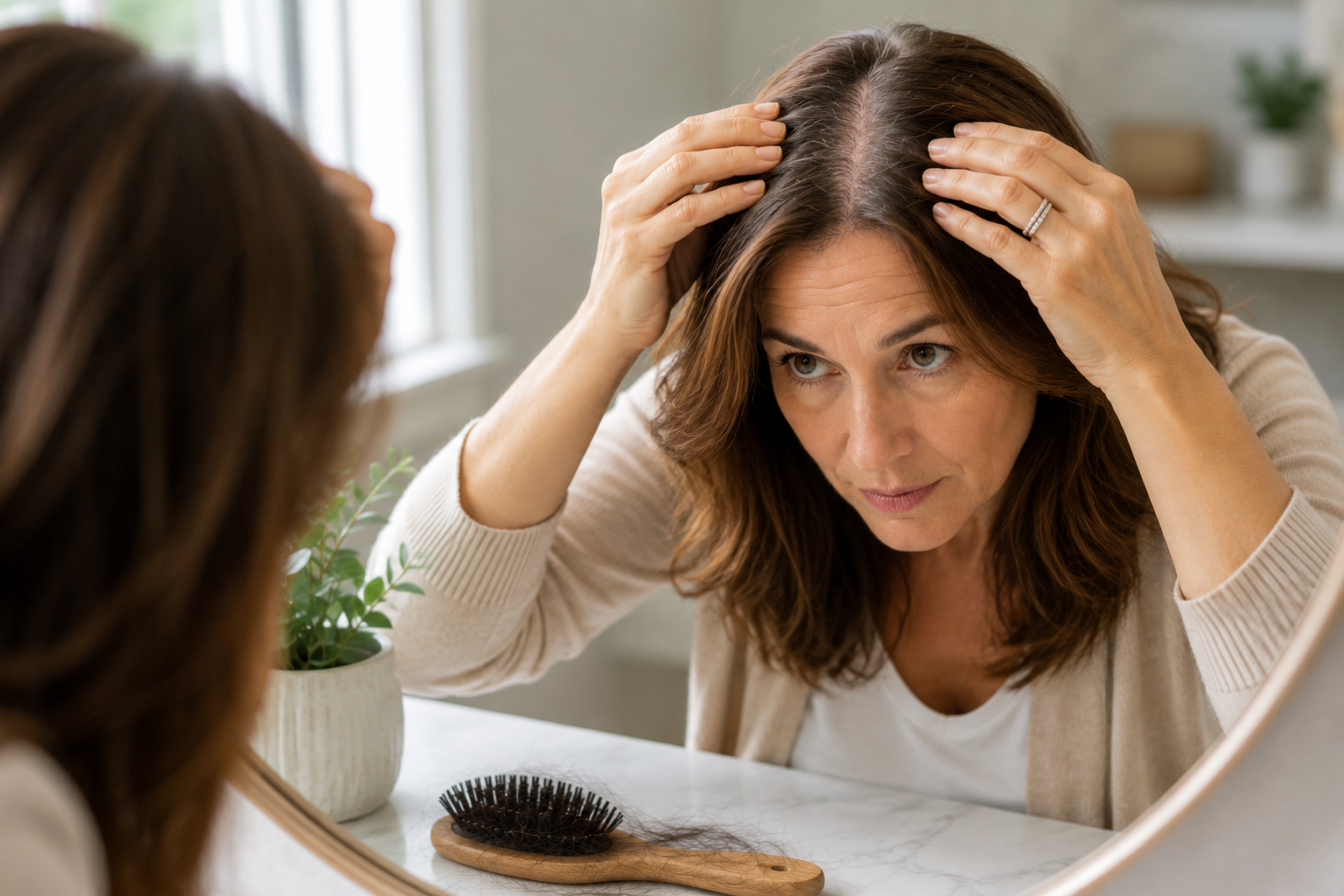
You eat well, exercise and sleep well. And yet: the fatigue, the weight, the brain fog, the mood swings don't budge. You've been told it's just stress or just aging.
It isn't. Every one of these symptoms is a biological signal. And every one of them can be traced to a specific hormone that's out of balance.

Declining estrogen and progesterone directly disrupt deep sleep architecture

Estrogen protects neurotransmitter function; as it drops, so does clarity.

Weight gain despite dieting, especially around the middle
Hormonal shifts slow metabolism and drive abdominal fat storage

Progesterone has natural calming effects via GABA; its loss triggers anxiety.

Women also produce testosterone and its decline effects energy and desire.

Hot flashes, night sweats, temperature swings
Estrogen regulates the brain's thermostat; declining levels destabilize it.
“Your labs look fine. This is probably just stress or anxiety."
What women hear from their GP
“You're too young for menopause. Come back in a few years."
What women hear from their OB-GYN
“It's part of getting older. Just eat better and exercise more."
What women hear everywhere

These symptoms are real, measurable, and treatable when the right provider is looking with the right tools. That's what we do.
Weight, hormones, and energy restored within months
For years my doctor told me it's just how a busy young mom should feel. I was done being told there's nothing we can do for you. 1st Optimal set me up with a great plan, and I finally feel like I'm in my body again. I'm seeing results at the gym, I have my energy back, and I feel like a better mom. I wish I'd done it years ago.

Annie R.
Weight loss & hormone optimization


Select a hormone to understand what it does, what happens when it declines, and how 1st Optimal restores it.
Estrogen governs over 300 functions in the body; from bone density and cardiovascular health to brain function, mood, and metabolism. It's the hormone most people associate with menopause, and for good reason: its decline drives the majority of perimenopausal symptoms.
Hot flashes & night sweats
Brain fog & memory lapses
Unexplained weight gain
Bone loss & joint aches
Tests not just estrogen levels, but how your body metabolizes it. This is critical for safety and effectiveness.
Molecularly identical to your body's estrogen, delivered as a cream, patch or pellet based on your protocol.
Regular lab testing ensures your levels stay in the optimal range, not just "normal" by population averages.
Estrogen is never prescribed in isolation. Your provider balances it with progesterone and monitors estrogen metabolism, protecting against risk while maximizing benefit.
Progesterone is often the first hormone to decline in perimenopause, sometimes a full decade before estrogen. It counterbalances estrogen, promotes deep sleep via GABA receptors, and is essential for mood stability. Its loss is frequently the root cause of the anxiety, insomnia, and irritability women write off as "just stress."
Anxiety & mood instability
Irregular or heavy periods
Insomnia & poor sleep quality
Irritability & worsening PMS
Captures progesterone metabolites that standard blood tests miss, giving a complete picture of production and breakdown
Oral micronized progesterone is often the fastest path to sleep restoration. Many members notice improvement within days.
Chronic stress depletes progesterone via the cortisol steal pathway; we address both simultaneously.
Progesterone is often the quickest win. Many members report better sleep within 1–2 weeks of starting. making it one of the most immediately impactful interventions in perimenopause care.
Testosterone isn't just a male hormone. Women produce it in the ovaries and adrenal glands, and it drives energy, motivation, muscle tone, libido, and cognitive sharpness. Its decline, which begins in the early 30s, is one of the most underdiagnosed causes of low energy and lost drive in women.
Low libido & diminished arousal
Muscle loss & weakness
Low motivation & flat mood
Persistent low energy
Standard panels only test total testosterone. We also measure free (active) testosterone, which is what the body actually uses.
Women require much smaller doses than men; micro-dosing via cream or pellet restores energy and libido without masculinizing effects.
Resistance training, adequate protein, and sleep quality all support testosterone. Your coach builds these into your plan.
Testosterone for women is not TRT. Women's protocols use physiological doses. The goal is restoration to your own optimal range, not supraphysiological levels.
Cortisol is your primary stress hormone, essential in short bursts, but damaging when chronically elevated. In perimenopausal women, high cortisol is especially harmful because it actively steals from progesterone production, compounding hormone imbalance. It also drives abdominal fat storage and disrupts sleep regardless of other hormone levels.
Anxiety, wired-but-tired feeling
Belly fat that won't budge
Can't fall or stay asleep
Sugar cravings & energy crashes
Measures cortisol across the full day, morning, noon, afternoon, and evening, mapping your personal stress rhythm
Ashwagandha, phosphatidylserine, and magnesium are among the evidence-based tools used to regulate the HPA axis
Sleep hygiene, blood sugar stability, and targeted stress protocols are built into your coaching plan alongside treatment
Cortisol is the silent saboteur. No hormone therapy works optimally if cortisol remains chronically elevated. that's why we test and treat it as part of every women's protocol.
Growth hormone (GH) declines at approximately 14% per decade after your mid-20s, making it one of the most consistent age-related hormonal shifts in both men and women. It governs cellular repair, lean muscle maintenance, fat metabolism, skin quality, and sleep architecture. Its decline is a major driver of the "aging" experience many women accept as inevitable.
Muscle loss despite training
Thinning skin & hair
Poor sleep & slow recovery
Increased body fat
Peptides stimulate your own pituitary to produce more GH naturally, safer than direct GH injections with fewer side effects.
We test growth hormone activity as part of your comprehensive lab panel and use it to titrate therapy.
Growth hormone is released primarily during deep sleep, improving sleep quality through progesterone and lifestyle changes amplifies peptide results.
Peptide therapy is not HRT. It works by enhancing your body's own growth hormone secretion, making it a complementary tool that amplifies the results of hormone optimization across the board.
Most of our members had a lot of questions before starting. We’d rather you ask them all than stay stuck wondering. These are the most common ones.
Memberships are set up with a card on file in your Patient Portal. You can change your card via our Patient Portal App.
Payment drafts for memberships are on the 1st or the 16th of each month.
For treatments, your orders are processed on the card on file, typically 6-7 weeks prior to the refill date, with advanced notification.
Unlock your FREE, personalized guide, designed to optimize your peptides for better energy, weight, and hormones.