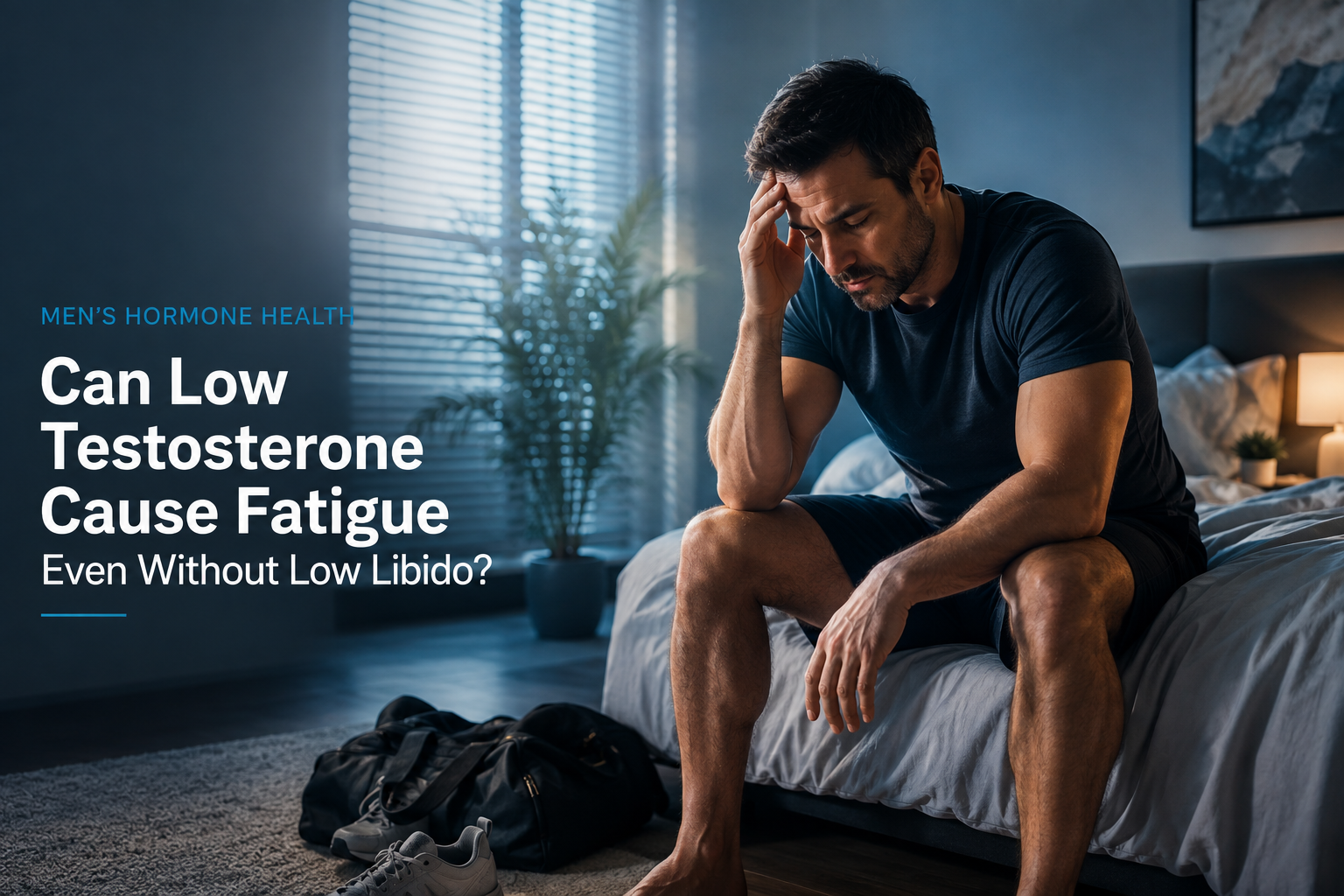
You're working out. You're following the diets. You're trying to push through the fatigue and yet, you still feel the loss of drive.
It isn't a discipline or effort issue, it is a biological signal. Every one of these symptoms can be traced back to a specific hormone that is out of balance.

Testosterone drives mitochondrial energy. When it drops, no amount of sleep repairs it.

Testosterone receptors are dense in the brain. Low T directly degrades cognitive performance.

Belly fat that won't respond despite dieting
Hormonal shifts disrupt insulin sensitivity and visceral fat storage regardless of calorie intake.

Testosterone is deeply tied to dopamine signaling, its loss flattens the competitive drive that once came naturally.

Growth hormone, released during deep sleep, governs repair, It’s decline means working harder with less recovery.

Low libido & declining sexual performance
Testosterone is the primary driver of male sexual desire. Low T is the most common and reversible cause to low libido.
Standard medicine checks total testosterone against a broad range and calls it normal. But “normal” and “optimal” are not the same thing.
Millions of men struggle with symptoms for years before getting real answers, not because nothing is wrong, but because the right questions were never asked and the right tests were never run.
At 1st Optimal, we specialize in exactly this. Comprehensive testing, functional medicine, and a care team that actually listens.
"Your testosterone is within the normal range. You're fine."
“You're just getting older. Fatigue and weight gain are normal at your age."
Your labs look fine. Maybe try exercising more and reducing stress.

These symptoms are real, measurable, and treatable when the right provider is looking with the right tools. That's what we do.
Weight, hormones, and energy restored within months
The combination of getting your hormones dialed back in, addressing the sleep apnea, sleeping better, and actually recovering at night, at 45, I feel as good as I ever have. I lift 4 days a week, I do cardio on those other days, I’m active with my family, I coach a lot. I feel great. Again, it’s a testament to the partnership I have with the 1st Optimal team.

Jesse B.
Weight loss & hormone optimization

Select a hormone to understand what it does, what happens when it declines, and how 1st Optimal restores it.
Testosterone is the primary anabolic hormone in men, governing muscle mass, fat distribution, libido, cognitive performance, energy, mood, and cardiovascular health. After age 30, it declines at ~1–2% per year. By 45–50, many men have lost 25–40% of their peak levels without knowing it.
Persistent fatigue & low energy
Muscle loss despite training
Stubborn belly fat accumulation
Low libido & sexual function
Total T, free T, SHBG, estradiol, LH, FSH: the complete picture, not just a single number.
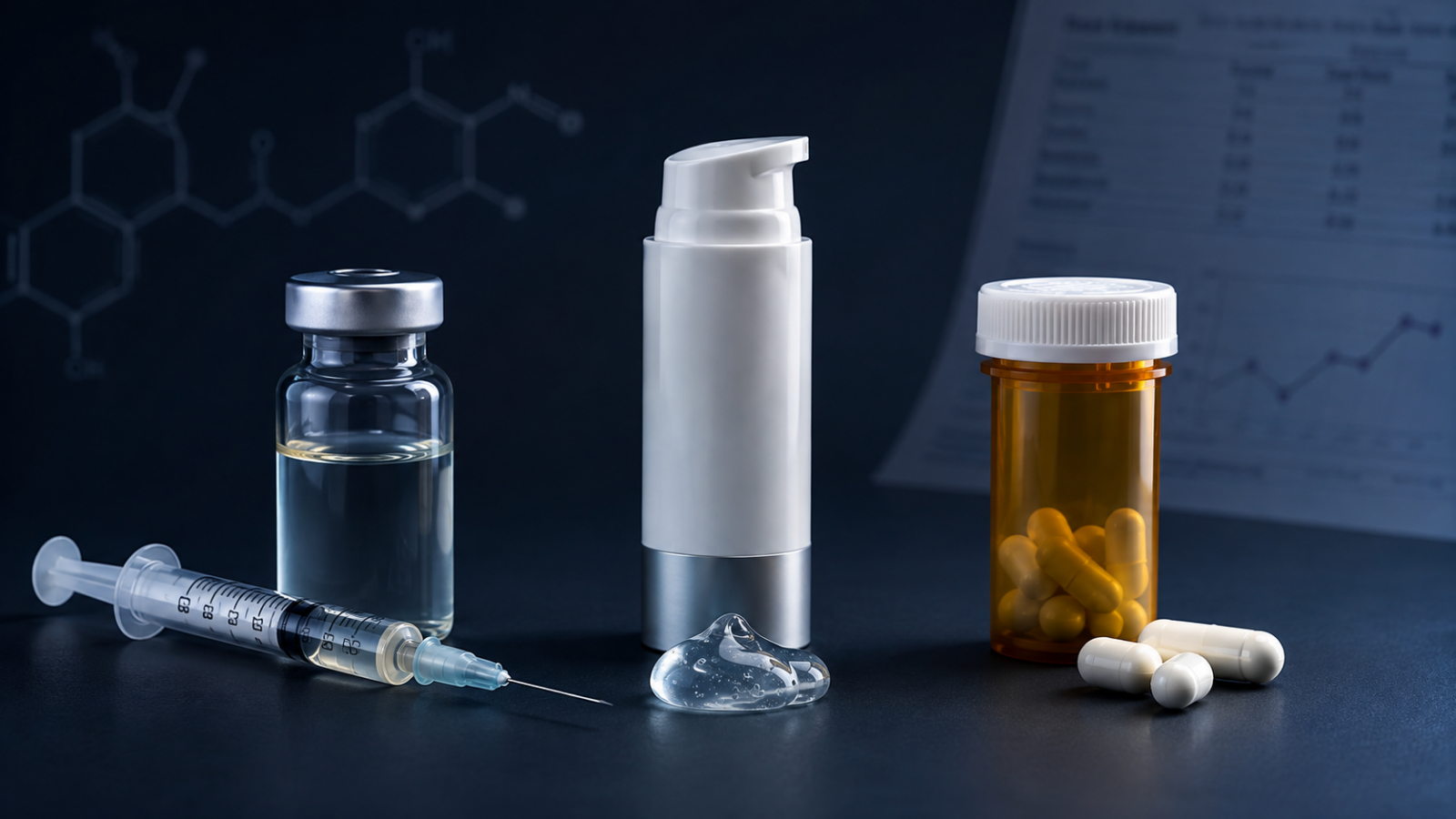
Injections, gels, or pellets personalized to your labs and delivery preference: molecularly identical to your body's own testosterone.
Regular retesting of T levels, estradiol, hematocrit, and metabolic markers ensures your protocol stays optimized over time.
TRT is never a set-and-forget prescription. Your provider monitors your full panel continuously, adjusting dosage as your levels respond and your goals evolve.
Most testosterone is bound to SHBG and biologically unavailable. Only free testosterone (~2–3% of total) is active. Standard labs test total T only. If your SHBG is elevated, free T can be critically low even when total T looks "normal": the most common reason men are dismissed despite real symptoms.
Fatigue despite "normal" labs
Can't build or hold muscle
Low libido, poor sexual function
Brain fog & flat motivation
We always test free testosterone, the biologically active fraction your GP almost certainly didn't measure.
Elevated SHBG can be addressed through lifestyle, supplementation, and protocol adjustments that free up bound testosterone.
Your TRT dosing brings free testosterone into the optimal functional range, not just somewhere in the broad "normal" band.
This is why "your labs are normal" doesn't mean you're optimal. Total T of 450 with high SHBG can leave free T as low as someone at 250, and both feel the same.
Chronic cortisol elevation directly suppresses testosterone production at the hypothalamic level: the HPA-HPG axis suppression. It also drives visceral fat storage and creates the "wired but exhausted" state that persists regardless of TRT. No hormone therapy works optimally with chronically elevated cortisol.
Anxiety, wired-but-tired feeling
Belly fat that won't budge
Can't fall or stay asleep
Sugar cravings & energy crashes
Maps your cortisol rhythm across the full day: morning, noon, afternoon, and evening to identify the exact dysregulation pattern.
Ashwagandha, phosphatidylserine, and magnesium are among the evidence-based tools used to regulate the HPA axis.
Cortisol responds dramatically to nutrition timing and sleep hygiene, both built into your coaching plan alongside treatment.
Cortisol is the silent saboteur. No TRT works optimally if cortisol remains chronically elevated, that's why we test and treat it as part of every men's protocol.
Growth hormone declines at ~14% per decade after the mid-20s. In men, it compounds testosterone decline; accelerating muscle loss, increasing body fat, degrading sleep quality, and impairing recovery. Peptide therapy can support GH secretion at any age without the side effects of direct HGH injections.
Muscle loss despite training
Thinning skin & hair
Poor sleep & slow recovery
Increased visceral fat
Peptides stimulate your own pituitary to produce more GH naturally, safer than direct GH with fewer side effects.
We test insulin activity as part of your panel and use it to titrate therapy accurately.
GH is released primarily during deep sleep, improving sleep quality amplifies peptide results significantly.
Peptide therapy is not HGH. It works by enhancing your body's own GH secretion, making it a powerful complement to TRT that amplifies body composition results across the board.
Thyroid hormones regulate metabolic rate, body temperature, energy, and cognition. Hypothyroidism is a common and frequently underdiagnosed cause of low energy, weight gain, brain fog, and depression in men; especially when only TSH is tested. Free T3 and T4 often reveal what TSH alone misses.
Slow metabolism & weight gain
Always feeling cold
Brain fog & poor memory
Fatigue not resolved by TRT
TSH, Free T3, Free T4, and thyroid antibodies: the complete picture that standard single-marker testing completely misses.
Standard TSH ranges are broad. We interpret against functional optimal ranges where energy, metabolism, and cognition actually work well.
When indicated, thyroid support is integrated into your overall protocol, addressing the metabolic foundation alongside TRT.
Undiagnosed thyroid dysfunction is one of the most common reasons TRT underperforms. We always test thyroid as part of every men's panel.
Most of our members had a lot of questions before starting. We’d rather you ask them all than stay stuck wondering. These are the most common ones.
Memberships are set up with a card on file in your Patient Portal. You can change your card via our Patient Portal App.
Payment drafts for memberships are on the 1st or the 16th of each month.
For treatments, your orders are processed on the card on file, typically 6-7 weeks prior to the refill date, with advanced notification.
Unlock your FREE, personalized guide, designed to optimize your peptides for better energy, weight, and hormones.

As a first-time member, enjoy 15% OFF your first purchase and take the first step toward personalized care designed around you.
Discover practical insights to help you feel better, perform better, and live optimally.
Fill out the form below and we’ll send your exclusive first-purchase discount code straight to your inbox.