
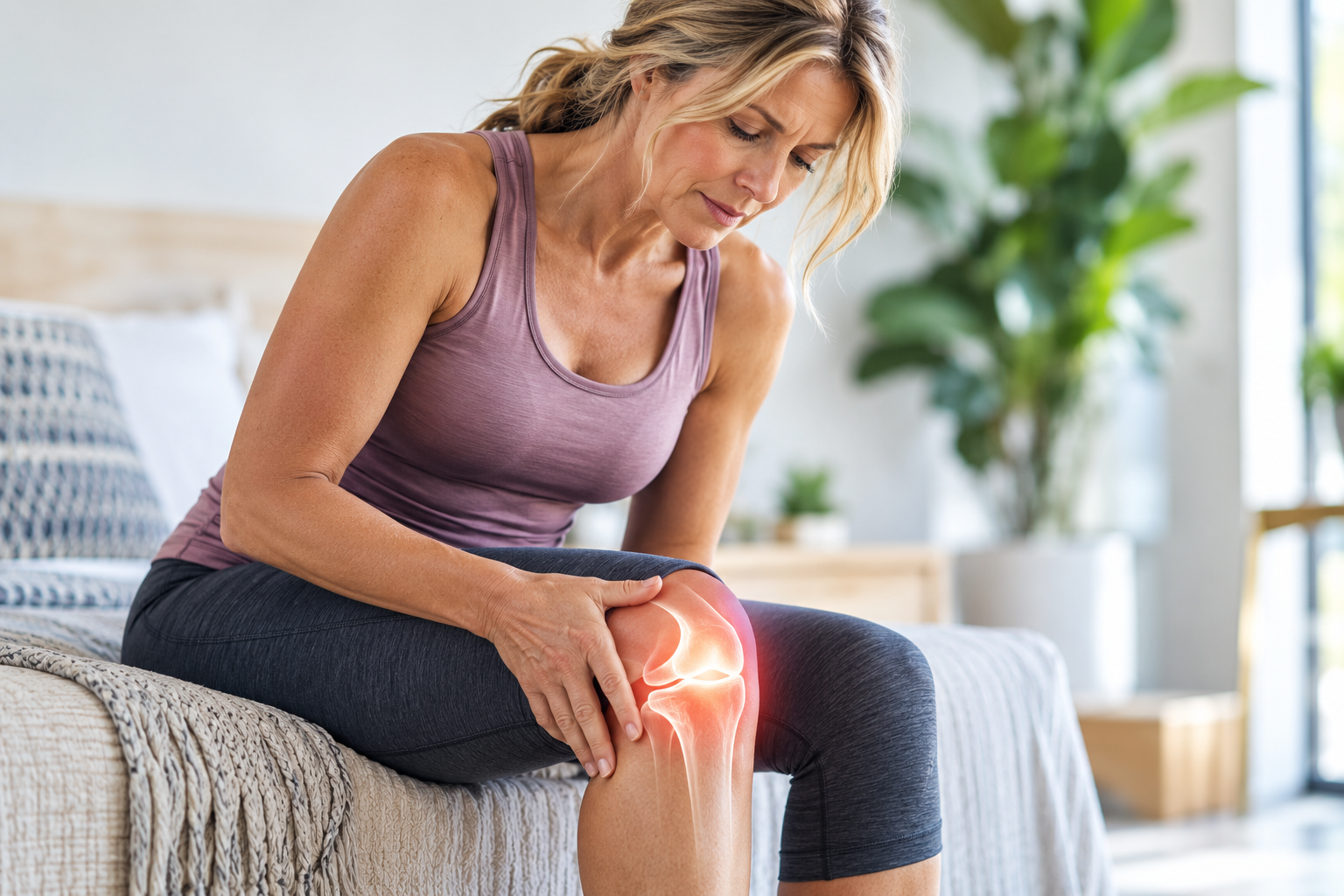
You wake up and your knees feel stiff.
Your hips ache after sitting too long.
Your shoulders feel tighter than they used to, and workouts suddenly take longer to recover from.
You might assume you are simply getting older.
But if these changes started around perimenopause or menopause, there may be another factor worth considering: estrogen.
Joint and muscle pain are recognized symptoms of the menopause transition. A 2026 systematic review and meta-analysis involving more than 93,000 women found muscle or joint pain in approximately 40% of premenopausal women, compared with 57% of perimenopausal women and 59% of postmenopausal women. The researchers cautioned that the studies were observational and varied considerably, so menopause cannot automatically be considered the cause of every new ache or pain.
Still, the connection is becoming increasingly difficult to ignore.
Estrogen does much more than regulate the menstrual cycle. Estrogen signaling affects bone, muscle, cartilage, tendons, connective tissue, inflammation, and potentially how the nervous system processes pain.
When estrogen begins fluctuating and eventually declining during menopause, your musculoskeletal system may notice too.
What Does Menopause Joint Pain Feel Like?
Menopause-related musculoskeletal symptoms can look different from woman to woman.
You may notice:
- Morning stiffness
- Aching knees, hips, shoulders, hands, or feet
- Increased soreness after exercise
- Reduced mobility or flexibility
- Pain after sitting for long periods
- Muscle aches
- Tendon discomfort
- Longer recovery between workouts
- New aches without an obvious injury
Both the NHS and NICE recognize joint and muscle pain as symptoms that can occur during perimenopause and menopause.
The frustrating part is that these symptoms can appear at the same time as fatigue, poor sleep, weight changes, hot flashes, and reduced exercise tolerance.
That can make it easy to blame everything on age.
The biology is more complicated.
The Estrogen and Joint Pain Connection
Estrogen receptors have been identified in tissues throughout the musculoskeletal system, including cartilage and joint tissue.
Research suggests estrogen signaling may influence cartilage metabolism, inflammation, bone remodeling, muscle function, and other processes involved in joint health.
That matters because estrogen levels do not simply fall overnight.
During perimenopause, estrogen can fluctuate significantly before settling at much lower levels after menopause.
Those changing hormone signals may influence several systems simultaneously.
1. Estrogen May Influence Cartilage
Cartilage is the smooth tissue covering the ends of bones inside many joints. It helps joints move with less friction.
Estrogen receptors exist in cartilage cells called chondrocytes, suggesting cartilage is capable of responding to estrogen signaling. Laboratory and animal research indicates estrogen may influence cartilage turnover, inflammatory pathways, and extracellular matrix metabolism.
A 2026 systematic review examining estrogen deficiency and cartilage degeneration found strong supportive evidence in animal models but less conclusive findings in humans. Human studies showed trends toward greater cartilage loss with estrogen deficiency, but the pooled results were not statistically significant.
In other words, estrogen appears biologically relevant, but the human evidence is still developing.
2. Estrogen May Affect Inflammation
Inflammation is another possible piece of the puzzle.
Estrogen participates in signaling pathways involved in inflammatory regulation. The exact effects vary depending on the tissue, hormone concentration, receptor type, and biological environment.
Research has suggested that losing estrogen signaling may influence inflammatory pathways that affect cartilage and joint tissues.
This does not mean every painful joint during menopause is an inflammatory condition.
It means that hormonal changes may alter one part of the environment in which inflammation, tissue recovery, and pain occur.
3. Menopause Affects More Than the Joint Itself
Sometimes the painful joint is only part of the story.
Estrogen decline occurs alongside changes that can affect:
- Muscle mass
- Bone density
- Tendon health
- Physical activity
- Sleep quality
- Body composition
- Recovery
- Pain sensitivity
A 2024 review proposed the term “musculoskeletal syndrome of menopause” to describe the collection of musculoskeletal changes that can appear during the menopause transition, including joint pain, declining muscle mass, bone loss, and osteoarthritis progression.
The term is still relatively new, but it highlights something important:
Menopause is not limited to hot flashes.
Why Joint Pain Can Suddenly Appear in Perimenopause
Many women notice something confusing during their 40s.
They have trained for years.
They eat reasonably well.
They have not suffered a major injury.
Yet suddenly their shoulders, hips, knees, or hands begin bothering them.
Perimenopause may be part of the explanation.
Hormones can fluctuate considerably during this transition. At the same time, sleep may deteriorate, muscle mass may become harder to maintain, recovery can slow, and body composition may change.
Those factors can interact.
Poor sleep may make pain feel worse.
Loss of muscle may reduce support around a joint.
Reduced activity because something hurts can lead to further weakness.
Weight gain can increase mechanical stress on weight-bearing joints.
And an old injury that barely bothered you at 35 may feel very different at 48.
There usually is not one single cause.
Is Menopause Joint Pain the Same as Osteoarthritis?
No.
Joint pain is a symptom.
Osteoarthritis is a specific joint disease involving changes in cartilage, bone, and surrounding joint structures.
Osteoarthritis becomes more common with age, and research has long investigated why rates rise significantly among women after menopause. Estrogen signaling is one potential contributor, but aging, genetics, previous injuries, body composition, joint loading, metabolic health, and other factors also influence risk.
That distinction matters.
A painful knee during menopause does not automatically mean estrogen deficiency caused osteoarthritis.
And it does not automatically mean hormone therapy will fix it.
Does Hormone Therapy Help Menopause Joint Pain?
This is where the conversation requires some nuance.
In a large randomized Women’s Health Initiative analysis involving 10,739 postmenopausal women who had undergone hysterectomy, women receiving estrogen alone reported a modest reduction in joint pain compared with placebo. After one year, joint pain was reported by 76.3% of the estrogen group compared with 79.2% of the placebo group.
That suggests estrogen may influence joint symptoms.
But it does not establish hormone therapy as a treatment for joint pain.
A more recent systematic review and meta-analysis found no significant overall effect of previous or current hormone therapy use on generalized musculoskeletal pain, with substantial differences among individual studies. Researchers concluded that better trials specifically designed to study menopausal musculoskeletal pain are still needed.
The Menopause Society specifically states that estrogen-containing hormone therapy is not currently recommended for managing musculoskeletal conditions such as arthritis or joint pain outside of its established role in preventing bone loss and reducing fracture risk.
Hormone therapy does remain an established treatment for certain menopausal symptoms, particularly bothersome hot flashes and night sweats, and systemic estrogen helps prevent menopause-related bone loss. Whether hormone therapy is appropriate depends on symptoms, age, time since menopause, personal history, uterus status, cardiovascular risk, cancer history, clotting risk, and other factors.
So the question should not be:
“Do my joints hurt, therefore do I need estrogen?”
A better question is:
“What is driving my symptoms, and is menopause one part of the bigger picture?”
What Else Can Cause Joint Pain During Menopause?
Hormones are only one possibility.
Joint pain during midlife can also come from:
- Osteoarthritis
- Previous injuries
- Tendon problems
- Rheumatoid or other inflammatory arthritis
- Excessive or rapidly increased training volume
- Loss of muscle strength
- Poor movement mechanics
- Inadequate recovery
- Sleep deprivation
- Metabolic health changes
- Thyroid disorders
- Certain medications
- Vitamin or nutritional deficiencies
- Other medical conditions
This is why persistent pain deserves an evaluation instead of being automatically labeled “menopause.”
What Can Women Do About Menopause Joint Pain?
The first goal is identifying what is actually driving the pain.
From there, treatment can become much more specific.
Strength Train Consistently
Muscle provides stability and support around your joints.
Resistance training becomes increasingly important through perimenopause and menopause because maintaining muscle and strength supports mobility, function, metabolic health, and healthy aging.
If your joints hurt, that does not necessarily mean you should stop strength training.
It may mean the program needs to be modified.
Changing exercise selection, volume, range of motion, frequency, or load can often allow you to keep training while addressing the underlying issue.
Prioritize Recovery
More exercise is not always better.
Pay attention to:
- Sleep quality
- Training frequency
- Rest days
- Stress
- Soreness
- Protein intake
- Hydration
- Recovery between sessions
If your body never fully recovers between workouts, pain can become progressively harder to interpret.
Maintain Healthy Muscle and Body Composition
Maintaining muscle becomes increasingly important with age.
Muscle helps stabilize joints, supports metabolic health, and preserves physical independence.
For weight-bearing joints such as the hips and knees, body composition also affects mechanical load.
The goal is not simply to weigh less.
The goal is to maintain or build metabolically active muscle while supporting a healthy level of body fat.
Look at the Whole Menopause Picture
If joint pain appeared alongside:
- Hot flashes
- Night sweats
- Poor sleep
- Cycle changes
- Vaginal changes
- Brain fog
- Mood changes
- Reduced libido
- Changes in body composition
it may be useful to discuss the entire symptom pattern with a healthcare professional rather than treating each symptom independently.
Perimenopause and menopause affect multiple systems at once.
Your evaluation should reflect that.
When Should Joint Pain Be Evaluated?
Do not assume persistent joint pain is simply hormonal.
Seek medical evaluation if you experience:
- Significant swelling, warmth, or redness
- Sudden severe pain
- Pain following an injury
- Fever with joint pain
- Persistent or worsening pain
- Significant morning stiffness
- Loss of strength or mobility
- Pain interfering with sleep or everyday activities
- Multiple painful or swollen joints
- Unexplained systemic symptoms
Joint pain may occur during menopause, but other musculoskeletal and inflammatory conditions still need to be considered.
The Bigger Picture: Your Joints Are Part of Your Hormonal Health
For years, menopause conversations focused almost entirely on hot flashes and periods.
That picture is changing.
Women commonly experience musculoskeletal symptoms during the menopause transition, and growing research suggests changing sex hormones, including estrogen, are connected to pain, cartilage biology, muscle, bone, and joint function.
But estrogen is one piece of a much larger system.
Sleep matters.
Muscle matters.
Inflammation matters.
Training matters.
Metabolic health matters.
Previous injuries matter.
And menopause matters.
The goal should not be to blame every ache on estrogen.
The goal is to understand why your body has changed and what factors you can actually address.
At 1st Optimal, our approach combines lab-informed medical evaluation, hormone and metabolic care, nutrition, exercise, recovery, and ongoing coaching to understand the bigger picture behind how you feel.
Ready to Understand What’s Changing?
If joint pain is showing up alongside other perimenopause or menopause symptoms, you do not have to guess your way through it.
Book a Health Consultation with 1st Optimal to review your symptoms, health history, and available testing and treatment options with our care team.
Treatment recommendations are individualized and provided by licensed healthcare professionals following clinical evaluation.
Frequently Asked Questions About Menopause Joint Pain
Can low estrogen cause joint pain?
Declining or fluctuating estrogen may contribute to musculoskeletal pain during the menopause transition. Estrogen receptors are present in joint tissues, and research suggests sex hormones influence cartilage, inflammation, bone, and pain pathways. However, joint pain is multifactorial, and current research has not established estrogen deficiency as the sole cause of menopausal joint pain.
Where does menopause joint pain usually occur?
Women may experience discomfort in the knees, hips, shoulders, hands, feet, back, or multiple joints. Muscle aches and stiffness may occur at the same time.
Does menopause joint pain eventually go away?
It varies. Some menopause symptoms improve over time, while joint pain can persist after menopause. The NHS notes that joint pain is among the symptoms that may continue after the menopause transition.
Persistent symptoms should be evaluated rather than automatically attributed to hormones.
Can HRT help aching joints?
Some studies have reported modest improvements in joint pain with estrogen therapy, while other research has found inconsistent results. Current menopause guidance does not recommend hormone therapy specifically as treatment for joint pain or arthritis.
Hormone therapy may still be appropriate for other menopause symptoms depending on an individual’s medical history and risk profile.
Is joint pain common during perimenopause?
Yes. A 2026 meta-analysis found muscle or joint pain reported by approximately 57% of perimenopausal women included in the analyzed studies, compared with roughly 40% of premenopausal women.
What helps menopause joint pain?
The right strategy depends on the cause. Strength training, appropriate exercise modification, adequate recovery, sleep, maintaining muscle, weight management when appropriate, physical therapy, and condition-specific medical treatment may all play a role. Women experiencing other menopause symptoms can also discuss whether menopause-specific treatment is appropriate with their healthcare provider.
References
Wright VJ, et al. The musculoskeletal syndrome of menopause. Climacteric. 2024.
Watt FE, et al. The influence of sex hormones on musculoskeletal pain and osteoarthritis.
The Menopause Society. Hormone Therapy guidance and statement on appropriate hormone therapy use.
American College of Obstetricians and Gynecologists. Hormone Therapy for Menopause.
Medical Disclaimer: This article is for educational and informational purposes only and is not intended to diagnose, treat, cure, or prevent any disease. Individual symptoms can have many causes. Consult a qualified healthcare professional for personalized medical advice, diagnosis, and treatment.