
An FSH test cannot reliably settle whether you have reached menopause while you are using combined hormonal birth control. The medication changes the hormonal picture, and bleeding patterns may be difficult to interpret. Bring your exact contraceptive method and symptom history to a licensed clinician. Do not stop contraception or rely on a test result to decide pregnancy prevention is unnecessary.
Why can birth control make menopause harder to recognize?
Many people expect menopause to announce itself through a final period. Hormonal contraception can complicate that signal. The NHS explains that contraceptive pills can affect periods and that the combined pill can mask or improve menopause symptoms.
That means your current bleeding pattern may not show what would be happening without the medication. A missing period while using hormonal contraception is not, by itself, confirmation of menopause. Conversely, having symptoms while taking contraception deserves a conversation rather than an assumption that the method rules out perimenopause.
Start with the practical question: are you trying to understand symptoms, investigate an unusually early change, or decide whether you still need contraception? Those are different decisions. A test that contributes to one assessment may not answer the others.
What does FSH measure?
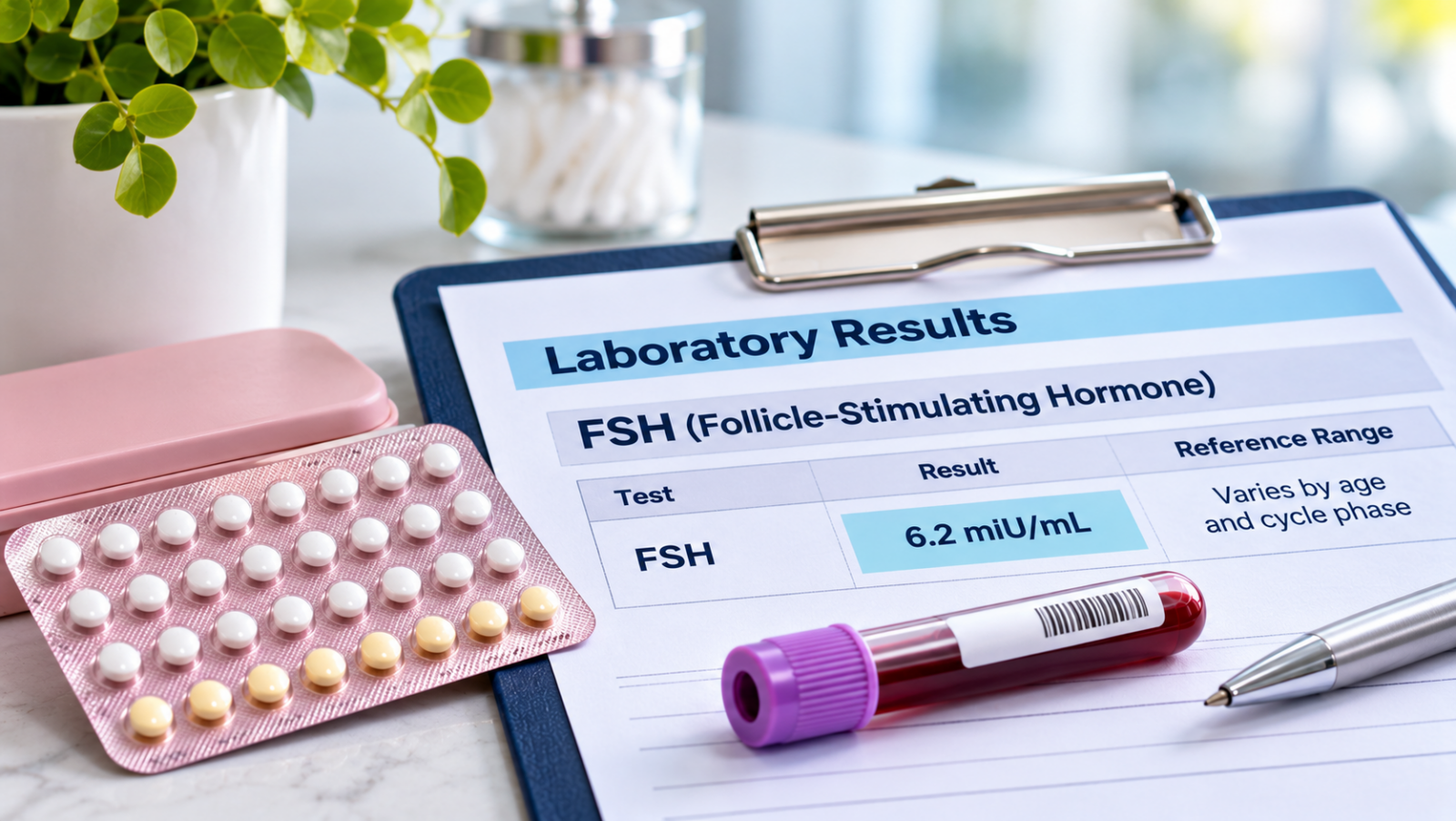
FSH stands for follicle-stimulating hormone. It is a chemical messenger made by the pituitary gland that helps regulate ovarian function and the menstrual cycle. The blood test measures its concentration in the sample; it does not directly measure whether you can become pregnant.
MedlinePlus describes FSH testing as one tool used to investigate reproductive and other hormonal concerns. Results need interpretation alongside age, symptoms, medical history, and sometimes other tests. FSH also changes through the menstrual cycle.
A number shown in a laboratory’s reference range is therefore not a personal treatment instruction. If you already have a result, keep the report, collection date, and the name of the medication you were using at the time.
Can FSH identify menopause while you use the combined pill?
NICE’s menopause guideline specifically advises against using FSH to identify menopause in people using combined estrogen–progestogen contraception or high-dose progestogen. This is clinical guidance, rather than a claim that all hormone tests are useless.
The key issue is the purpose of the test and the treatment context. A result obtained while using one method should not be interpreted as though you were taking no hormones. Tell the ordering clinician about contraception before testing, including a pill, patch, ring, injection, implant, or hormonal IUD.
Do not create your own medication break to get a supposedly clearer answer. If a clinician believes a change is needed, ask for a coordinated plan that also addresses pregnancy prevention. This article does not provide a stopping interval or a threshold for declaring menopause.
Does the same rule apply to every contraceptive method?
No single testing rule should be copied across every method. “Birth control” describes different medicines and devices. The exact method matters, as do your age, symptoms, and the decision the clinician is trying to make.
Use the following table to prepare the discussion. It is a communication checklist, not a guide to selecting, stopping, or extending contraception.
| What you use | What to bring | What to ask |
|---|---|---|
| Pill, patch, or vaginal ring | Product name, strength, schedule, and any missed doses | Does this contain both estrogen and a progestin, and would FSH answer the question we have? |
| Progestin-only pill, injection, or implant | Exact product and start date; injection or replacement dates when applicable | How does this specific method affect the assessment and our next step? |
| Hormonal IUD | Device name and insertion date, if known | What information is needed to review its current role and the plan if menopause therapy is considered? |
| Nonhormonal method | Method used and a record of spontaneous menstrual changes | How should my age and natural bleeding history guide the assessment? |
If the product name is unclear, a photograph of the package or your medication list is more useful than guessing. Ask the prescribing office for device details when needed.
When might hormone testing still be appropriate?
Testing can be useful when it addresses a defined clinical question. NICE recommends considering FSH in people aged 40–45 with menopause-associated symptoms and menstrual changes, and in people under 40 when menopause is suspected. Those recommendations do not cancel the need to account for hormonal treatment.
If you are younger than expected for menopause, tell the clinician when changes began and what contraception you were using then. Ask whether the assessment is for perimenopause, early menopause, premature ovarian insufficiency, or another explanation. These labels have different implications and should not be assigned from an isolated home result.
For the broader distinction between testing to diagnose menopause and testing for other health concerns, see our guide to blood tests before hormone therapy.
Can a high FSH result tell you to stop contraception?
No. The CDC’s U.S. contraceptive guidance states that no reliable laboratory test confirms definitive loss of fertility. It cautions that FSH may not accurately establish when someone is no longer fertile. Pregnancy can still occur after age 44, even though it is less common.
The CDC describes guidance to continue contraception until menopause or approximately age 50–55, while also weighing the individual’s risks of pregnancy and continued contraceptive use. That is a discussion with a clinician, not a universal birthday or blood-test rule for stopping a particular product.
Ask for a clear answer to this question: “What evidence and circumstances will we use to decide when I no longer need pregnancy prevention?” Write down the agreed plan and follow-up date.
Is menopause hormone therapy a replacement for birth control?
Menopausal hormone therapy does not provide contraception, as the Royal College of Obstetricians and Gynaecologists explains. Symptom treatment and pregnancy prevention may both need attention during the transition.
Do not add menopause hormones to your current regimen yourself. The NHS advises against taking HRT alongside the combined pill. A clinician should review the actual medicines and decide whether continuing, changing, or coordinating treatments is appropriate. Advice for one combination cannot be applied automatically to another.
A short checklist for your appointment
Prepare one page with the following information. It can help the clinician understand the timeline without requiring you to remember everything during the visit.
- Your method: product or device name, dates, and current schedule.
- The timeline: symptoms before starting it, changes afterward, and recent bleeding.
- Your priorities: pregnancy prevention, symptom relief, understanding an early change, or reviewing a previous result.
- Previous testing: reports and which medicines you were taking when samples were collected.
- Your health history: other prescriptions, supplements, medical conditions, and recent health changes.
- The next decision: what would change if a test were high, low, or inconclusive?
Before leaving, confirm who is responsible for follow-up, whether anything should change now, and whom to contact if you are uncertain about instructions. A written plan is more useful than collecting additional numbers without knowing what they mean.
Frequently asked questions
Does no bleeding on hormonal contraception prove menopause?
No. Hormonal methods can change bleeding. Ask your clinician how the method affects interpretation of your history.
Can a home menopause test tell me whether pregnancy is impossible?
No. MedlinePlus cautions that home FSH tests should not be used to determine whether you can become pregnant. Share the result with a clinician rather than changing contraception based on it.
Do I need to wait until I know my exact menopause stage to ask for help?
No. The NHS advises discussing bothersome menopause symptoms without waiting for periods to stop completely. Assessment and treatment choices still depend on your history and current medication.
Get help organizing the next step
1st Optimal offers Functional Health Coaching powered by Functional Medicine. Coaches can help organize symptom records and support follow-through; contracted licensed medical providers handle medical evaluation, laboratory interpretation, diagnosis, and prescribing within their scope.
Explore women’s hormone care and how the care process works. To discuss available care and the questions to bring to a licensed provider, book a conversation with 1st Optimal.
Optimize You, Uplift Others.