
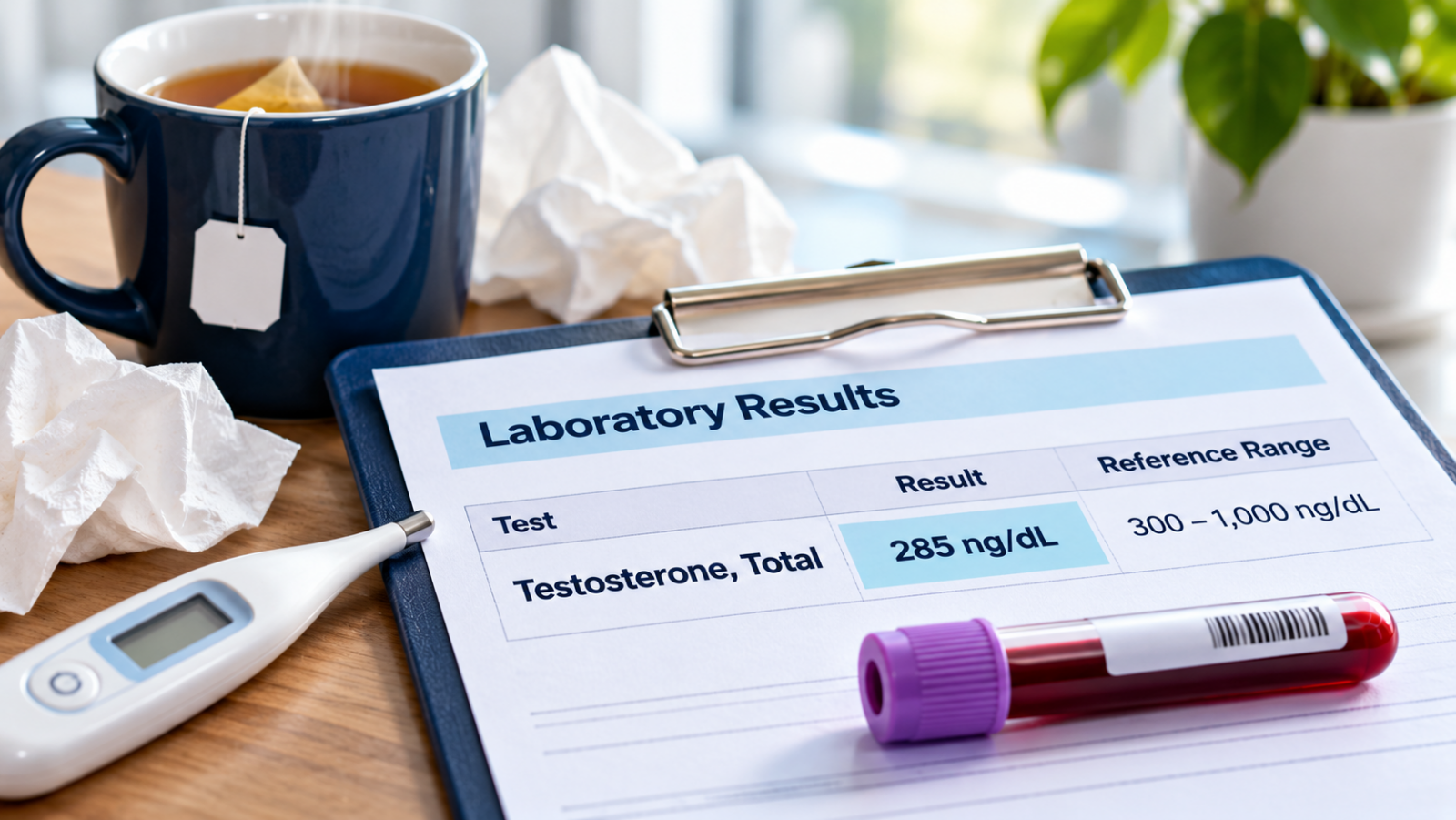
A low testosterone result during an acute illness may not represent your usual level. Clinical guidelines advise against testing for testosterone deficiency while a man is ill or recovering from an acute illness. If testing already happened, tell the ordering clinician about the illness and medications, and ask when reassessment would be appropriate. One low result does not establish a diagnosis.
Can being sick lower a testosterone result?
Yes. Acute illness can temporarily lower testosterone. The Endocrine Society’s clinical practice guideline specifically advises clinicians not to test for testosterone deficiency during acute illness or recovery, or during short-term use of medicines that suppress testosterone, such as opioids.
This concerns how well the result represents your usual hormonal state. It does not mean the laboratory necessarily made an error. A blood sample can accurately describe that moment while being a poor basis for a lasting treatment decision.
It also does not prove that illness explains every low result. The next step is clinical review, rather than either accepting the number as a diagnosis or dismissing it as irrelevant.
What if the blood draw has already happened?
Keep the report and contact the clinician who ordered it. Explain what was happening when the sample was collected, including whether you were still recovering. Do not arrange a string of new tests without a plan for interpreting them.
A useful first message is simple:
“My testosterone sample was collected on [date/time]. I was experiencing or recovering from [illness] and taking [medicines]. Could that affect how we interpret the result? Should we review it now and plan a repeat test when appropriate?”
Ask whether any other findings need attention now. A concern about testosterone timing is not a reason to postpone assessment of the illness itself or ignore the rest of your results.
How long after illness should you wait to repeat testosterone?
Ask your clinician to set the timing based on the illness, recovery, medication exposure, and the reason for testing. There is no single waiting period supplied here for every infection, hospital stay, or recovery pattern.
The Endocrine Society’s recommendation includes people who are recovering, not only those who feel acutely unwell on the collection day. Tell the clinician if recovery is incomplete even when an appointment has already been booked.
Before rescheduling, confirm what the team wants to know: whether symptoms have resolved, whether temporary medicines are still being used, and whether your usual sleep and routine have returned. Do not stop prescribed medicine to produce a different number.
What information makes the review more useful?
Prepare a short timeline instead of relying on memory. Dates can help distinguish symptoms that preceded the illness from changes that appeared during recovery.
| Record | Details to bring | Question it helps answer |
|---|---|---|
| Illness and recovery | When it started, major changes, and whether you still feel unwell | Was testing done during a temporary change in health? |
| Medicines | Names, doses, start and stop dates, including temporary prescriptions | Does a medication need to be considered in interpretation? |
| Sample conditions | Collection date/time, fasting status, and recent sleep | Were the collection conditions appropriate for the intended assessment? |
| Symptoms before illness | What was happening beforehand and how long it had been present | Is there an ongoing concern to assess separately? |
| Previous results | Full reports with units, reference ranges, and collection dates | Is the comparison being made fairly? |
| Follow-up arrangements | Ordering clinician and the next review appointment | Who will interpret the result and decide the next step? |
If you do not know a detail, mark it as unknown. A discharge summary or medication list can be more reliable than trying to reconstruct a complicated illness from memory.
How should a repeat test be prepared?
For men with symptoms suggesting testosterone deficiency, a joint Society for Endocrinology and laboratory-medicine position statement recommends morning, fasting total-testosterone samples when the person is not acutely ill. It also discusses normal day-to-day variation and the effects of restricted sleep and meals.
Follow the ordering clinician’s instructions for the actual tests. Mention a night-shift schedule before booking; timing may need a different discussion from that of someone who sleeps at night. Our testosterone-testing guide for night-shift workers explains that separate issue.
The goal is a meaningful assessment, not to engineer the highest possible result. Record any preparation problem and tell the team rather than hiding it.
Why does confirmation matter?
The Endocrine Society’s diagnostic recommendations require compatible symptoms and signs together with unequivocally and consistently low testosterone. They recommend confirming the diagnosis with a repeat morning, fasting total-testosterone measurement and investigating the cause when deficiency is established.
Two numbers collected under substantially different circumstances need interpretation. Do not average a result taken during illness with a later result and diagnose yourself from the calculation. Ask how much weight each result should carry.
A repeat value that is no longer low does not automatically explain persistent symptoms. A value that remains low does not, by itself, decide which treatment is appropriate. Both outcomes call for a clear discussion of what has been learned and what remains unresolved.
What if you already use prescribed testosterone?
Tell your prescriber that you were ill when monitoring was performed and ask how the result should be reviewed. An initial evaluation for deficiency and monitoring an existing prescription are different clinical questions.
Bring the formulation, prescribed schedule, actual last dose, and blood-draw time. Do not skip, add, or change doses to adjust the next result. If you need help understanding what to record, use the men’s blood work guide as preparation material, then confirm instructions with your prescriber.
Questions to answer before the review ends
- Is this result suitable for evaluating my usual testosterone level?
- What symptoms or health concerns need attention now?
- Should testing be repeated, and who will decide when recovery is sufficient?
- What preparation and medication instructions apply?
- Who will review the repeat result, and when?
- What would a normal, persistently low, or inconclusive result change?
Write down the answers. If a repeat test is recommended, arrange the review as well as the blood draw so the result does not become an unresolved portal notification.
Frequently asked questions
Does illness mean my low result is definitely temporary?
No. Illness is a possible influence, not proof of the explanation. The clinical history and appropriate follow-up determine how the result is used.
Should I stop a short-term prescription before retesting?
Ask the prescriber. Disclose every medicine and follow the instructions provided; do not stop treatment yourself for a laboratory appointment.
Can I ignore symptoms until testosterone is retested?
No. Discuss persistent, new, or worsening symptoms with a medical professional. Repeating a hormone measurement is only one possible part of the assessment.
Make the next step clear
1st Optimal’s approach is Functional Health Coaching powered by Functional Medicine. Coaches can help organize symptom timelines and support follow-through. Contracted licensed medical providers handle clinical assessment, laboratory interpretation, diagnosis, prescribing, and treatment decisions within their scope.
Explore men’s hormone care or book a conversation with 1st Optimal to discuss the available care process and questions to bring to a licensed provider.
Optimize You, Uplift Others.
References
- Bhasin and colleagues: Testosterone Therapy in Men With Hypogonadism, Endocrine Society clinical practice guideline.
- Society for Endocrinology and Association of Clinical Biochemistry and Laboratory Medicine: Standardising biochemical confirmation of adult male hypogonadism.
- Endocrine Society: Guideline resources and diagnostic recommendations.