

The line that stopped the room
Twelve seconds into the episode, before the intro, before the handshake, Joe Wachs says this:
“Muscle is the number one currency in the world. You can’t buy it. It’s hard earned through hard work and grit, but it’s the best thing you have because it’s going to keep you healthier and you’re going to look a million times better.”
That’s the whole episode in one sentence, and it’s worth sitting with for a second. You can buy a better mattress. You can buy better food. You can buy a gym membership, a coach, a lab panel, a protocol. You cannot buy muscle. Nobody has ever wired money and woken up with more lean tissue.
Which makes it the one asset in your life that’s earned only, and the one that pays you back the longest.
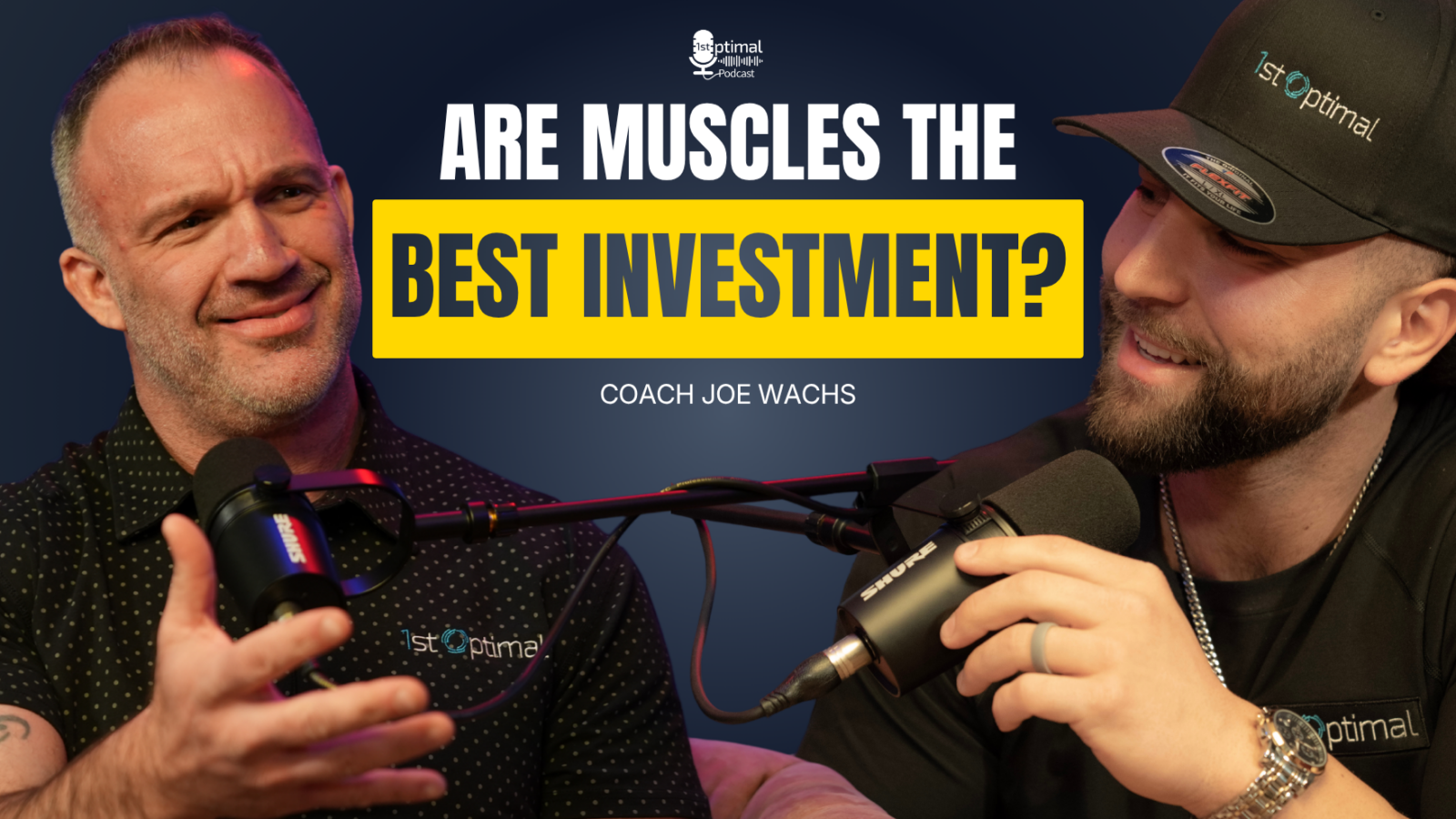
Joe Wachs flew in from Chicago to sit down in studio with Joe Miller for this one, and it turned into the most tactical conversation we’ve had on the 1st Optimal Podcast. We covered the psychology of starting, the exact daily numbers he tracks with clients, why fat loss is cyclical instead of linear, when labs actually matter, and why most people quit protocols right before they start working.
Here’s the full breakdown.
Most people don’t have an information problem
Ask a room of a hundred adults how to lose weight and ninety-nine will say eat less, move more. They’re not wrong. So why is the room still stuck?
Joe’s answer is blunt:
“Most of the people that come into the program that kind of struggle with weight loss or being consistent, most of the time it’s not that they don’t know what to do.”
The gap isn’t knowledge. It’s structure.
Without structure, there’s no plan to return to. You have a bad week, you fall off, and there’s nothing to climb back onto. You lose fifteen pounds, you plateau, and you have no idea what the next move is, so you drift. As Joe puts it, if you don’t prep your food, it doesn’t matter. If you eat out more than you should, it doesn’t matter. None of it matters, because there was never a plan for it to violate.
“If you don’t have a plan, you’re kind of just planning to fail, or at least stay the same.”
This is why the accountability piece keeps showing up in every transformation story worth telling. Not because people are lazy. Because a plan you report on is a plan you follow.
Takeaway: if you’re smart, motivated, and still stuck, stop buying more information. Buy structure.
Self-doubt is the actual bottleneck
Joe Miller pushed on this: there’s a gap between wanting to change and starting. What’s sitting in that gap?
Joe Wachs didn’t hesitate. Self-doubt.
Here’s how it plays out in a real consult. He looks at intake photos and calls out the person’s true potential, and the number is often enormous. Eighty pounds down. Eighteen months. A completely different body composition.
“I think is they don’t believe it’s possible for them to have what others have. And it’s like I always tell my clients, I believe in most of my clients more than they believe in themselves.”
That’s not a motivational poster. It’s a job description. A coach’s first function is to hold the standard before the client can hold it themselves.
“Self-doubt is what kills dreams and keeps people complacent.”
Joe Miller added a piece of this from his own early coaching years that’s worth stealing. He was, in his words, too naive to realize people could fail. He’d sit down across from a woman in her mid-forties, look at her calendar and her life, and say flatly: we’re losing fifty pounds in this window. This is what I do.
Years later he asked those same clients why they signed up. The answer was almost always the same. You were so certain.
Certainty is contagious. If nobody in your life is certain about your outcome, that’s the missing piece, not another macro calculator.
Meet Kylie
Joe Wachs has a name for his primary client avatar. Kylie.
Early forties. Two kids. Works outside the home. Also runs the house. Hasn’t had a real hormone panel in a decade, if ever. Has started over on Monday more times than she can count.
If that’s you, this episode was built for you. Kylie isn’t a marketing persona. She’s the person Joe is describing every time he talks about structure, accountability, and the emotional cliff at week three.
Which brings up the part most programs skip.
The honeymoon ends. Plan for it.
Every start feels great. Monday one is electric. Monday three is not.
Joe’s approach to the cliff is communication frequency, and the framing he uses is deliberately unsentimental:
“You’re not going to not show up to work. It’s like you have a boss, you have expectations, no matter how tired you are, you’re going to get up and do it.”
He installs that same mindset, then stays visible enough that the plan and the coach live rent-free in the client’s head. Early on he’s supportive and encouraging, because someone drowning in self-doubt won’t respond to hard coaching. Later, once they’ve built some proof, he shifts.
“The discipline of coach and calling them out on their BS is what I love to do, because I’m speaking facts and truth and they need to hear what’s proper for them.”
Support first. Standards always. Hard truth once it can land.
Nobody transforms alone. Bring the house with you.
This section deserves more attention than it usually gets, and Joe was direct about it.
He asks every client about their support system, because he’s watched the alternative:
“Sometimes when I work with people, the husband will get mad that the wife’s looking better and feeling more confident. So then it’s like pulling teeth back and forth and then he’s pulling her off track.”
It goes both directions, and it’s often not conscious. One person in a household starting to change can make the other person feel indicted. That resistance is real, and it derails more programs than bad programming ever will.
The fix is unglamorous: talk about it before you start. Who cooks. Who covers the kids on training nights. Who’s going to be asked to do something slightly uncomfortable so you can succeed.
Joe Miller pointed out that even in a household where both people work in health, this still takes active management. His wife will quietly absorb everything until she’s about to miss her own class, and he has to catch it and take the swim run instead.
“If we don’t stay on the same page, this will never work and these results we’re talking about will not come to life.”
Takeaway: the support system conversation is not a soft skill. It’s programming.
Order of operations: foundation first, protocols second
This was the most important clinical thread in the episode, and it’s where a lot of the internet gets it backward.
Joe Wachs’s rule is simple. Structure, nutrition, training, sleep, consistency. Get those in and let the body respond. Then dial the labs in further. Then, once someone has seen the fruit of their own work, layer in what modern medicine can add.
“We’re not going to recommend somebody three or four peptides and HRT who’s eighty pounds overweight and is not even working out.”
Joe Miller framed the biology behind it with an analogy borrowed from a colleague. Think of leucine as the foreman on a job site and the other amino acids as the crew. Most optimization protocols are signaling mechanisms. They’re the foreman shouting orders.
A foreman with no crew builds nothing. A crew with no raw materials builds nothing. And a job site with materials and workers but no foreman just sits there.
“It doesn’t matter if we don’t have this foundation built first.”
That’s why protocols get a bad reputation. Not because they don’t work. Because they were deployed into a body that had no raw materials, no training stimulus, and no recovery to build on.
Joe Wachs has a food metaphor for it that we’re stealing permanently:
- Training and nutrition are the meat and rice. The meal.
- Hormone optimization is the main condiment. The flavor that changes the dish.
- Peptide protocols are the cilantro, the green onion, the tomato. They finish it.
“No one needs to be taking a million things that aren’t needed yet.”
You don’t garnish an empty plate.
The exception: when foundations aren’t enough
Fair counterpoint from Joe Miller, and it matters.
Sometimes the person can’t build the foundation because their physiology won’t let them. They’ve labeled themselves lazy. They’ve adopted an identity of “I’m just not a healthy person.” And then the labs come back and the thyroid is trashed and hormone production is on the floor.
“You don’t have the raw materials to get up and go.”
That person doesn’t need more discipline. They need a look under the hood, and sometimes an intervention early so they can actually execute the basics.
It cuts both ways. Some people should start with structure and see how the body responds. Some people need help getting off the floor first. The only way to know which one you are is to test.
What Joe actually orders, and how often
Blood work inside the first thirty to ninety days. That’s the standard.
Why the window instead of day one? Because a lot of people want to prove to themselves they’ll show up first, and Joe would rather build the habit and then measure the machine. But it doesn’t get skipped.
What he wants to see:
- For women: progesterone, estrogen, testosterone, thyroid
- For men: testosterone and thyroid, because low T caps energy and quality of life no matter how good the program is
- For everyone: the metabolic picture, including insulin sensitivity and blood sugar
The problem he runs into constantly:
“A lot of my clients haven’t gotten blood work in five, ten years, or some have never gotten a full hormone panel in their life. They just get it through their work system, the CBC and the cholesterol panel.”
Those work panels are designed to confirm you’re alive and employable. They’re not designed for performance, body composition, or how you feel at 3pm.
Retest cadence: Joe personally runs labs quarterly and freely admits he’s a health freak about it. His recommendation for normal humans is every six months.
His reasoning is the part people miss:
“Your body is changing every six to twelve months drastically based on just your lifestyle choices and the way you live.”
Joe Miller extended it with a specific example. A man who walks in at high twenties body fat may have more aromatase activity, which changes how he responds to a given testosterone level. Nine months later, leaner, that same man needs different dosing, different frequency, potentially a different approach entirely. His internal biology changed.
Labs from two years ago are a historical document, not a plan.
Takeaway: annual physicals are a floor, not a strategy. If you’re actively changing your body, test like it.
Book a call and get an actual baseline instead of guessing.
Stop letting the scale run your mood
This connects directly. Joe Miller made the point that the scale is one measurement, and a noisy one.
A woman finishes a brutal strength week. Micro-tears, inflammation, water retention. Maybe it’s the wrong week of her cycle. The scale is up three pounds and she spirals, when her blood work is the best it’s been in years and her measurements are down.
So what does Joe track instead?
Mandatory weekly: progress photos and body measurements. Every week. No exceptions.
“If your weight isn’t changing but you’re looking better and your measurements are going down, you’re building muscle and dropping body fat at the same time.”
Which, by the way, he considers completely doable for normal people.
“You know how people say you can’t build muscle and drop body fat at the same time? Yes, you can, all day long. I do it with sixty-year-old women.”
The requirements are unsexy: adequate protein, real training intensity, and recovery that’s actually dialed in. Food and recovery handled, you can do both.
The daily variables Joe tracks with every client
This is where the episode gets genuinely operational. Every client reports daily:
- Weight, to the decimal
- Steps
- Water
- Nutrition, tracked, not estimated
- Sleep
- Training output, and he knows which days they train
“I like to see everything, basically a spreadsheet in front of me, so I know what variable is doing what and what variable needed to change.”
The payoff is diagnostic. If someone drops two pounds on a Tuesday, he can see it was a high carb day on a high output day. If they’re up two on Sunday, he can see it was leg day plus a family dinner out, and that they were down four midweek.
“That’s the problem, why people plateau. They’re not tracking all these variables.”
Weekly weigh-ins with no context aren’t data. They’re a mood swing on a schedule.
The training and activity numbers
Everyone wants the actual prescription, so here it is, with the caveat that these are Joe’s general starting ranges and not a plan built for you.
Lifting frequency: nobody in his program trains more than five days a week.
“Even as a professional athlete, I don’t think it’s productive, just for overall recovery, managing stress and cortisol to actually drop body fat and build muscle relatively at the same time.”
Step baseline: 8,000 per day to start. He considers that the sweet spot for getting the body moving and energy expenditure up without wrecking anyone’s schedule.
Step ceiling: 10,500 in a fat loss phase. He’s openly skeptical of the 10k minimum trend.
“Everybody now, it’s a trend where it’s like 10k a day minimum, where I don’t even think that’s needed until you dial everything else in.”
Cardio: start with two high quality intense sessions per week. The absolute ceiling for a busy parent in a deep fat loss phase is four sessions at fifty minutes, and he says that reluctantly.
His framing on all of it is tools in a box:
“Let’s only use the tool when it’s needed. And if we need to change from a screwdriver to a power drill because we need some more power, we can add more frequency of cardio.”
And the honest gut check at the end:
“If you can’t transform your body and get the results you want with 10.5k steps per day, four cardio sessions a week, four weight training sessions, and strategized nutrition, then there’s a deeper response we need to look at.”
That’s the line. If you’re doing all of that and nothing is moving, the answer isn’t more cardio. It’s a lab panel.
The glute protocol, since you asked
Joe Miller flagged this one as the clip the women in the audience would want, and he was right.
Joe’s structure for glute development:
Two leg days per week. Not three. He’s firm on this. If you’re not a professional athlete, recovering from three leg sessions is unrealistic and unproductive. He generally programs Monday and Thursday.
Day one, compound and heavy:
- RDLs
- Barbell hip thrust
- Some form of squat
- Finish with a heavy accessory kickback in the six to ten rep range
Day two, volume and isolation:
- Fifteen to twenty rep range
- Abduction and adduction work (he calls them good girl, bad girls)
- Cable kickbacks
- Machine isolation
- Calves
He also loves the Smith machine squat, which will annoy purists and continues to build glutes anyway.
Joe Miller raised the quad-dominant issue, which is real. Plenty of women recruit quads on everything, load the knee, and struggle to feel glutes at all. Joe’s answer is that for most people, the fix is proportional programming rather than exotic corrective work. Build the broad structure first, then get surgical once someone’s composition is close and you’re chasing details like one glute lagging the other.
Fat loss is a cycle, not a line
This is the mental model most people are missing, and it’s why they think they’ve failed when they haven’t.
Nobody loses fifty pounds at a pound a week for fifty weeks. That’s not how a body works.
Here’s the loop Joe runs:
- Deficit. Client comes in undereating and untrained. Structure goes in. Weight comes off, often a lot of it.
- The stall. Metabolism downregulates. Body stops responding. This is not failure. This is the signal.
- Reverse diet. Calories go up slowly. Metabolism speeds back up. Body composition holds.
“Reverse dieting, if you’re listening, is where we slowly increase your calories, making your metabolism quicker, but you’re maintaining the same level of body fat and body composition.”
- Rebuild. Muscle goes on. Appetite comes back. Energy goes through the roof. This is where the person eating 3,000 calories at 120 pounds gets built, and gains almost no fat doing it.
- Deficit again. Now you reveal the new tissue and the new composition.
The catch is human. Clients want to go back into fat loss before their body is ready, and Joe ends up negotiating.
“It’s fighting against sometimes what my clients want, what they desire, versus what their body’s telling me and what’s working so well.”
He’ll reverse diet four to six months, sit at maintenance, then push back into a deficit, even when he’d prefer a longer runway. The tradeoff is that shortened reverse means a harder cut.
The people who refuse the rebuild phase entirely are the ones who stay stuck forever:
“If you never feed your body, most people in my program, ninety-nine percent of them, have never reverse dieted or intentionally fed their body ever in their life.”
Twenty years of undereating with macros out of whack, then a diet, then more undereating. Of course it stops working.
Joe Miller confirmed it from his own prep experience. Late thirties, sixteen week bodybuilding prep, and his coach told him he’d gain size in the first four to eight weeks. In a deficit. Which happened, because it had been fifteen years since his protein, sleep, training intensity, and supplementation were all dialed at the same time. The scale went up two or three pounds and the lines got deeper.
Takeaway: if your fat loss has stopped working, you may not need a bigger deficit. You may need to eat.
Chase the picture, not the number
This might be the most useful reframe in the entire episode, especially for women.
The scenario: a woman at 185 wants to be 150, because 150 is what she weighed in college and that’s what she pictures.
Joe Miller’s read is that the number is a proxy for an image, and the image is achievable at a different number.
The physique sports trick most people don’t know: if you want a smaller waist, build your delts and lats. A wider upper body makes the waist read narrower. It’s not all about shrinking the middle.
“Not only is your metabolic response, your strength, all the benefits of having more muscle, but if this is wider, this is going to just appear more narrow and give you that hourglass look you’re going for.”
Same principle on legs. A straight line from glute to knee reads blocky in a dress. Add a little quad sweep, build the adductors, put lean tissue on, and the silhouette changes completely. That version might weigh 165 or 170.
“Maybe that actually looks better in the dress they wanted, they were picturing for that wedding, for that special occasion, versus just simply, I’m going to be skinny fat, diet myself down, and I’m closer to that 150 but I look saggy, I look weak, I look frail.”
Joe Wachs is the walking proof. He’s 245 pounds and gets guessed at 215 to 220, because dense tissue at a good composition doesn’t read as heavy.
And for anyone worried about getting bulky, he addresses it on every call:
“When I say build lean muscle tissue, think lean, tight, and toned. You’re never going to get big and bulky.”
Takeaway: treat your goal weight as a reference range, not a verdict. Ask what that number is supposed to deliver, then chase that instead.
Protocols are signals, and signals need runway
Here’s where most people waste their money.
Joe Wachs’s minimum before you judge anything:
“Three to four months, because it’s just like your fitness. If you’re not consistent with something for at least three to four months, don’t expect much results.”
Three to five months of true consistency. Not missing doses. Not starting and stopping.
The mechanism explains why. Optimization protocols are signaling mechanisms, not switches. They tell the body to do something. The body then does that thing over weeks and months, the same way training does.
Joe Miller’s example: you don’t train arms for four weeks, look in the mirror, and conclude that lifting doesn’t work.
“You’re signaling growth. A certain response in the muscle to say, to deal with this work capacity, we need more of the good stuff, because this dude is taking me to the gym every day.”
Hormone optimization follows the same curve. Someone moving from a deeply suppressed level up into an optimal range might feel better inside a week. The body composition change from having that level sustained doesn’t show up until month three or four.
The hair analogy landed hardest, and every man reading this already understands it. Topical hair growth agents work by signaling. Stop the signal, the effect goes with it.
Recovery peptide protocols work on the same principle. They aren’t a solution injected into a knee. They initiate a cascade, including IGF-1 release and vascular growth factors, and those signaling molecules go looking for the flagged tissue.
“If that signaling is cut off too short, the recovery is never going to get there. And people think, oh, this doesn’t really work for me.”
Three weeks. Five weeks. Then they quit and tell everyone it didn’t work.
“There’s a lot of things in life people don’t do long enough to see it work, and that’s why they quit.”
Note: protocol categories on this show are discussed at a general education level. Nothing here is a prescription or a recommendation of a specific compound or dose. Individual protocols may support different goals and are determined by a licensed clinician after labs and intake.
What Joe is running and why he’s not chasing novelty
Without getting into compounds or dosing, the categories Joe finds most broadly useful for his clients look like this:
- Metabolic and blood sugar support, which he credits for unlocking clients who did everything perfectly and still couldn’t drop weight. His read is that improving insulin sensitivity was the missing variable.
- Cellular energy and focus support, which he half-jokingly calls the entrepreneur’s edge, and which he thinks a lot of women waking up exhausted may benefit from.
- Growth hormone releasing protocols, which may support sleep quality, lean tissue, visceral fat reduction, and recovery. He also notes the effects most people don’t expect: skin, hair, nails, and collagen production.
- Recovery protocols, for the person who feels beat up after every session or is carrying a lagging injury.
- Antioxidant and liver support, which is where the conversation turned genuinely nerdy.
On that last one, Joe Miller added a piece worth understanding. The liver has a real role in blood sugar regulation. A liver under less oxidative stress signals more efficiently, which affects glucose release. It’s not something you feel. It’s something that’s working.
“You won’t feel it like a lot of peptides. I tell people you’re not going to feel a certain different pre-workout or something.”
Which is precisely why the three to four month runway matters. Half of this category doesn’t announce itself. It shows up in labs, photos, sleep quality, and how you feel getting out of bed in October versus June.
He also addressed the growth hormone fear directly. People hear anything in that category and picture a 1990s bodybuilder. What these protocols may do is nudge the body toward the upper end of what it can already produce, and they self-regulate. Dosing still has to be dialed in by a professional, and Joe Miller noted he’s seen water retention when it isn’t.
Joe Miller’s framing:
“It’s all you’re doing is replacing what was there ten, twenty years ago.”
The compound effect, told two ways
Two stories from this episode that we can’t stop thinking about.
Story one: the treadmill and the clock.
Back in Joe Miller’s training days, his edge wasn’t programming. It was surveillance.
Every session started with the client on a treadmill where he could see them while he wrapped up his previous client. Every session ended the same way, with a prescribed duration and heart rate.
“I can see you from across the gym. You see the clock, it’s 1:05, and if you’ve got 45 minutes, it means at 1:50 I should see you walking off. Not any sooner.”
Eye rolls all around. Then other trainers started asking why his clients got better results.
The math is the whole answer. An extra 1,750 calories a week over six months is roughly an extra pound of body fat every couple of weeks. Nothing about the programming was special. The behavior was.
“That compound effect made me look like a super trainer, but really it was just getting the right behaviors in.”
Story two: the rep that doesn’t count.
At eleven or twelve years old, lifting on cement weights in his parents’ basement, Joe Miller made a rule for himself. He doesn’t count the first rep of a set. Still doesn’t, decades later.
Run the arithmetic. Twenty working sets in a session. One uncounted rep each. Three hundred training days a year. Five years.
That’s tens of thousands of extra reps against a version of yourself who counted normally.
Joe Wachs’s version comes from bodybuilding:
“If you have someone to push you, how many extra reps am I doing per workout, per week, in a year, compounding to why someone’s way denser than you, bigger than you, harder than you? Every little thing adds up.”
There is no hack in either story. Just a small edge, repeated until it becomes a physique.
Intensity is a ceiling you’ve never touched
Related, and worth its own section.
Most people have no idea how hard they can actually train, because nobody has ever taken them there.
“A lot of people never reach their full potential or get to the intensity they need because they’ve never felt it or experienced it. So they don’t even know how hard to push.”
They stop when it burns. They stop when it gets uncomfortable. They call that their limit, and it isn’t.
“Most people don’t find their breaking point until they have someone push them at that breaking point.”
Once you’ve felt real intensity, the standard resets. You’re not squatting 500 pounds on day one, but at some point that becomes your baseline, and the whole scale moves with it.
The hidden cost is recovery. Higher intensity demands more nutrition, more sleep, and better recovery protocols, or you can’t sustain it. Joe Miller learned this training jiu-jitsu at volume: hydration, inflammation management, and sleep became the limiting factors long before effort did.
Don’t compare your stage to someone else’s
Last thing, and it’s a good one for anyone scrolling fitness content at 11pm feeling behind.
Clients ask Joe how many steps he walks a day. His answer:
“Let’s not talk about it.”
Some days it’s 3,000. And that’s fine, because he’s spent a decade building tissue, he knows his body precisely, he plays hockey through the week, and he has a maintenance system that fits his life.
“You can’t even compare yourself to me, because you’re at a completely different part of your journey. We were all there too.”
Same for Joe Miller, who trains jiu-jitsu and runs his own structure.
The rules that apply to you are the rules for your current stage. Not the rules for someone ten years in. That’s the entire reason the beginner protocol and the advanced protocol look nothing alike, and why copying an advanced person’s routine is one of the fastest ways to stall.
Frequently asked questions from this episode
Can you build muscle and lose fat at the same time? Yes, according to Joe Wachs, and he does it regularly with clients into their sixties. It requires adequate protein, real training intensity, and recovery that’s genuinely handled. Food and recovery dialed in, both can happen at once.
How many steps a day should I walk for fat loss? Joe starts every client at 8,000 as a baseline and caps most people at 10,500 during a fat loss phase. He’s skeptical of the universal 10k minimum until everything else is dialed in first.
How many days a week should I lift? No more than five in Joe’s program, including athletes. Recovery, stress, and cortisol management matter more than added volume when the goal is dropping fat and building muscle at the same time.
How often should I get blood work? Joe runs his own quarterly. His recommendation for most people is every six months, because body composition and lifestyle changes shift your internal picture significantly over six to twelve months.
Why did my weight loss stop working? Often because the body has downregulated after an extended deficit. The move at that point is usually a reverse diet, slowly increasing calories to bring metabolic rate back up while holding composition, before returning to a deficit.
How long before a protocol shows results? Three to four months minimum, per Joe, and three to five for true confidence. These are signaling mechanisms, not switches. Cutting the signal off at three or five weeks is the most common reason people conclude something didn’t work.
Where to find Joe Wachs
Joe coaches one on one and works with clients across the country. You can follow him on Facebook, YouTube, Instagram, and TikTok, and you can book a free consult through his site at bodybywachs.com.
A number of his clients have their internal health overseen by the 1st Optimal team, which is exactly the model he describes in the episode: elite coaching and strategy on one side, clinical oversight and labs on the other, so nothing gets left to guesswork.
Instagram: joewachsofficial & wachsathletics
Facebook: joe.t.wachs& BodyByWachs
Website: bodybywachs.com
TikTok: @wachs
Ready to Take the Next Step?
Ready to begin your own fitness journey and take control of your health? Book your free consultation with 1st Optimal today and let’s explore how personalized coaching and expert-led strategies can help you achieve your health goals!
🔗 Listen to the full episode on your favorite platform:
🎧 Spotify | Apple Podcasts | Amazon Music | Google Podcasts
📺 Watch it on YouTube: