

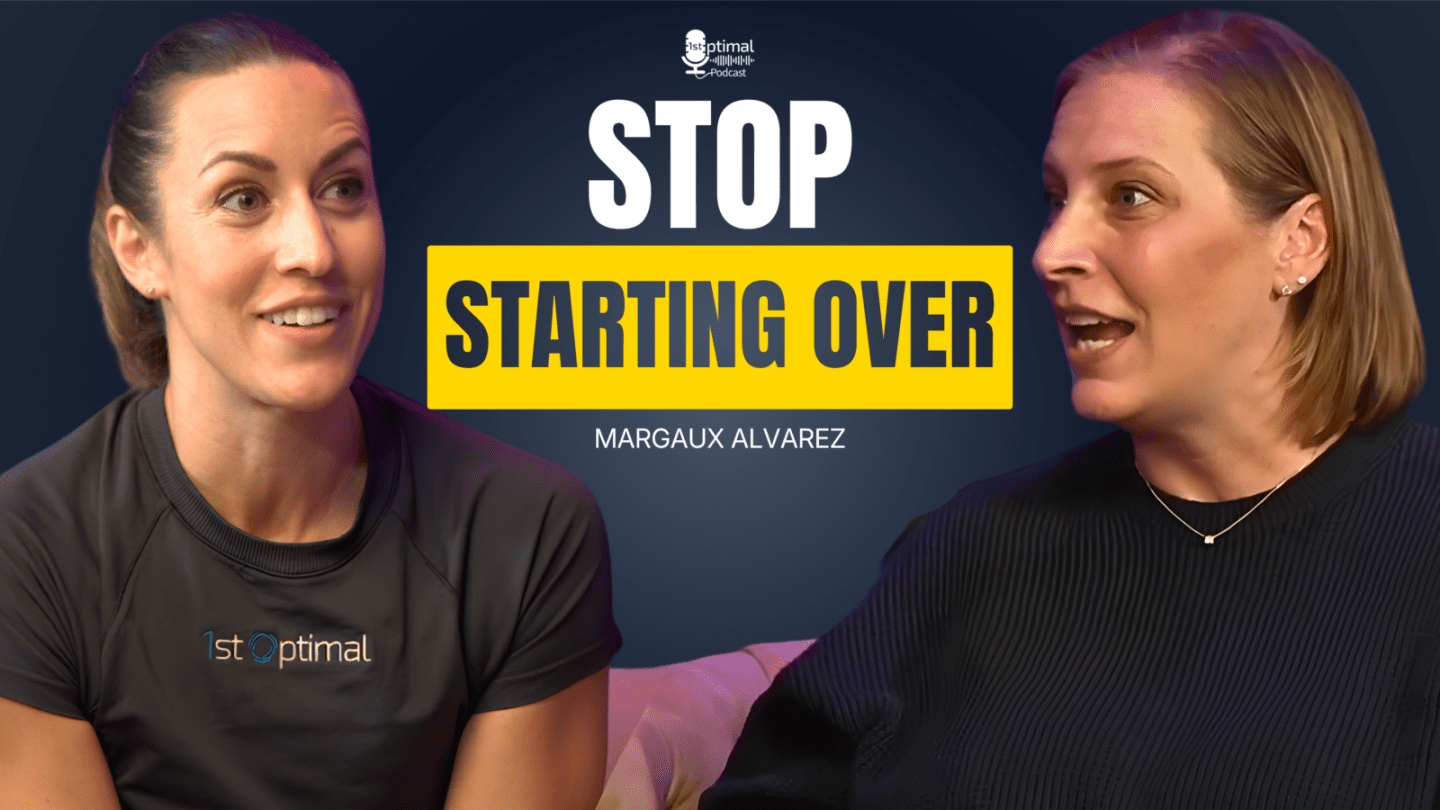
Success is usually measured by the visible moment: reaching the podium, hitting a personal record or achieving a long-term goal. But Margaux Alvarez believes the process leading up to that moment is where most of life happens.
In this episode of the 1st Optimal Podcast, Margaux joins Amber for an honest conversation about competitive fitness, mindset, injuries, identity and learning to enjoy the work along the way.
Drawing from her experience in CrossFit competition, coaching, American Ninja Warrior, The Titan Games and entrepreneurship, Margaux explains how she has learned to pursue difficult goals without allowing one accomplishment to define her.
The conversation also offers a practical message for anyone who feels intimidated by fitness: you do not have to begin with an intense workout. You can begin with five minutes of movement.
Mindset Is the Foundation
Margaux describes mindset as the foundation beneath physical performance.
Training programs, nutrition plans and measurable goals matter, but the way someone speaks to themselves can influence whether they remain consistent when progress becomes difficult.
Negative statements such as “I can’t get up early” or “I can’t lose weight” can reinforce the belief that change is impossible. Margaux encourages replacing that language with a more constructive approach:
“I may not be there yet, but I am working toward it.”
This shift does not remove the work. It creates enough possibility to take the next step.
She and Amber also discuss how people often speak to themselves in ways they would never speak to a friend. Improving that internal conversation takes awareness, patience and repetition. Margaux compares it to training a muscle: meaningful change develops over time.
Small Goals Create Sustainable Progress
Large goals can feel overwhelming when viewed all at once.
Someone who wants to lose 20 pounds may become discouraged by how far away the goal seems. An athlete who wants to lift 200 pounds may overlook the progress represented by adding five pounds to the bar.
Margaux recommends breaking the larger objective into smaller, achievable steps. Those steps build confidence and make progress easier to recognize.
The same principle applies outside the gym. Whether the goal involves health, business or personal growth, consistency usually matters more than one dramatic effort.
Coaching the Person Behind the Workout
After nearly two decades in the fitness industry, Margaux has learned that coaching involves more than prescribing exercises.
A person’s relationship with movement, nutrition and body image may be shaped by years of experiences. Margaux discusses working with clients whose previous athletic environments created restrictive beliefs about food. She also shares her own past experience with disordered eating and the importance of recognizing when support is needed.
Changing those patterns is rarely immediate. It requires trust, honest conversations and a willingness to examine what may be driving a behavior.
Margaux is clear that asking for help is not weakness. It is often the first meaningful step toward change.
Grief, Movement and Finding a Healthier Outlet
Margaux opens up about losing her sister and turning to movement as an outlet for grief.
Fitness helped her process difficult emotions, but she also recognizes that even seemingly healthy behaviors can become unhealthy when used to avoid what someone is experiencing. Exercise can support healing, but it does not automatically resolve grief, trauma or a difficult relationship with food.
Her experience has shaped the way she coaches. She cannot change what happened, but she can use what she learned to help other people feel stronger and less alone.
Recovering From Injuries and Adjusting Expectations
Margaux’s competitive career required her to navigate several physical setbacks.
She competed after breaking her first rib, adapting her training around movements that had become painful or nearly impossible. Years later, a herniated disc and sciatica created an entirely different challenge.
This time, the struggle was not only physical. Movement had always been part of Margaux’s identity and emotional outlet. Being unable to sit comfortably, bend normally or train the way she once had triggered fears about losing her fitness and no longer feeling like an athlete.
Recovery required her to reconsider what strength meant.
Instead of measuring success only through maximum lifts or competitive results, Margaux began asking whether her training supported the life she wanted outside the gym. Could she run, hike, lift a case of wine or help a friend move?
Her goals changed from proving what her body could do in competition to maintaining strength, function and freedom in everyday life.
Separating Identity From Achievement
Amber and Margaux explore what happens when an athlete can no longer perform at the same level or participate in the same sport.
When identity is built entirely around a title, result or role, an injury or transition can feel like a loss of self. Margaux’s competitive history will always be part of her, but it does not have to define every chapter that follows.
That perspective can help athletes and non-athletes alike. Missing a goal does not change who someone is. It may simply require a different approach, a new timeline or a new definition of success.
Why Enjoying the Process Matters
Margaux offers one of the episode’s clearest reminders: the achievement itself is brief.
An athlete may train for months to spend only a few minutes on the podium. A student may study for years before walking across a graduation stage. Most of the experience happens before the final result.
That is why Margaux encourages people to “embrace the struggles and celebrate the successes.”
The process includes ordinary workouts, difficult conversations, meal preparation, setbacks and days when motivation is missing. Learning to find meaning in those moments makes the journey more sustainable.
What Winemaking Taught Margaux About Patience
Margaux sees a direct connection between training and winemaking.
Grapes must be planted, grown, harvested, crushed, pressed and aged. Skipping a stage changes the result. Physical progress works the same way.
Her “work hard, wine down” philosophy is about more than drinking wine. It represents slowing down, being present and making time to enjoy what the work was meant to support.
Her winery also carries a personal connection to her sister, who loved wine, cooking and baking. For Margaux, sharing wine with other people is a way to honor those interests while remembering that tomorrow is never guaranteed.
Your Environment Can Support or Undermine Progress
Margaux and Amber also discuss the effect that friends, family members, partners and coaches can have on a health journey.
Supportive people can provide accountability and encouragement. Unsupportive or toxic relationships can gradually weaken confidence, especially when criticism comes from someone close.
Margaux emphasizes focusing on what you can control. Other people’s reactions often reflect their own struggles, fears or insecurities. You may not be able to change them, but you can decide how much energy their behavior receives and seek out people who respect the direction you are moving.
How to Start Exercising When the Gym Feels Intimidating
Margaux’s advice for beginners is simple: start with five minutes.
Walk outside. Use a treadmill. Walk around your home or climb the stairs. If traditional exercises feel difficult, begin with bodyweight movements and modify them around your current ability.
The goal is not to prove your fitness on the first day. It is to begin creating a relationship with movement.
Margaux also challenges the belief that someone must get in shape before joining a gym. A good coach should meet a person where they are and adjust exercises when needed.
Most people at the gym are also focused on themselves, not judging the person next to them.
Five minutes can eventually become 10, 20 or 30 minutes. Confidence grows through action.
Community Makes Consistency Easier
Motivation will not be present every day. Community can help fill that gap.
A supportive gym, coach or group provides accountability and connection. Over time, exercise becomes more than a workout. It becomes a shared space where people with different backgrounds can show up for the same purpose.
Margaux believes that when people feel better and take care of themselves, the effect reaches beyond the gym. They have more capacity to support their families, friends and communities.
What Margaux Discusses With Amber
In this episode, Margaux and Amber explore:
- How Margaux developed her competitive mindset
- Why hard work can eventually surpass natural talent
- The effect of negative self-talk on fitness goals
- How to break large goals into manageable steps
- Why mindset work is difficult to measure but important to practice
- Coaching clients through body image, food and emotional barriers
- Margaux’s experience with grief and disordered eating
- Recovering from a broken rib, a herniated disc and sciatica
- Adjusting fitness goals after competitive athletics
- Separating personal identity from performance
- Finding a form of movement you genuinely enjoy
- The relationship between patience, fitness and winemaking
- Protecting your energy around unsupportive people
- Starting with five minutes of walking or bodyweight movement
- How coaches and fitness communities support consistency
- Taking care of yourself so you can better support others
Where to find Margaux Alvarez
Instagram: @321gaux
Facebook: Margaux Alvarez
Website: Margaux Alvarez
TikTok: @margauxalvarez
YouTube: @MargauxAlvarez
Ready to Take the Next Step?
Ready to begin your own fitness journey and take control of your health? Book your free consultation with 1st Optimal today and let’s explore how personalized coaching and expert-led strategies can help you achieve your health goals!
🔗 Listen to the full episode on your favorite platform:
🎧 Spotify | Apple Podcasts | Amazon Music | Google Podcasts
📺 Watch it on YouTube:


