
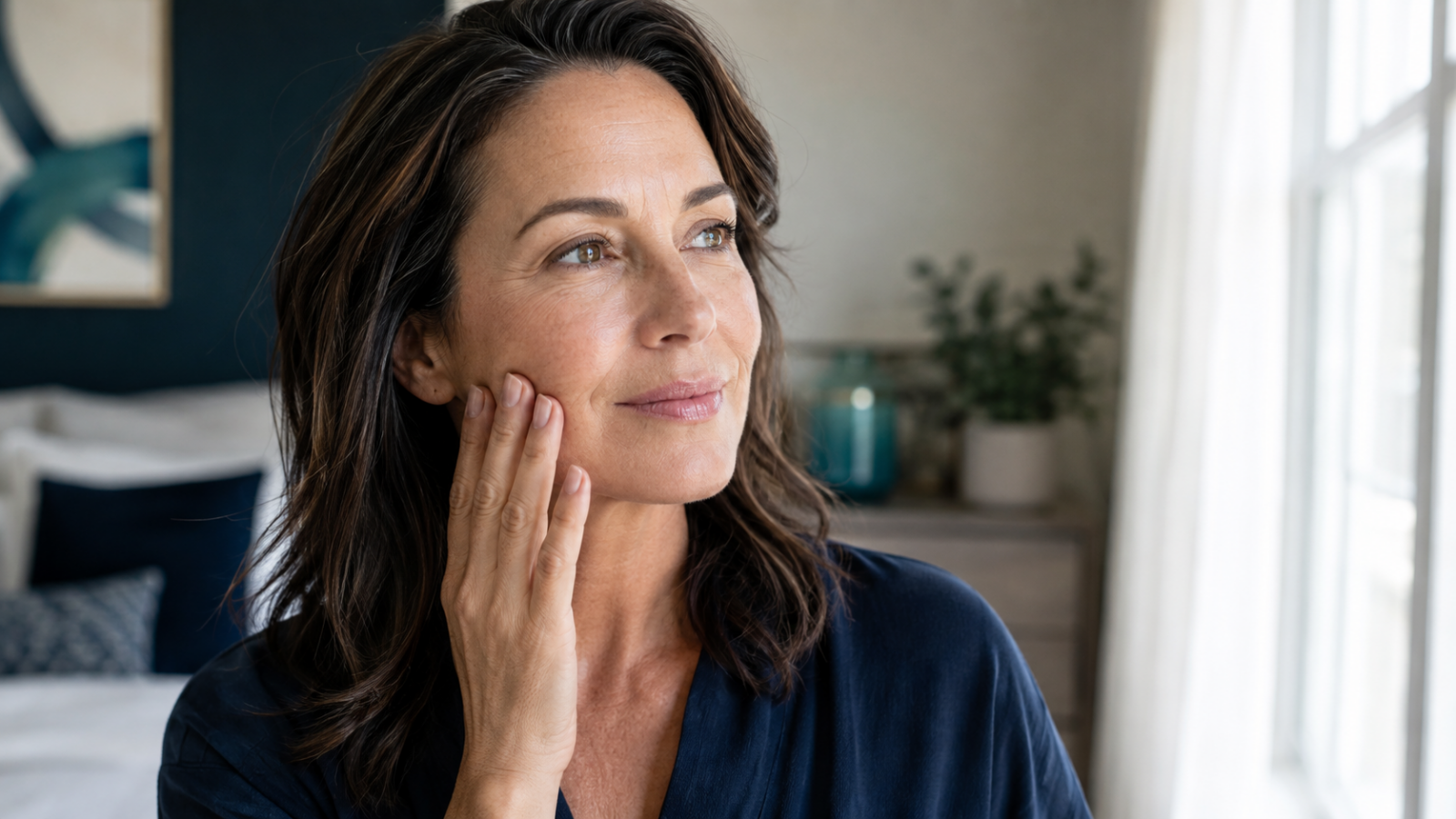
If your skin suddenly feels drier, thinner, less firm, or simply different during perimenopause or menopause, hormones may be part of the reason.
Estrogen-containing menopausal hormone therapy can improve certain measures of skin health, including collagen content, skin thickness, elasticity, and moisture in some women. The Menopause Society recognizes these potential benefits, and multiple clinical studies have reported improvements in estrogen-treated postmenopausal women.
But there is an important distinction.
Hormone therapy should not be viewed as a wrinkle treatment or prescribed solely to make skin look younger. The Menopause Society specifically states that estrogen-containing hormone therapy is not recommended for prevention of aging or primarily age-related skin changes alone.
The more useful question is this:
If a woman is already an appropriate candidate for hormone therapy because of menopause symptoms, could healthier-looking skin be an additional benefit?
For some women, the answer appears to be yes.
Here is what happens to skin during menopause, what estrogen actually does inside the skin, and what women should realistically expect from hormone therapy.
Why Does Skin Change During Menopause?
Skin aging doesn’t suddenly begin at menopause. Genetics, ultraviolet exposure, smoking, nutrition, sleep, stress, environmental exposure, and normal aging have been influencing the skin for decades.
Menopause adds another factor: a significant decline in estrogen.
Skin isn’t separate from your endocrine system. It contains receptors that respond to hormones, including estrogen. These hormonal signals influence processes involved in collagen production, moisture retention, wound healing, elasticity, and skin structure.
As estrogen availability falls, women may notice changes such as:
- Increased dryness
- Thinner or more fragile skin
- Reduced firmness
- Fine lines becoming more noticeable
- Loss of elasticity
- Changes in skin texture
- Slower healing
- Increased sensitivity
- Changes in facial fullness
This is one reason a skincare routine that worked perfectly at 35 may suddenly feel completely inadequate at 45 or 50.
The moisturizer didn’t betray you. The biology underneath the skin changed.
What Does Estrogen Actually Do for the Skin?
Estrogen’s influence extends far beyond menstrual cycles and reproduction.
Within the skin, estrogen influences fibroblasts and other cells involved in producing and maintaining the extracellular matrix, including collagen and elastin.
Estrogen and collagen
Collagen provides much of the structural framework that keeps skin firm and resilient.
Research has repeatedly linked estrogen treatment in postmenopausal women with higher skin collagen content. Earlier studies found greater collagen content among estrogen-treated women compared with untreated postmenopausal women, while subsequent clinical research has reported improvements in dermal structure and thickness.
This matters because declining collagen contributes to:
- Fine lines
- Wrinkles
- Crepey texture
- Reduced firmness
- Increased skin fragility
Hormone therapy doesn’t create a facelift in prescription form, despite what parts of the internet occasionally imply. But estrogen may influence the biological processes responsible for maintaining the skin’s structural support.
Estrogen and skin thickness
Both the epidermis and dermis can become thinner with aging and declining estrogen.
The Menopause Society’s hormone therapy position statement notes that estrogen therapy has been associated with increased epidermal and dermal thickness. A clinical study in early postmenopausal women also reported increased skin thickness after hormone therapy.
Thicker does not mean puffy.
It refers to improved structural tissue within the skin.
Estrogen and elasticity
Elasticity describes the skin’s ability to stretch and return toward its original position.
Collagen and elastin both contribute.
Clinical studies have reported improvements in skin elasticity among women receiving hormone therapy, and a 2023 review concluded that menopausal hormone therapy appears capable of increasing elasticity and collagen while improving several markers of skin aging.
Estrogen and hydration
Dry skin is one of the more common changes women notice during menopause.
Estrogen influences mechanisms involved in water retention, barrier function, and components of the skin’s extracellular matrix. Clinical research has found improvements in epidermal moisture among postmenopausal women using hormone therapy.
For some women, that may translate into skin that feels:
- Less tight
- Less rough
- Better hydrated
- More supple
That does not mean estrogen replaces a good moisturizer. Your bathroom cabinet is not completely obsolete yet.
Can Hormone Therapy Actually Make Skin Look Younger?
Potentially, but expectations matter.
Research suggests menopausal hormone therapy may improve measurable characteristics such as:
- Collagen content
- Skin thickness
- Moisture
- Elasticity
- Fine wrinkle appearance
The 2022 Menopause Society position statement concluded that estrogen therapy appears to have beneficial effects on skin thickness, elasticity, and collagen when given around menopause.
Some individual studies have also reported improvements in visible wrinkles.
For example, research involving estrogen-containing topical preparations has reported improvements in skin thickness and fine wrinkles compared with placebo.
But hormone therapy cannot reverse every component of facial aging.
It will not necessarily correct:
- Years of sun damage
- Deep wrinkles
- Significant facial volume loss
- Skin cancers or precancerous lesions
- Prominent pigmentation
- Dynamic wrinkles caused by muscle movement
- Significant skin laxity
Menopause and chronological aging happen at the same time. Separating the contribution of estrogen deficiency from age, genetics, and accumulated ultraviolet damage is scientifically difficult.
That’s one reason the evidence is promising but not strong enough to treat estrogen as an anti-aging medication.
Should You Start Hormone Therapy for Better Skin?
Not for skin alone.
This is where the evidence needs to be interpreted carefully.
The Menopause Society states that hormone therapy is used primarily for established menopause-related indications, including bothersome vasomotor symptoms such as hot flashes and night sweats, genitourinary syndrome of menopause, premature estrogen deficiency, and prevention of bone loss in appropriate patients.
The Society also explicitly states that estrogen-containing hormone therapy should not be prescribed simply for:
- Prevention of aging
- Hair loss
- Skin aging
- Weight gain
- Other primarily age-related changes
So the clinical conversation shouldn’t be:
“I have wrinkles. Should I take estrogen?”
A better conversation would be:
“I’m experiencing multiple symptoms associated with perimenopause or menopause. Would hormone therapy be appropriate for my overall health and symptoms, and could skin improvement be one secondary benefit?”
That is a very different question.
What If You Have Other Menopause Symptoms?
Skin changes rarely exist in isolation.
A woman noticing dramatic skin changes may also be experiencing:
- Hot flashes
- Night sweats
- Poor sleep
- Brain fog
- Changes in menstrual cycles
- Vaginal dryness
- Painful intercourse
- Mood changes
- Changes in body composition
- Reduced recovery
- Low libido
When multiple symptoms develop during the menopausal transition, evaluating the entire clinical picture makes far more sense than treating one symptom at a time.
Menopausal hormone therapy is considered the most effective treatment for vasomotor symptoms, and both The Menopause Society and the American College of Obstetricians and Gynecologists recommend individualized decisions based on symptoms, medical history, age, timing of menopause, risks, and treatment goals.
For a woman who is already an appropriate candidate for treatment, improved skin quality may become an additional benefit rather than the primary treatment goal.
Does the Type of Hormone Therapy Matter?
Hormone therapy isn’t one medication.
Treatment may involve different:
- Hormones
- Dosages
- Routes of administration
- Treatment schedules
- Combinations
Systemic estrogen can be administered through methods such as oral medications or transdermal patches, gels, or sprays.
Women who still have a uterus generally require appropriate endometrial protection when using systemic estrogen, usually with a progestogen. Estrogen used without adequate endometrial protection can increase the risk of endometrial hyperplasia and cancer.
Whether one systemic route produces meaningfully better facial skin outcomes than another remains unclear.
The goal shouldn’t be to choose a hormone delivery method based on Instagram before-and-after photos.
Route, dose, and formulation should be selected according to the woman’s symptoms, medical history, risk profile, preferences, and treatment goals.
What About Estrogen Cream for the Face?
This has become a particularly interesting area because estrogen-related skincare has gained attention online.
Small clinical studies have investigated topical estrogen applied to the skin and reported improvements in measures including:
- Skin moisture
- Thickness
- Firmness
- Elasticity
- Collagen
- Fine wrinkles
For example, placebo-controlled research examining a conjugated estrogen cream found statistically significant improvements in skin thickness and fine wrinkles. Another study comparing estradiol and glycolic acid formulations found increased epidermal thickness in the estradiol group.
That sounds impressive.
It also does not mean women should start putting vaginal estrogen cream on their faces.
These are prescription hormones, and the long-term safety, ideal formulation, dosing, systemic absorption, and appropriate patient selection for cosmetic facial use have not been established well enough to turn prescription vaginal estrogen into an over-the-counter skincare hack.
Current menopause guidance does not recommend systemic estrogen therapy for age-related skin changes alone.
Prescription hormones should be used for their intended medical purpose under clinical supervision.
What About Vaginal Estrogen?
Vaginal estrogen is different from systemic menopausal hormone therapy.
Low-dose vaginal estrogen is primarily used to treat genitourinary syndrome of menopause, which can include vaginal dryness, irritation, painful intercourse, and other vulvovaginal or urinary symptoms.
It is designed to act largely within the vaginal and vulvar tissues rather than produce the systemic estrogen exposure expected from systemic hormone therapy.
For women whose main concern is facial skin, vaginal estrogen should not be assumed to provide the same potential systemic skin effects as appropriately prescribed systemic estrogen.
And again, vaginal estrogen medication isn’t facial moisturizer with a medical-sounding label.
How Long Would Skin Changes Take?
Hormonal changes in skin biology aren’t instantaneous.
Clinical studies examining estrogen and skin have generally measured changes over several months rather than several days.
Depending on the study and treatment, researchers have evaluated outcomes around:
- Three months
- Six months
- One year
This makes biological sense.
Producing collagen, remodeling connective tissue, improving hydration, and altering skin structure takes time.
A woman beginning hormone therapy for appropriate menopause symptoms should therefore not expect to wake up two weeks later with dramatically different skin.
Skin changes, if they occur, are usually a gradual secondary effect.
Hormone Therapy Won’t Replace a Good Skin Strategy
Hormones influence skin biology, but estrogen is only one part of the equation.
Women in perimenopause and menopause still need to address the major external and lifestyle factors affecting skin aging.
1. Protect skin from ultraviolet exposure
Consistent sun protection remains one of the most important steps for limiting additional photoaging.
Use broad-spectrum sunscreen and avoid unnecessary prolonged ultraviolet exposure.
2. Support the skin barrier
Menopausal skin often becomes drier and more sensitive.
A simple moisturizer containing barrier-supportive ingredients can often outperform an expensive routine containing twelve products that spend most of their time arguing with each other.
3. Consider evidence-based topical skincare
Depending on skin type and medical history, dermatologists may recommend ingredients such as retinoids for photoaging and collagen support.
Introduce active products carefully because menopausal skin can become more reactive.
4. Eat enough protein
Skin is living tissue.
Adequate protein provides amino acids needed throughout the body, including for connective tissue maintenance.
5. Avoid smoking
Smoking accelerates visible skin aging and negatively affects tissue health.
6. Prioritize sleep and recovery
Night sweats and insomnia can make this difficult during menopause, which is another reason treating menopause as a whole-body transition often works better than chasing isolated symptoms.
Who Should Be Careful With Systemic Hormone Therapy?
Hormone therapy is not appropriate for everyone.
The 2022 Menopause Society position statement lists contraindications to oral and transdermal hormone therapy that include unexplained vaginal bleeding, liver disease, prior estrogen-sensitive cancer, previous coronary heart disease, stroke, myocardial infarction, venous thromboembolism, or a high personal or inherited risk of thromboembolic disease.
Risk also depends on factors such as:
- Age
- Time since menopause
- Type of hormone therapy
- Dose
- Route
- Duration
- Whether estrogen is combined with a progestogen
- Individual cardiovascular and breast cancer risk
For healthy symptomatic women younger than 60 or within approximately 10 years of menopause onset without contraindications, The Menopause Society states that the overall benefit-risk ratio of hormone therapy is generally favorable for established indications.
That doesn’t mean every woman in that category should take hormones.
It means decisions should be individualized rather than driven by blanket claims that hormone therapy is either universally dangerous or universally beneficial.
Both extremes make for excellent social media content and rather poor medicine.
Do You Need Hormone Testing Before Treatment?
Menopause care shouldn’t revolve around chasing one laboratory number.
Hormone levels can fluctuate significantly during perimenopause. Treatment decisions therefore depend on the entire clinical picture, including:
- Symptoms
- Menstrual history
- Age
- Medical history
- Medications
- Cardiovascular risk
- Breast and gynecologic history
- Metabolic health
- Sleep
- Sexual symptoms
- Treatment goals
Laboratory testing may still be valuable when symptoms could have several possible causes.
For example, fatigue, hair changes, dry skin, difficulty losing weight, and mood changes aren’t exclusive to menopause.
Depending on the situation, evaluating thyroid function, iron status, metabolic markers, nutrient status, and other hormones may help identify additional contributors.
The goal isn’t to generate the largest laboratory report physically possible.
It’s to collect information that changes the treatment decision.
Can Perimenopausal Women See Skin Benefits Too?
Potentially.
Hormonal changes often begin years before a woman’s final menstrual period.
During perimenopause, estrogen levels can become highly variable rather than simply declining in a straight line. Women may notice changes in cycles, sleep, body temperature regulation, mood, vaginal tissues, body composition, and skin during this period.
Hormone therapy may be considered for appropriate symptomatic women during perimenopause. A woman does not necessarily need to wait until she has gone 12 months without a menstrual period before discussing menopause-related treatment.
Again, the indication should be the woman’s broader symptom burden and clinical picture rather than cosmetic skin concerns alone.
Is Progesterone Responsible for the Skin Benefits?
Most of the research examining skin structure during menopause has focused on estrogen.
Estrogen has the clearer relationship with collagen, skin thickness, elasticity, and hydration.
Progesterone may be included in menopausal hormone therapy primarily because women with a uterus receiving systemic estrogen generally require protection of the endometrium.
This is an important distinction because “hormone therapy” is sometimes discussed online as though estrogen, progesterone, and testosterone all accomplish the same thing.
They don’t.
Each hormone has different physiological actions and different indications.
What About Testosterone for Menopausal Skin?
Testosterone should not be added simply because someone wants thicker skin, more energy, better mood, easier fat loss, or generalized anti-aging benefits.
The Menopause Society currently recommends testosterone therapy for appropriately screened postmenopausal women with hypoactive sexual desire disorder in specific circumstances. It does not recommend testosterone as a general treatment for age-related changes.
Hormone therapy works best when each treatment has a clear clinical reason.
More hormones do not automatically equal more optimization.
The Bigger Picture: Skin Can Be a Clue
Skin changes during menopause are real.
But they’re also useful information.
A woman suddenly experiencing dry skin, poor sleep, hot flashes, reduced recovery, brain fog, body composition changes, or sexual symptoms may not need five unrelated treatments.
She may need someone to look at the pattern.
Menopause affects multiple systems simultaneously because hormones communicate with tissues throughout the body.
That is why comprehensive evaluation matters.
The goal isn’t simply to make a laboratory number “normal.”
The goal is to determine what’s changing physiologically, rule out other possible contributors, understand the woman’s risks and priorities, and build a treatment strategy around the full picture.
Frequently Asked Questions About Hormone Therapy and Menopausal Skin
Does estrogen improve skin collagen?
Research suggests that estrogen therapy can increase or preserve skin collagen in postmenopausal women. The Menopause Society recognizes beneficial effects of estrogen therapy on collagen, skin thickness, and elasticity.
Can HRT reduce wrinkles?
Some studies have reported improvement in fine wrinkles with estrogen treatment. Results vary, and hormone therapy should not be prescribed solely as a wrinkle treatment.
Can hormone therapy help dry menopausal skin?
Potentially. Estrogen therapy has been associated with improvements in skin moisture in clinical research, although moisturizers and appropriate skincare remain important.
Can hormone therapy tighten loose skin?
Hormone therapy may improve collagen, thickness, and elasticity, but it cannot reliably reverse significant skin laxity or facial volume loss.
Can I put vaginal estrogen cream on my face?
Prescription vaginal estrogen products are intended to treat vulvovaginal and genitourinary symptoms. Using them as facial skincare isn’t an established standard treatment, and women should not repurpose prescription hormone medications without guidance from their healthcare professional.
Should I take hormone therapy just for better skin?
Current menopause guidance says no. Hormone therapy can have skin benefits, but estrogen-containing hormone therapy is not recommended solely to prevent aging or treat age-related skin changes.
When might hormone therapy make sense?
Hormone therapy may be appropriate when a woman has clinically significant menopause symptoms or another established indication and her individual health history supports treatment. The decision should account for symptoms, age, time since menopause, medical history, risks, treatment goals, formulation, and route.
The Bottom Line
Hormone therapy can improve some biological characteristics of menopausal skin, particularly collagen content, thickness, elasticity, and hydration.
That doesn’t make hormone therapy an anti-aging drug.
The strongest approach is to evaluate the entire menopausal picture. If a woman has hot flashes, poor sleep, vaginal symptoms, cycle changes, cognitive symptoms, or other concerns alongside changes in her skin, those symptoms deserve a comprehensive conversation.
When menopausal hormone therapy is medically appropriate, improvements in skin quality may be one additional benefit.
But the treatment decision should start with health, symptoms, risk, and quality of life, not wrinkles.
At 1st Optimal, we take a comprehensive approach to women’s hormone health by looking at symptoms, health history, metabolic health, lifestyle factors, and appropriate testing rather than treating one isolated symptom. If menopause feels like your body suddenly changed the rules without sending you the updated manual, a deeper evaluation can help clarify what is actually happening.
Educational only, not medical advice. Hormone therapy requires individualized evaluation with a qualified healthcare professional.