
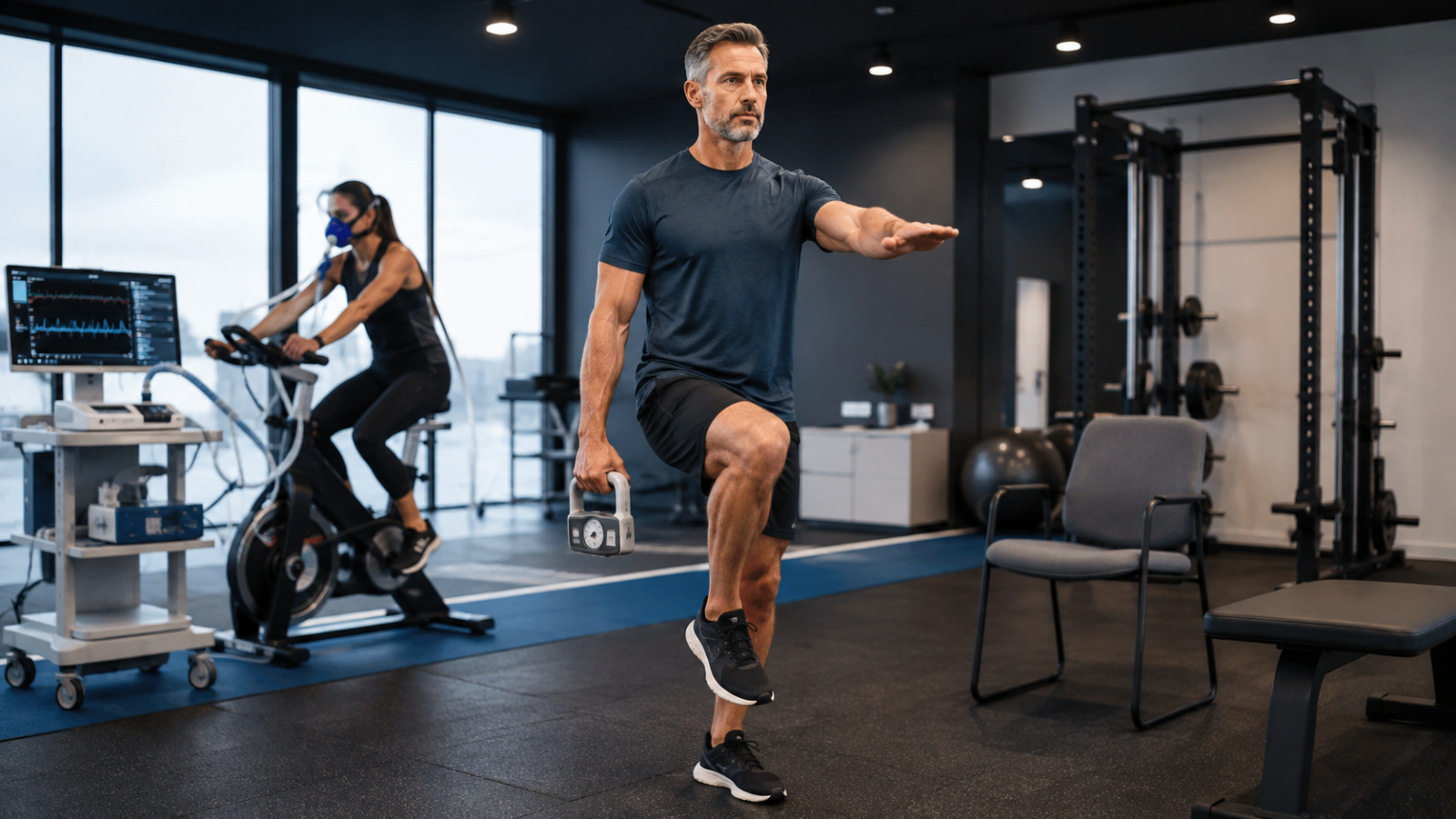
A biological age score can be fascinating.
You enter your data, connect a wearable, complete a blood test, or submit a biological sample. Then an algorithm tells you that although you are 47 years old, your body is supposedly 42.6.
That number feels precise.
But precision does not automatically make it useful.
If you want to know how well your body is aging, some of the most valuable information may come from much simpler questions:
How strong are you?
How efficiently can your heart and lungs support exercise?
Can you repeatedly get out of a chair without struggling?
Can you balance on one leg?
These sound almost too basic compared with epigenetic testing, artificial intelligence, wearables, and sophisticated longevity dashboards.
But physical function is not trivial.
It reflects the combined performance of your muscles, nervous system, cardiovascular system, metabolism, joints, coordination, and overall conditioning.
Research has repeatedly linked measures such as muscular strength, cardiorespiratory fitness, lower-body function, and balance with health outcomes and mortality risk.
That does not mean a 10-second balance test can predict exactly how long you will live.
It means your physical capacity provides a different and highly practical window into how your body is functioning today.
Here are four tests worth paying attention to.
First, What Does “Biological Age” Actually Mean?
Your chronological age is simple.
It is the number of years since you were born.
Biological age attempts to answer a much harder question:
How old does your body appear to be based on measurable biological characteristics?
Different biological-age systems may use completely different information, including:
- DNA methylation
- blood biomarkers
- resting heart rate
- heart rate variability
- sleep
- body composition
- activity levels
- metabolic markers
- inflammation
- wearable data
This is why two biological-age platforms can potentially give the same person different answers.
Epigenetic clocks, which estimate aging through patterns of DNA methylation, have become particularly interesting to researchers. Studies have linked accelerated epigenetic aging with numerous health-related characteristics and outcomes. However, researchers have developed dozens of different clocks, and aging itself remains a multidimensional process that cannot be reduced perfectly to one number.
Biological-age technology can provide useful information.
The mistake is treating the resulting number like a medical verdict.
A better question is:
What can I measure that helps me make better decisions about my health?
That is where physical performance becomes interesting.
Test 1: Grip Strength
Grip strength sounds like a forearm test.
It is much more than that.
Handgrip strength is often used as a simple indicator of overall muscular strength and physical function.
The most accurate way to test it is with a handgrip dynamometer. You squeeze the device as hard as possible while it records force, usually in kilograms.
Why should someone interested in longevity care about how hard they can squeeze something?
Because grip strength appears to capture information about broader physical health.
In the large Prospective Urban Rural Epidemiology, or PURE, study involving nearly 140,000 adults, lower grip strength was associated with higher all-cause mortality, cardiovascular mortality, and cardiovascular disease risk.
For every 5-kilogram reduction in grip strength, the researchers observed a 16% higher risk of all-cause mortality after adjustment for other factors.
That does not mean weak grip strength directly causes early death.
Grip strength may instead act as a practical marker of muscle health, neurological function, activity level, nutritional status, chronic disease burden, or several factors working together.
Why Muscle Strength Matters More With Age
Starting somewhere around midlife, maintaining muscle becomes increasingly important.
Muscle supports:
- glucose disposal
- insulin sensitivity
- joint stability
- bone loading
- metabolic health
- physical independence
- injury resilience
- movement
- recovery
The problem is that many adults monitor body weight far more closely than strength.
Someone might weigh exactly the same at 48 as they did at 38 while carrying less muscle and more fat.
The bathroom scale congratulates them.
Their physiology may have a different opinion.
That is why strength deserves to be tracked directly.
How to Test Grip Strength
For better consistency:
- Use the same dynamometer each time.
- Test under similar conditions.
- Perform multiple attempts with each hand.
- Record your best result.
- Compare your results over time rather than obsessing over one measurement.
Grip-strength norms vary significantly based on age, sex, body size, population, testing technique, and geography, so there is no single perfect number that applies to everyone.
The trend matters.
If your grip strength is gradually improving while you are getting older, that is generally a much more useful signal than watching an app declare that your biological age changed from 44.2 to 43.8.
How to Improve It
You do not need to spend your workouts crushing hand grippers.
Improving whole-body strength should be the priority.
Build a resistance-training program around movements such as:
- rows
- pulldowns
- presses
- squats
- split squats
- deadlift variations
- loaded carries
Farmer carries can be particularly useful because they combine grip strength, posture, trunk stability, gait, and work capacity.
Test 2: Cardiorespiratory Fitness
If there were a ranking of physical measurements worth caring about for long-term health, cardiorespiratory fitness would belong near the top.
Cardiorespiratory fitness describes how effectively your heart, lungs, circulation, and muscles work together during sustained physical activity.
One of the best-known measurements is VO2 max, or maximal oxygen consumption.
VO2 max measures the maximum amount of oxygen your body can use during intense exercise, typically expressed as milliliters of oxygen per kilogram of body weight per minute.
A laboratory test with respiratory gas analysis provides the most direct assessment.
Wearables can also estimate VO2 max, although estimates are not equivalent to direct laboratory testing.
Why Cardiorespiratory Fitness Matters
In 2016, the American Heart Association published a scientific statement arguing that cardiorespiratory fitness should be considered a clinical vital sign.
The statement noted that lower cardiorespiratory fitness is strongly associated with cardiovascular disease and all-cause mortality and that fitness can provide risk information beyond traditional cardiovascular risk factors.
A separate study of more than 122,000 adults undergoing treadmill testing found a strong inverse relationship between fitness and long-term mortality. People with the highest fitness levels had substantially lower mortality risk than people in the lowest fitness category.
Again, this does not prove that a specific VO2 max guarantees a specific lifespan.
It does tell us that aerobic capacity is meaningful.
What VO2 Max Actually Represents
A strong cardiovascular system needs to:
- Move air into the lungs.
- Transfer oxygen into the blood.
- Pump that blood efficiently.
- Deliver oxygen to working muscle.
- Allow the muscle to use that oxygen to produce energy.
Your VO2 max reflects this entire chain.
That is part of the reason cardiorespiratory fitness is such an interesting health marker.
It is not measuring one organ.
It is measuring a system.
How to Test Cardiorespiratory Fitness
The most accurate option is a supervised cardiopulmonary exercise test or laboratory VO2 max assessment.
Depending on your health status and goals, other options may include:
- graded treadmill testing
- cycling tests
- validated submaximal fitness tests
- walking tests
- running tests
- wearable-based estimates
Your starting fitness level matters more than chasing an elite athlete’s number.
The goal is to establish a baseline and improve from there.
How to Improve It
A balanced cardiovascular program might include both lower-intensity aerobic work and carefully programmed higher-intensity training.
For example:
Zone 2-style aerobic work: conversational but sustained exercise performed regularly.
Higher-intensity intervals: shorter periods of harder work separated by recovery.
Walking is a useful starting point, but eventually the cardiovascular system needs enough stimulus to adapt.
Depending on your current fitness, that could mean:
- incline walking
- cycling
- rowing
- swimming
- running
- elliptical training
- hiking
The right approach depends on your joints, health history, training experience, and baseline cardiovascular fitness.
Test 3: Five Sit-to-Stand Repetitions
This test looks almost laughably simple.
Sit in a chair.
Stand up.
Sit back down.
Repeat five times as quickly and safely as possible.
Then try it after another 20 years of aging.
Suddenly it becomes more interesting.
The Five Times Sit-to-Stand Test is commonly used to evaluate lower-body function.
It requires your hips and legs to generate enough strength and power to move your body repeatedly against gravity while maintaining balance and coordination.
That makes it a surprisingly information-rich test.
Why Getting Out of a Chair Matters
Lower-body strength affects far more than gym performance.
You need it to:
- climb stairs
- get off the floor
- stand from a chair
- hike
- carry groceries
- recover from a stumble
- maintain walking speed
- preserve independence
Studies in older adults have associated worse sit-to-stand performance with future disability, falls, hospitalization, and other adverse outcomes. A systematic review of objective physical capability measures also found associations between chair-rise performance and all-cause mortality in older populations.
For someone in their 40s or 50s, however, the goal should not be to wait until getting out of a chair becomes difficult.
You want to build a large reserve of strength before you need it.
How to Perform the Test
Use a stable chair placed against a wall.
Sit with your feet comfortably positioned.
If appropriate for your ability, cross your arms over your chest rather than pushing off the chair.
Then:
- Start seated.
- Stand completely.
- Sit back down.
- Repeat until you have completed five stands.
- Record the total time.
Use the same chair and testing method when repeating the assessment.
Do not turn this into a competition with internet strangers using different chair heights, techniques, and questionable definitions of a completed repetition.
Track yourself against yourself.
What the Test Reveals
Sit-to-stand performance involves:
- quadriceps strength
- hip strength
- lower-body power
- trunk control
- coordination
- balance
- mobility
Power is especially important.
Strength describes how much force you can produce.
Power describes how quickly you can produce it.
We tend to lose explosive physical capacity with aging, which is one reason maintaining lower-body strength and power should become a priority well before old age.
How to Improve It
Resistance training is the foundation.
Consider exercises such as:
- squats
- goblet squats
- split squats
- step-ups
- Romanian deadlifts
- leg presses
- lunges
- appropriate jumping or power exercises
Not everyone needs to perform high-impact plyometrics.
But everyone capable of resistance training should have some strategy for preserving the ability to produce force efficiently.
Test 4: The 10-Second Single-Leg Balance Test
Stand next to something stable.
Lift one foot.
Can you remain balanced for 10 seconds?
This test measures something most healthy younger adults barely think about until they start losing it.
Balance.
Good balance requires continuous communication between several systems, including:
- vision
- the vestibular system of the inner ear
- sensory feedback from muscles and joints
- the brain
- the nervous system
- muscle strength
- coordination
Your body is constantly making tiny corrections to keep you upright.
Aging can gradually weaken this system.
Balance and Aging
In a study of 1,702 adults between ages 51 and 75, researchers examined whether participants could successfully complete a 10-second one-legged stance.
After adjustment for age, sex, body mass index, and several health conditions, inability to complete the test was associated with a higher risk of all-cause mortality during follow-up.
The researchers emphasized that the findings were observational, meaning the test should not be interpreted as proof that poor balance itself causes mortality.
Still, it is an interesting example of how a simple physical task can reveal useful information about overall function.
How to Perform It Safely
Stand next to a sturdy countertop, railing, or wall so you can immediately catch yourself.
Keep your eyes open.
Lift one foot and attempt to maintain your position for 10 seconds.
Test both sides.
Do not perform challenging balance testing near stairs, hard furniture, or other hazards.
And do not close your eyes to make the test dramatically harder unless you are being assessed or appropriately supervised.
There is no longevity prize for falling into your coffee table.
How to Improve Balance
Balance is trainable.
Useful approaches include:
- single-leg standing
- split-stance exercises
- single-leg strength training
- step-ups
- lunges
- controlled single-leg Romanian deadlifts
- walking on varied terrain
- appropriate balance drills
Strength training helps too.
Balance is not just neurological. You also need enough muscular strength to make rapid corrections when your center of mass shifts.
Why These Tests May Be More Useful Than Your Biological Age Score
Biological-age testing and physical-performance testing are not competitors.
They measure different things.
But physical tests have one major advantage:
They lead directly to action.
If your grip strength is declining, build strength.
If your aerobic capacity is poor, improve cardiovascular fitness.
If getting out of a chair repeatedly is harder than it should be, train your lower body.
If your balance is deteriorating, work on balance, strength, coordination, and mobility.
Compare that with being told your biological age is 3.7 years older than your chronological age.
Interesting.
Now what?
Without additional context, the number does not automatically tell you what needs to change.
Physical performance can.
The Bigger Picture: Aging Is Multidimensional
None of these tests should be used alone to judge your health.
Someone can have excellent grip strength and still have severe hypertension.
Someone can have an impressive VO2 max while dealing with elevated ApoB, sleep apnea, or poor glucose regulation.
Someone can perform a perfect single-leg balance test while ignoring concerning symptoms.
Physical testing should complement, not replace, appropriate medical evaluation.
A more complete picture of healthy aging may include:
- blood pressure
- body composition
- waist circumference
- glucose regulation
- lipid markers
- cardiovascular fitness
- muscle mass
- strength
- sleep quality
- hormone health when clinically appropriate
- nutrition
- recovery
- mental health
- physical activity
- medical and family history
That is far less exciting than receiving one shiny “biological age” number.
Unfortunately, human physiology did not organize itself around what looks best inside an app.
Track Capacity, Not Just Age
Most people track outcomes that are easy to measure.
Weight.
Calories.
Steps.
Sleep scores.
Heart rate.
Those can all be useful.
But if your goal is to remain strong, capable, active, and independent for decades, start measuring physical capacity too.
You could create a simple personal dashboard:
| Measurement | Baseline | 3 Months | 6 Months | 12 Months |
|---|---|---|---|---|
| Grip strength | ||||
| Cardiorespiratory fitness | ||||
| Five sit-to-stand time | ||||
| Single-leg balance |
You are looking for trends.
Not perfection.
Not comparison with a genetically gifted 24-year-old fitness influencer.
The question is whether your physical capacity is improving, holding steady, or declining.
Your Goal Is Not to Become Younger
This is where longevity conversations can go sideways.
Aging is not a disease you can completely eliminate.
A 55-year-old does not need to become biologically 27.
The better goal is to become an exceptionally capable 55-year-old.
Then an exceptionally capable 65-year-old.
Then 75.
That means preserving the physical abilities that allow you to keep participating in your own life.
Can you carry something heavy?
Can you walk quickly?
Can you climb stairs without becoming exhausted?
Can you get off the floor?
Can you recover when you lose your balance?
Can you hike on vacation?
Can you maintain muscle while losing fat?
Can your cardiovascular system handle demanding activity?
Those questions may tell you something meaningful that an age score cannot.
The Bottom Line
Biological-age technology is interesting, and research into epigenetic and phenotypic aging clocks continues to evolve.
But do not let sophisticated technology distract you from simple measurements of physical function.
Four tests are worth tracking:
- Grip strength for muscular strength and overall physical capacity.
- Cardiorespiratory fitness for the ability of your cardiovascular and respiratory systems to support sustained exercise.
- Five sit-to-stand repetitions for lower-body strength, power, and functional movement.
- Single-leg balance for balance, coordination, and neuromuscular function.
The purpose is not to predict the exact date you will die.
It is to identify capacities you can improve now.
At 1st Optimal, we believe healthy aging should involve more than chasing one number. Blood work, body composition, metabolic health, hormone health, nutrition, recovery, cardiovascular fitness, and physical performance all provide different pieces of the picture.
The goal is not simply to live longer.
It is to maintain enough strength, energy, cardiovascular capacity, and physical independence to use those years well.
Educational only, not medical advice. People with cardiovascular disease, balance problems, joint limitations, neurological conditions, recent surgery, or other medical concerns should discuss appropriate physical testing and exercise with a qualified healthcare professional.