
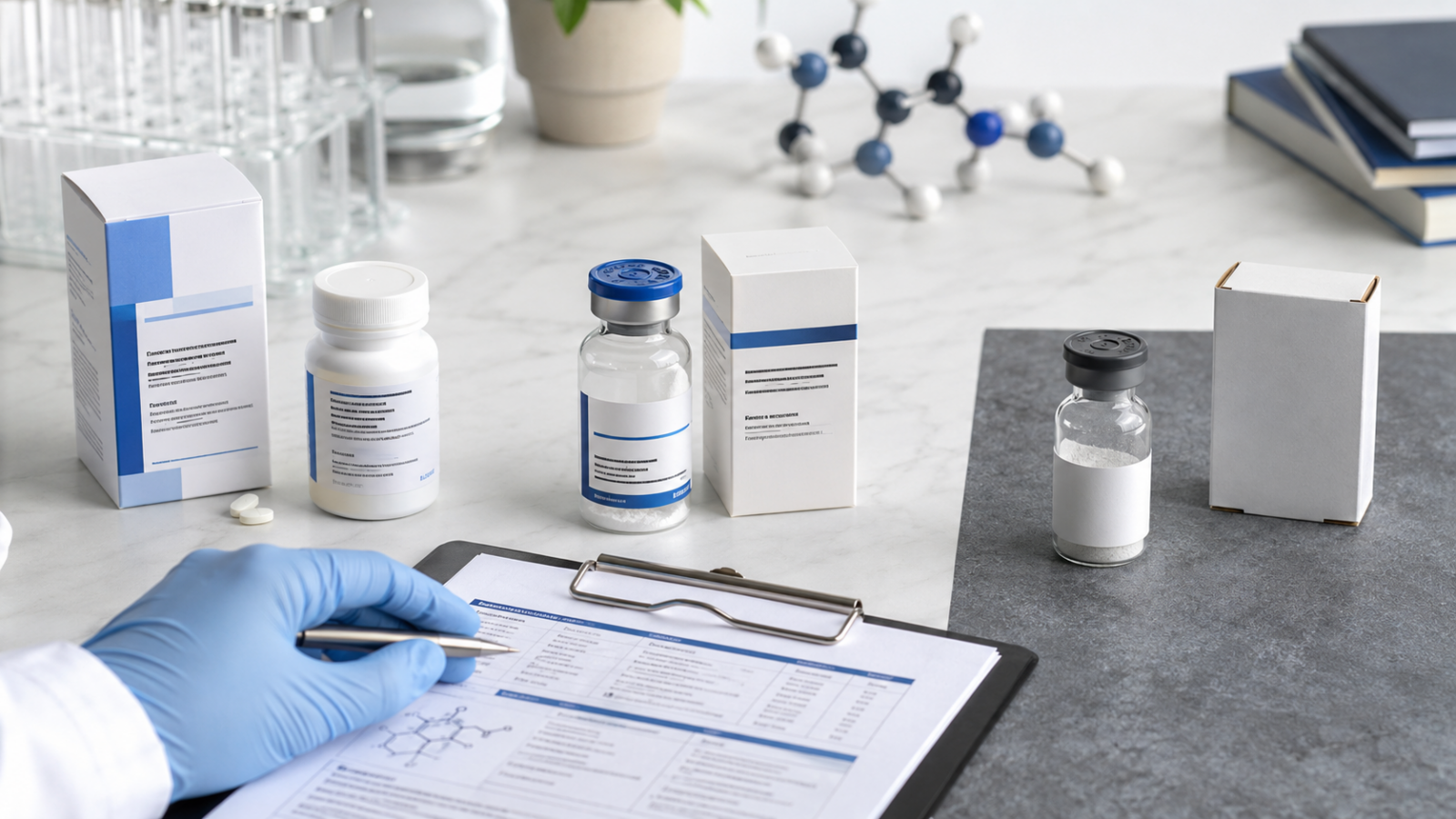
What Are Peptides?
Peptides are short chains of amino acids, the same basic building blocks that form proteins. Your body naturally produces thousands of peptides that help regulate processes such as appetite, blood sugar, immune signaling, tissue repair, hormone release, digestion, and reproduction.
Some peptides act like messengers. They bind to specific receptors and tell cells to perform a particular action. Because these signals can be highly targeted, scientists have developed peptide-based medications for conditions ranging from diabetes and obesity to osteoporosis and hormone-related disorders.
But the word “peptide” does not tell you whether a product is safe, effective, legally marketed, or appropriate for human use.
An FDA-approved peptide medication, a compounded peptide prescription, and a vial sold online as “research use only” may all contain molecules described as peptides. They do not have the same evidence, manufacturing controls, regulatory status, or level of medical oversight.
That distinction matters, especially as peptide products become more widely promoted for weight loss, muscle growth, recovery, sleep, skin health, immune support, and longevity.
This article explains what peptides are, how peptide drugs work, and the important differences between FDA-approved drugs, compounded peptide medications, and research peptides.
How Do Peptides Work in the Body?
A peptide is generally smaller than a protein, although the boundary between the two is not always rigid. Peptides consist of amino acids connected by chemical bonds called peptide bonds.
Their biological effects depend on several factors:
- The amino acids included in the chain
- The order of those amino acids
- The peptide’s three-dimensional structure
- Which receptors it can activate or block
- How quickly the body breaks it down
- The dose and route of administration
- How the product was manufactured and stored
Some peptides replace or imitate naturally occurring hormones. Others stimulate or suppress a biological pathway. A peptide may influence insulin release, appetite signaling, bone formation, reproductive hormones, inflammation, or other cellular functions.
Peptide drugs can be difficult to manufacture consistently. Small changes in the production process may affect stability, purity, potency, aggregation, or the risk of an immune response. FDA guidance for peptide drug development specifically addresses issues such as drug interactions, organ impairment, heart-rhythm effects, pharmacokinetics, and immunogenicity.
This is why the name of the molecule is only part of the story. The finished medication, manufacturing process, formulation, testing, storage conditions, dosing system, and clinical evidence also matter.
Why Peptide Therapy Has Become So Popular
Peptide therapies have gained attention because they can interact with specific biological targets. In theory, a more targeted mechanism may produce a desired effect without influencing as many unrelated pathways.
Some peptide medications have already transformed medical care.
Examples of FDA-approved peptide or peptide-based medications include:
- Insulin products used to manage diabetes
- Glucagon-like peptide-1 receptor agonists such as liraglutide and semaglutide
- Tirzepatide, which activates glucose-dependent insulinotropic polypeptide and GLP-1 receptors
- Teriparatide and related medications used in certain patients with osteoporosis
- Leuprolide products used for several hormone-sensitive conditions
The FDA approved the first biosynthetic human insulin product in 1982. More recently, peptide-based metabolic medications have expanded treatment options for type 2 diabetes and chronic weight management.
These legitimate medical advances have also fueled interest in experimental peptides. Unfortunately, marketing frequently moves faster than clinical evidence. Molecules studied in animals, laboratory experiments, or early human trials may be promoted online as though their benefits were already established.
A promising mechanism is not the same as a proven treatment.
The Three Main Categories of Peptide Products
Patients commonly encounter three broad categories:
- FDA-approved peptide drugs
- Compounded peptide medications
- Research peptides or unapproved peptide products
The categories are not interchangeable.
1. FDA-Approved Peptide Drugs
An FDA-approved peptide drug has gone through a formal regulatory review for a specific product and intended use.
Before approving a new drug, the FDA reviews information that may include:
- Laboratory and animal research
- Human clinical trial results
- Safety and effectiveness data
- Appropriate dosing
- Drug interactions
- Known contraindications
- Adverse effects
- Manufacturing methods
- Product stability
- Purity and potency controls
- Packaging and prescribing information
A New Drug Application includes animal and human data, information about how the medication behaves in the body, and details about how it is manufactured. FDA reviewers also evaluate whether manufacturing controls can reliably preserve the drug’s identity, strength, quality, and purity.
FDA Approval Is Product-Specific
FDA approval applies to a particular finished drug product, formulation, manufacturer, route of administration, and labeling.
It does not automatically apply to every product containing a similarly named molecule.
For example, an FDA-approved prefilled injection pen and a multidose vial sold by an unrelated company are not necessarily equivalent. Differences in concentration, ingredients, manufacturing, testing, delivery device, storage, and dosing instructions can affect the patient experience and risk profile.
The FDA-approved label provides information about:
- Approved indications
- Recommended dosing
- Titration schedules
- Contraindications
- Warnings
- Side effects
- Use in specific populations
- Administration instructions
FDA approval also does not mean a medication is risk-free. It means the agency has determined that the expected benefits outweigh the known and potential risks when the medication is used according to its approved labeling.
What About Off-Label Peptide Treatment?
A licensed healthcare professional may sometimes prescribe an FDA-approved medication for an unapproved use when they determine that it is medically appropriate.
This is called off-label prescribing.
The medication itself remains an FDA-approved product, but the FDA has not specifically determined that it is safe and effective for that particular off-label condition, dose, population, or method of administration.
Off-label prescribing should not be confused with purchasing an entirely unapproved peptide from an online research vendor.
2. Compounded Peptide Medications
Drug compounding involves combining, mixing, or altering ingredients to prepare a medication for a patient’s specific medical needs.
Compounding can serve an important purpose. A patient may need:
- A dosage that is not commercially available
- A liquid instead of a tablet
- A medication without a particular dye or inactive ingredient
- A different delivery method
- Access during a qualifying drug shortage
- A formulation that meets a documented individual medical need
However, compounded drugs are not FDA-approved.
The FDA does not evaluate and approve each compounded product for safety, effectiveness, quality, or therapeutic equivalence before it reaches patients. A compounded medication is also not the same thing as an FDA-approved generic drug.
What Is the Difference Between 503A and 503B?
Federal law establishes two major pathways for human drug compounding.
Section 503A Pharmacies
A Section 503A compounder is generally a state-licensed pharmacy, federal facility, or licensed physician operating under the conditions of Section 503A of the Federal Food, Drug, and Cosmetic Act.
Compounding under Section 503A usually requires a valid prescription for an identified individual patient.
State boards of pharmacy typically provide much of the routine oversight of these pharmacies. Products properly compounded under Section 503A may qualify for exemptions from certain federal requirements, including premarket drug approval and current good manufacturing practice requirements.
Section 503B Outsourcing Facilities
A Section 503B outsourcing facility registers with the FDA and compounds drugs under the supervision of a licensed pharmacist.
Unlike a traditional 503A pharmacy, a 503B facility may compound certain medications without first receiving a patient-specific prescription. Section 503B outsourcing facilities must comply with current good manufacturing practice requirements and are subject to FDA inspection under a risk-based schedule.
Registration as an outsourcing facility does not make each compounded product FDA-approved. It describes the regulatory pathway and requirements under which the facility operates.
When Can Compounded Peptides Be Appropriate?
A compounded peptide may be considered when a licensed clinician determines that an FDA-approved medication cannot meet a patient’s documented medical needs.
The decision should include a careful review of:
- Whether an FDA-approved alternative exists
- Why the approved product is not appropriate
- The evidence supporting the proposed treatment
- The compounder’s licensing and registration status
- The source and quality of the active pharmaceutical ingredient
- Sterility and potency testing
- Storage requirements
- Dosing instructions
- Appropriate follow-up and monitoring
Compounding should not be used merely to create routine copies of an available FDA-approved medication at a lower price. Federal law restricts the regular compounding of products that are essentially copies of commercially available or approved drugs, subject to specific exceptions and shortage-related policies.
Risks Associated With Compounded Peptides
Compounded medications can carry risks related to:
- Contamination
- Incorrect concentration
- Too much or too little active ingredient
- Degradation during storage
- Peptide aggregation
- Peptide-related impurities
- Dosing mistakes
- Inconsistent labeling
- Inadequate sterility controls
- Limited adverse-event reporting
These concerns can be especially important for injectable products because injections bypass several of the body’s normal defenses against contaminants and microorganisms.
The FDA has reported serious dosing errors involving compounded injectable semaglutide, including errors caused by unclear concentrations, measurement mistakes, and miscalculated doses. The agency has also warned that semaglutide sodium and semaglutide acetate are different active ingredients from the semaglutide used in FDA-approved products.
This does not mean every compounded medication is poor quality. It means patients and clinicians must evaluate the pharmacy, formulation, evidence, and medical need rather than assuming that every product with the same ingredient name is equivalent.
3. Research Peptides
A research peptide is generally a substance sold or distributed for laboratory investigation rather than as an approved medication for human use.
These products may be labeled:
- Research use only
- Not for human consumption
- Laboratory reagent
- For analytical testing only
- Not intended to diagnose or treat disease
The label does not transform the product into an approved medication.
Some websites market research peptides beside bacteriostatic water, syringes, dosing discussions, body-composition claims, recovery claims, or descriptions of human benefits. That creates an obvious contradiction: the company claims the product is only for laboratory research while presenting it in a way that encourages personal use.
In March 2026, the FDA issued a warning letter to an online peptide seller offering retatrutide and tirzepatide products. The agency stated that “research use only” disclaimers did not override website evidence showing that the products were intended to affect the human body or treat health conditions.
Why Research Peptides Carry Greater Uncertainty
A research peptide purchased online may not have undergone reliable verification of:
- Identity
- Purity
- Potency
- Sterility
- Endotoxin levels
- Stability
- Storage conditions
- Contaminants
- Peptide-related impurities
- Appropriate human dosing
- Short-term safety
- Long-term safety
- Drug interactions
A certificate of analysis can provide useful information, but it does not by itself establish that a product is safe, sterile, clinically effective, or appropriate for self-injection.
The document may also come from the seller rather than an independent laboratory. Even accurate testing of a sample does not guarantee that every vial in every production batch has the same identity, concentration, or sterility.
FDA Concerns About Specific Peptides
The FDA maintains a list of certain bulk drug substances that may present significant safety risks when used in compounding.
As of April 22, 2026, the agency’s list included substances such as:
- AOD-9604
- BPC-157
- CJC-1295
- Epitalon
- Injectable GHK-Cu
- Ipamorelin acetate
- KPV
- Melanotan II
- MOTS-c
- Selank
- Semax
- Thymosin alpha-1
- TB-500
FDA concerns vary by substance but include limited human data, possible immune reactions, aggregation, peptide-related impurities, active-ingredient characterization problems, and reported serious adverse events.
Placement on this list does not necessarily prove that every possible use will cause harm. It means the FDA has identified significant concerns or does not have enough reliable information to determine whether the substance can be used safely through the proposed route.
Lack of evidence of harm is not evidence of safety.
FDA-Approved vs. Compounded vs. Research Peptides
| Category | FDA-approved peptide drug | Compounded peptide medication | Research peptide |
|---|---|---|---|
| FDA-approved finished product | Yes | No | No |
| Reviewed for safety and effectiveness | Yes, for approved uses | Not individually reviewed by FDA | Usually no established FDA review |
| Standardized manufacturing | Product-specific FDA requirements | Depends on compounding pathway and facility | Often unclear |
| Patient prescription | Usually required | Generally required under 503A; rules differ for 503B | Often sold without a legitimate prescription |
| Approved prescribing label | Yes | No FDA-approved label for the compounded product | No |
| Intended for human treatment | Yes | Yes, when lawfully prescribed and compounded | Officially presented as laboratory use, despite frequent consumer marketing |
| Evidence level | Clinical trials and regulatory review | Depends on ingredient and intended use | Often laboratory, animal, early-stage, or incomplete evidence |
| Best source | Licensed pharmacy dispensing an approved product | Qualified state-licensed pharmacy or registered outsourcing facility | Not appropriate for self-directed human use |
How to Evaluate a Peptide Treatment
Before starting any peptide-based treatment, ask the following questions.
1. Is the Exact Product FDA-Approved?
Do not ask only whether the molecule has ever been approved.
Ask whether the exact:
- Brand or generic product
- Manufacturer
- Formulation
- Strength
- Route
- Delivery device
appears in the FDA’s drug database.
Drugs@FDA includes most prescription and over-the-counter drug products approved since 1939. A National Drug Code number alone does not prove that a product is FDA-approved.
2. Is This an Approved or Off-Label Use?
Ask what condition the medication is being used to treat and whether that indication appears in the approved prescribing information.
An off-label use may still be medically reasonable, but it deserves a clear explanation of the supporting evidence, expected benefits, alternatives, and uncertainties.
3. Why Is Compounding Necessary?
When a compounded product is proposed, the clinician should be able to explain why an FDA-approved medication cannot meet the patient’s needs.
“Customized,” “optimized,” and “pharmaceutical grade” are marketing phrases, not medical justifications.
4. Who Is Making the Product?
Confirm the full name and location of the pharmacy.
For a 503A pharmacy, confirm active state licensure. For a 503B facility, confirm that it is currently registered with the FDA as an outsourcing facility.
Registration does not guarantee that the facility has never received an inspection finding or warning letter, so its inspection and compliance history also matters.
5. What Testing Is Performed?
Appropriate testing may include:
- Identity
- Potency
- Purity
- Sterility
- Endotoxins
- Stability
- Particulate matter
The necessary testing depends on the formulation and route of administration.
6. What Human Evidence Supports the Use?
Ask whether the recommendation is supported by:
- Randomized controlled trials
- Peer-reviewed human studies
- Observational evidence
- Case reports
- Animal studies
- Laboratory research
- Anecdotal reports
A mechanism or animal study may justify further research. It does not automatically justify routine treatment.
7. What Monitoring Is Required?
Monitoring should match the treatment’s mechanism and known risks.
Depending on the peptide and patient, follow-up may include symptoms, blood pressure, heart rate, glucose, blood counts, kidney or liver markers, hormone levels, body composition, adverse effects, or other targeted testing.
8. What Happens If Something Goes Wrong?
Patients should know:
- Who to contact
- When to stop treatment
- Which symptoms require urgent evaluation
- How adverse events will be documented
- Whether the product should be reported to the pharmacy or FDA
A treatment plan without an adverse-event plan is not much of a plan. It is optimism wearing a lab coat.
Red Flags When Buying or Considering Peptides
Use caution when a company or seller:
- Does not require a medical evaluation
- Sells injectable products without a prescription
- Hides the pharmacy or manufacturer
- Uses only messaging apps or cryptocurrency
- Claims that a compounded product is an FDA-approved generic
- Guarantees weight loss, healing, muscle gain, or anti-aging effects
- Promotes one peptide for numerous unrelated conditions
- Provides dosing advice while labeling the product “research use only”
- Encourages customers to mix or inject products themselves
- Relies primarily on testimonials
- Cannot provide clear storage instructions
- Makes sterility claims without meaningful documentation
- Dismisses all FDA concerns as political or irrelevant
Legitimate healthcare does not require patients to become amateur pharmacists.
Are All Compounded or Unapproved Peptides Dangerous?
No responsible analysis should claim that every compounded product causes harm or that every investigational peptide lacks future medical value.
Compounded medications can meet legitimate patient needs. Experimental peptides may eventually become useful therapies. Many important medications began as investigational compounds.
The problem is not that a molecule is new.
The problem is presenting uncertainty as certainty.
A peptide may have an interesting mechanism, promising animal findings, or encouraging early human data. Those findings should lead to controlled research, careful manufacturing, dose-finding studies, and safety monitoring.
They should not be converted directly into confident social media claims and self-injection protocols.
The Bottom Line
Peptides are a broad class of biological molecules, not a single type of treatment.
FDA-approved peptide drugs have product-specific evidence, manufacturing requirements, prescribing information, and regulatory oversight.
Compounded peptide medications may serve an important medical need, but they are not FDA-approved and should not automatically be treated as equivalent to approved products.
Research peptides carry the greatest uncertainty. Products sold online for “research use only” should not be assumed to be safe, sterile, accurately dosed, or appropriate for human use.
Before considering peptide therapy, verify the exact product, indication, prescriber, pharmacy, supporting human evidence, dosing plan, and monitoring strategy.
The goal is not to find the most advanced-sounding molecule.
The goal is to choose a treatment with a defensible reason, reliable sourcing, appropriate oversight, and a benefit that justifies its risks.
Frequently Asked Questions
Are Peptides Steroids?
No. Peptides are chains of amino acids. Steroid hormones are derived from cholesterol and have a different chemical structure.
Both can influence signaling pathways, but they are not the same class of molecule.
Are Peptides the Same as Proteins?
Peptides and proteins are both made from amino acids. Peptides are generally shorter, while proteins are larger and often have more complex three-dimensional structures.
The precise boundary can vary depending on the scientific context.
Are Peptide Supplements FDA-Approved?
Dietary supplements generally do not undergo the same premarket approval process as prescription drugs.
A supplement label using the word “peptide” does not mean the product is approved to treat a disease or produces the same effects as an injectable peptide medication.
Are Compounded Peptides FDA-Approved?
No. Compounded medications are not FDA-approved finished drug products. FDA does not review each compounded product for safety, effectiveness, or quality before it is marketed.
Are Compounded Peptides Generic Drugs?
No. FDA-approved generic drugs must meet specific regulatory requirements, including demonstrating equivalence to a reference product. Compounded medications do not go through the same approval pathway.
Is BPC-157 FDA-Approved?
BPC-157 is not an FDA-approved drug. The FDA has identified concerns involving limited safety information, possible immunogenicity, peptide-related impurities, and difficulties characterizing the active pharmaceutical ingredient when used in compounded products.
Does “Research Use Only” Mean a Peptide Is Safe?
No. That label generally indicates that the product is not intended or approved for human treatment.
It does not establish identity, sterility, purity, effectiveness, or safe human dosing.
How Can I Check Whether a Peptide Drug Is FDA-Approved?
Search the medication by its brand name, active ingredient, and manufacturer in Drugs@FDA. Review the official prescribing information for the approved indication, strength, route, and dosage form.
Ask a pharmacist or qualified healthcare professional when the product’s status is unclear.
Next Step:
Considering peptide therapy?
1st Optimal evaluates your symptoms, health history, medications, goals, laboratory results, and available treatment evidence before recommending a plan. Our team focuses on appropriate sourcing, individualized care, and ongoing monitoring rather than chasing the latest peptide trend.
Apply for a functional medicine consultation to explore which evidence-based options may fit your health goals.
Educational only. This article does not provide medical advice, diagnose a condition, or recommend a specific medication. Peptide regulations, FDA lists, drug shortages, and product approvals can change. Consult a qualified healthcare professional and verify current FDA information before using any prescription or compounded medication.
