

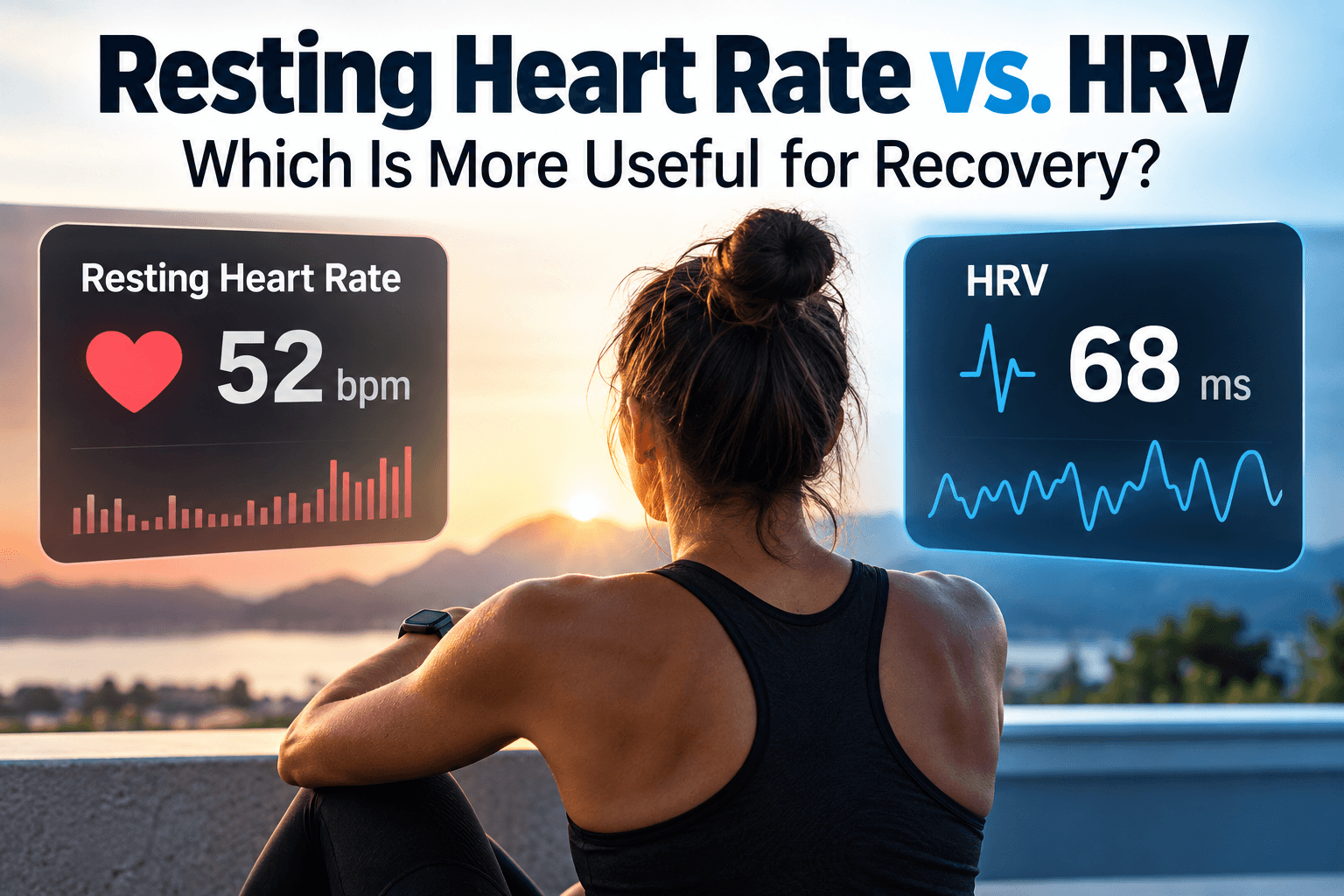
If you wear an Apple Watch, Garmin, Oura Ring, WHOOP, or another fitness tracker, you may wake up every morning to a collection of numbers telling you how “recovered” you are.
Two of the most common are resting heart rate (RHR) and heart rate variability (HRV).
Both can provide useful information about how your body is responding to training, sleep, stress, illness, alcohol, travel, and everyday life.
But they measure different things.
So when it comes to resting heart rate vs. HRV for recovery, which one should you actually pay attention to?
The short answer:
HRV may provide a more sensitive window into autonomic stress and recovery, while resting heart rate is simpler, easier to interpret, and still extremely useful. For most people, the best approach is to track both as trends rather than letting one morning’s number determine how you train.
Here is what those numbers actually mean and how to use them.
What Is Resting Heart Rate?
Your resting heart rate is simply the number of times your heart beats per minute while your body is at rest.
For most adults, a resting heart rate between 60 and 100 beats per minute (bpm) is considered within the typical range, although well-trained athletes frequently have lower resting heart rates.
Cardiovascular training can improve the efficiency of the heart. As fitness improves, the heart may be able to pump more blood with each contraction, meaning it does not have to beat as frequently while you are resting.
That is why lower resting heart rates are common in endurance athletes and highly active adults.
But fitness is only one factor influencing resting heart rate.
Your RHR can also change because of:
- Poor sleep
- Psychological stress
- Illness or infection
- Dehydration
- Alcohol
- Caffeine
- Heat
- Certain medications
- Changes in training load
- Hormonal or metabolic factors
This is why your personal baseline is usually more useful for recovery monitoring than comparing yourself with someone else’s resting heart rate.
What Is HRV?
Heart rate variability, or HRV, measures the variation in time between individual heartbeats.
Your heart does not beat like a perfectly timed metronome.
Imagine your heart rate is 60 beats per minute.
That does not necessarily mean there is exactly one second between every heartbeat. One interval might be 0.95 seconds, another 1.04 seconds, and another 0.98 seconds.
Those tiny differences are part of your heart rate variability.
HRV is measured in milliseconds and is influenced by your autonomic nervous system, particularly the balance of physiological processes involved in activation, stress, rest, and recovery.
In very simplified terms:
Sympathetic activity is associated with alertness, exercise, stress, and the classic “fight-or-flight” response.
Parasympathetic activity plays a major role in rest, digestion, recovery, and slowing the heart.
HRV can therefore provide information about how adaptable your autonomic nervous system is at a particular point in time.
Resting Heart Rate vs. HRV: What Is the Difference?
Although the two metrics are related, they tell you different things.
| Metric | Resting Heart Rate | HRV |
|---|---|---|
| Measures | Heartbeats per minute | Variation between heartbeats |
| Unit | Beats per minute (bpm) | Milliseconds (ms) |
| Often associated with | Cardiovascular demand and fitness | Autonomic regulation and adaptability |
| During poor recovery | May increase | Often decreases |
| Easy to measure | Yes | Requires more precise technology |
| Best comparison | Your normal RHR | Your normal HRV |
| Useful for recovery? | Yes | Yes, often more sensitive to autonomic changes |
There is another important difference.
Resting heart rate tends to be relatively intuitive.
If you normally wake up with an RHR of 56 bpm and suddenly see 67 bpm for several mornings while also feeling exhausted, something may be placing additional stress on your body.
HRV can change more dramatically from day to day and can be harder to interpret.
That does not make HRV less useful. It means context and trends matter even more.
Which Is Better for Measuring Recovery?
For detecting subtle changes in nervous-system stress, HRV may have an advantage.
Research suggests HRV can be useful for assessing training status, adaptability, and recovery, which is why HRV-guided training has gained attention in sports science.
For example, imagine your usual morning numbers look like this:
Resting heart rate: 55 bpm
HRV: 58 ms
After several nights of poor sleep, hard workouts, travel, and work stress, you might see:
Resting heart rate: 58 bpm
HRV: 39 ms
Your resting heart rate has changed slightly.
Your HRV has changed substantially.
That larger relative shift can sometimes make HRV more useful for spotting changes in autonomic recovery before they become obvious from resting heart rate alone.
But that does not mean HRV should automatically override every other recovery signal.
Why HRV Isn’t a Perfect Recovery Score
Wearable companies sometimes make recovery look extremely simple:
High HRV = recovered.
Low HRV = exhausted.
Human physiology is not that simple.
HRV is affected by many variables, including:
- Sleep
- Breathing patterns
- Stress
- Training
- Alcohol
- Illness
- Age
- Fitness
- Measurement position
- Time of day
- Medication
- Hydration
- Menstrual cycle and hormonal changes
- Measurement technology
Research has also highlighted important methodological limitations when using consumer wearables for HRV. Wrist devices commonly use photoplethysmography, or PPG, rather than clinical ECG recordings, and measurement accuracy can vary depending on device, movement, signal quality, and algorithm.
Consumer devices can still be extremely useful.
The key is to avoid treating the number as a medical diagnosis.
Higher HRV Is Not Always Better
This point is frequently missed.
You cannot look at two people and automatically say the person with an HRV of 80 is healthier or better recovered than someone with an HRV of 45.
HRV varies considerably between individuals and generally changes with age. Cleveland Clinic specifically notes that what is normal for one person may not be normal for another.
Your own baseline matters far more.
It is also possible for unusual autonomic patterns to occur during periods of heavy training or overreaching, meaning the simple rule of “higher HRV is always better” does not work in every situation.
Think of HRV as information rather than a score you are trying to maximize.
What About Resting Heart Rate?
Resting heart rate has one major advantage:
It is simple.
You do not need sophisticated algorithms to understand that your heart is beating faster than usual while you are lying in bed.
An elevated morning resting heart rate may occur when the body is dealing with additional physiological stress.
If your normal RHR is 52 bpm and you suddenly wake up at 64 bpm after several difficult training sessions, poor sleep, dehydration, or the beginning of an illness, that increase may be meaningful.
But just like HRV, one reading should not automatically dictate your entire day.
Research looking at heart-rate-based measures and overreaching has found that changes can be relatively small and may fall within normal day-to-day variation. Researchers therefore recommend interpreting heart rate measures alongside additional signs and symptoms rather than in isolation.
The Most Useful Signal Is Often the Combination
Instead of asking:
“Should I track HRV or resting heart rate?”
A better question may be:
“What happens when HRV, resting heart rate, sleep, symptoms, and performance all start telling me the same thing?”
Consider these scenarios.
Scenario 1: HRV Down, Resting Heart Rate Up
You wake up and notice:
- HRV significantly below baseline
- Resting heart rate above baseline
- Poor sleep
- Heavy legs
- Low motivation
- Higher perceived effort during training
That is a fairly strong collection of signals suggesting your body may be under more stress than usual.
You might consider lowering training intensity, focusing on recovery, or taking an easier day.
Scenario 2: HRV Down, Resting Heart Rate Normal
A lower-than-normal HRV by itself does not necessarily mean you need to cancel your workout.
Look at the bigger picture.
Did you sleep well?
Do you feel strong?
Is your resting heart rate normal?
Was yesterday stressful?
Did you drink alcohol?
Is your HRV actually outside your usual range, or is it simply normal daily variation?
Your answers matter.
Scenario 3: HRV Normal, But You Feel Terrible
Do not let your wearable overrule your body.
You might have:
- Significant muscle soreness
- Joint pain
- Poor sleep
- Mental fatigue
- Low motivation
- Declining performance
while your HRV still looks relatively normal.
HRV primarily reflects cardiac autonomic activity. It does not directly measure muscle damage or neuromuscular recovery.
One study following resistance-trained participants after exhaustive squatting found that HRV recovery did not closely match recovery of neuromuscular performance over the following 72 hours.
That is an important distinction for anyone using HRV to guide strength training.
Your nervous system can look “recovered” while your legs are still not ready to squat heavy.
How to Track HRV and Resting Heart Rate Correctly
If you want useful recovery data, consistency matters more than obsessing over the perfect number.
1. Measure Under Similar Conditions
Try to compare measurements taken at roughly the same time and under similar conditions.
For resting heart rate, the American Heart Association recommends checking it in the morning after sleep and before getting out of bed or having coffee.
For HRV, use the same wearable and measurement method whenever possible.
Switching devices or measurement conditions can make comparisons much less meaningful.
2. Establish Your Baseline
Do not judge recovery based on someone’s HRV screenshot on Instagram.
Track your own data long enough to understand your normal range.
The useful question is not:
“Is an HRV of 45 good?”
It is:
“Is 45 normal for me?”
3. Watch Trends, Not Single Days
HRV can fluctuate significantly.
One low morning may mean very little.
Patterns across several days are generally more informative than isolated measurements. Sports-science literature commonly examines rolling averages and individual baseline ranges rather than relying exclusively on single readings.
The same principle applies to resting heart rate.
4. Track How You Actually Feel
Your wearable should complement subjective feedback, not replace it.
Consider rating:
- Sleep quality
- Energy
- Muscle soreness
- Motivation
- Mood
- Stress
- Workout performance
A 30-second daily check-in can sometimes reveal recovery problems faster than any algorithm.
What Can Cause HRV to Drop?
A temporary decrease in HRV can occur after many different stressors.
Common examples include:
Hard Training
High-volume or high-intensity exercise can temporarily shift autonomic activity and suppress HRV during the recovery period. Research suggests exercise intensity is an important factor influencing post-exercise HRV recovery.
Poor Sleep
Insufficient or disrupted sleep can place additional stress on the body and alter autonomic regulation.
Psychological Stress
Your nervous system does not necessarily distinguish between stress coming from a difficult workout and stress coming from a difficult week at work.
Both contribute to your overall physiological load.
Alcohol
Alcohol can alter sleep quality and autonomic function, which may appear as lower HRV and higher overnight or resting heart rate.
Illness
Changes in HRV or resting heart rate can sometimes occur when your body is responding to illness.
That does not mean a wearable can diagnose an infection. It means unusual trends may give you another reason to pay attention to how you feel.
Inadequate Recovery
Several demanding workouts combined with inadequate calories, insufficient carbohydrate intake, poor sleep, dehydration, and psychological stress can create a very different recovery environment than the workout itself would suggest.
Recovery Is Bigger Than Your Wearable
This is where recovery tracking can become misleading.
Imagine you sleep eight hours and your wearable gives you an excellent recovery score.
But for the past two months you have also experienced:
- Persistent fatigue
- Declining strength
- Poor sleep quality
- Difficulty concentrating
- Low libido
- Unexpected weight changes
- Changes in menstrual cycles
- Reduced exercise tolerance
- Consistently elevated resting heart rate
That is no longer simply a question of whether you should take one rest day.
Persistent changes may deserve a broader look.
Depending on the person, clinicians may consider factors such as:
- Sleep disorders
- Iron status
- Thyroid function
- Nutritional intake
- Medication effects
- Cardiovascular health
- Metabolic health
- Hormonal changes
- Infection or inflammatory conditions
- Training volume and energy availability
Recovery is the result of multiple physiological systems working together.
A smartwatch cannot measure all of them.
So, Which Number Should You Prioritize?
If we had to simplify it:
Use resting heart rate for simplicity.
Use HRV for additional insight into autonomic stress and adaptation.
Use both when possible.
And place both inside the context of:
Sleep + stress + training performance + soreness + energy + symptoms.
That combination is much more powerful than obsessing over a single wearable metric.
A Simple Recovery Dashboard
You do not need dozens of biomarkers every morning.
Consider monitoring five things:
1. HRV trend
Is it within your normal range?
2. Resting heart rate trend
Is it noticeably higher than your baseline?
3. Sleep
Did you get enough high-quality sleep?
4. Subjective recovery
How energetic, motivated, and physically recovered do you feel?
5. Performance
Are normal training loads suddenly feeling much harder?
When several markers deteriorate together for multiple days, your body may be telling you something.
Listen to the pattern.
Not just the wearable.
Resting Heart Rate vs. HRV: The Bottom Line
HRV and resting heart rate are both useful recovery metrics, but they measure different aspects of physiology.
HRV may be more sensitive to changes in autonomic stress and recovery.
Resting heart rate is easier to measure, easier to interpret, and can still provide valuable information about cardiovascular and physiological stress.
Neither should be used alone.
The most useful information comes from comparing your numbers against your own baseline while also paying attention to sleep, training performance, stress, muscle soreness, energy, and how you actually feel.
Your wearable can give you data.
The goal is learning how to put that data into context.
Because recovery isn’t one number.
It is the way your entire system is responding.
Frequently Asked Questions
Is HRV better than resting heart rate for measuring recovery?
HRV can be more sensitive to changes in autonomic nervous system activity, making it useful for monitoring training stress and recovery. Resting heart rate is simpler and can also detect physiological stress. Using both together is usually more informative than choosing only one.
What is a good HRV?
There is no single ideal HRV for everyone. HRV varies significantly based on age, genetics, fitness, health, measurement method, and other factors. Your personal baseline and long-term trend are generally more useful than comparing your number with another person’s.
Does low HRV mean I should skip my workout?
Not necessarily. One low HRV measurement can occur for many reasons. Consider your resting heart rate, sleep, soreness, stress, energy, and recent training before changing your workout solely because of HRV.
Why is my HRV low but resting heart rate normal?
HRV can sometimes respond to stress before resting heart rate changes substantially. Sleep, psychological stress, alcohol, training load, and other factors may influence HRV. Look for trends over several days instead of interpreting a single measurement.
Can HRV tell if my muscles have recovered?
Not reliably. HRV primarily reflects cardiac autonomic regulation and does not directly measure muscle damage or neuromuscular recovery. Research following resistance exercise has shown that HRV recovery and muscular performance recovery do not always occur at the same rate.
What is a normal resting heart rate?
For most adults, a resting heart rate between 60 and 100 bpm is considered typical. Well-trained athletes may have considerably lower resting heart rates. Your personal baseline, symptoms, medications, and overall health should also be considered.
Can wearables accurately measure HRV?
Consumer wearables can be useful for identifying personal trends, but accuracy varies. ECG remains the clinical standard, while many wearables estimate beat-to-beat intervals using optical PPG sensors. Research suggests portable devices can provide useful data, but device type and measurement conditions can affect accuracy.
References
- American Heart Association. All About Heart Rate.
- Mayo Clinic. Heart Rate: What’s Normal? Updated October 2025.
- Cleveland Clinic. Heart Rate Variability: What Is It? Updated September 2026.
- Addleman JS, et al. Heart Rate Variability Applications in Strength and Conditioning: A Narrative Review. Journal of Functional Morphology and Kinesiology. 2024.
- Bellenger CR, et al. Research on heart-rate-derived indices, training status, and recovery.
- Systematic review and meta-analysis on HRV accuracy from portable devices.
- Research examining HRV and neuromuscular recovery following resistance exercise.
This article is for educational purposes and is not intended to diagnose or treat a medical condition. Persistent changes in heart rate, palpitations, dizziness, fainting, chest pain, shortness of breath, or other concerning symptoms should be discussed with a qualified healthcare professional.