
Women are often told that menopause causes muscle mass to suddenly “fall off a cliff.” The newest research suggests a more interesting and more useful story.
Menopause does not appear to trigger a catastrophic, irreversible loss of muscle. Aging explains a meaningful part of the differences seen between younger and older women. But longitudinal research also suggests that the menopause transition may represent a distinct window when body composition begins changing faster. The menopause muscle cliff is probably not a cliff. But the transition may still matter.
At 1st Optimal, our approach is Functional Health Coaching powered by Functional Medicine: looking beyond a single hormone or symptom to understand the complete picture, including hormones, nutrition, metabolism, training, sleep, stress, recovery and overall health.
Does Menopause Cause Muscle Loss?
Probably not in the simple way it is often portrayed.
A 2026 University of Nottingham narrative review examined human studies of menopause, muscle mass and muscle protein turnover.
Compared with premenopausal women, the reviewed studies reported approximately:
- 2.5% lower lean or muscle mass in perimenopausal women
- 5.7% lower lean or muscle mass in postmenopausal women
Those numbers need context.
Many studies compared different women of different ages rather than following the same women over time. Aging itself is associated with gradual muscle loss, so cross-sectional comparisons cannot cleanly separate the effects of menopause from age, physical activity, nutrition, illness, body composition and other factors.
The review concluded that current human evidence is not sufficient to establish declining female sex hormones as the primary cause of muscle loss across menopause.
Why the 5.7% Number Needs Context
In a 2026 editorial, muscle-protein researcher Stuart Phillips emphasized that many pre- and postmenopausal groups in these studies were separated by roughly a decade or more.
If muscle is already declining gradually with age, some of the observed difference could occur even without a menopause-specific effect.
That does not mean menopause is irrelevant.
It means association is not causation, and a younger premenopausal group cannot automatically be treated as the perfect comparison for an older postmenopausal group.
The Longitudinal Evidence Changes the Conversation
The Study of Women’s Health Across the Nation, or SWAN, followed women over time and examined body composition in relation to each woman’s final menstrual period.
This design helps reduce the problem of comparing different women at different ages.
In the SWAN body-composition analysis, lean mass was increasing slightly before the menopause transition.
Around two years before the final menstrual period, the trajectory shifted:
- Lean mass began to decline
- Fat mass increased faster
- The proportion of body weight represented by lean mass fell more quickly
After the transition, those slopes largely flattened. The most useful interpretation is not “menopause destroys muscle.” It is that the transition may be a temporary period when body-composition changes accelerate.
Is There Really a Menopause Muscle Cliff?
The available evidence does not support a dramatic, universal cliff.
A more accurate framework is this:
Gradual age-related change continues across adulthood, while the years around the final menstrual period may represent an additional window of faster change for some women.
That framing matters because it moves the conversation away from inevitability and toward action.
Perimenopause may be an especially important time to protect:
- Strength
- Lean mass
- Metabolic health
- Recovery
Lean Mass Is Not Exactly the Same as Skeletal Muscle
Most studies in the 2026 review relied on DXA-derived lean body mass.
DXA is useful for body-composition assessment, but lean mass is not identical to contractile skeletal muscle. It includes other lean tissues and can also be affected by hydration.
So headlines claiming that women “lose 5.7% of their muscle after menopause” overstate what the underlying data can show.
A more accurate statement is that studies report lower average lean or muscle mass after menopause, but much of the evidence relies on DXA lean mass and cannot fully separate menopause from aging.
Does Falling Estrogen Cause Muscle Loss?
Estrogen receptors are present in skeletal muscle, and estrogen may influence:
- Muscle protein turnover
- Inflammation
- Mitochondrial function
- Connective tissue
- Repair
- Neuromuscular function
But a biologically plausible mechanism is not the same as proving that estrogen decline is the dominant cause of human muscle loss during menopause.
Current human evidence is mixed.
The most defensible conclusion is that estrogen may influence muscle physiology, while the relative contribution of estrogen loss versus aging, training, nutrition and other factors remains uncertain.
Does HRT Prevent Muscle Loss?
Menopausal hormone therapy can be an appropriate treatment for certain symptoms and health considerations when prescribed after individualized clinical evaluation.
However, it should not be viewed as a replacement for resistance training or as a proven muscle-building treatment.
Systematic reviews and meta-analyses have not shown consistent, clinically meaningful improvements in lean mass or muscle strength from menopausal hormone therapy alone.
HRT decisions should therefore be based on an individual woman’s:
- Symptoms
- Health history
- Risks
- Goals
They should not be based solely on the expectation that hormone therapy will build muscle.
Can Women Still Build Muscle After Menopause?
Yes.
This may be the most important practical message.
Postmenopausal women respond to resistance training, can get substantially stronger, and can improve lean mass and muscle size.
Menopause does not remove the body’s ability to adapt. The better question is not “How much muscle is menopause going to take from me?” It is “What am I doing now to give my body a reason to keep and build muscle?”
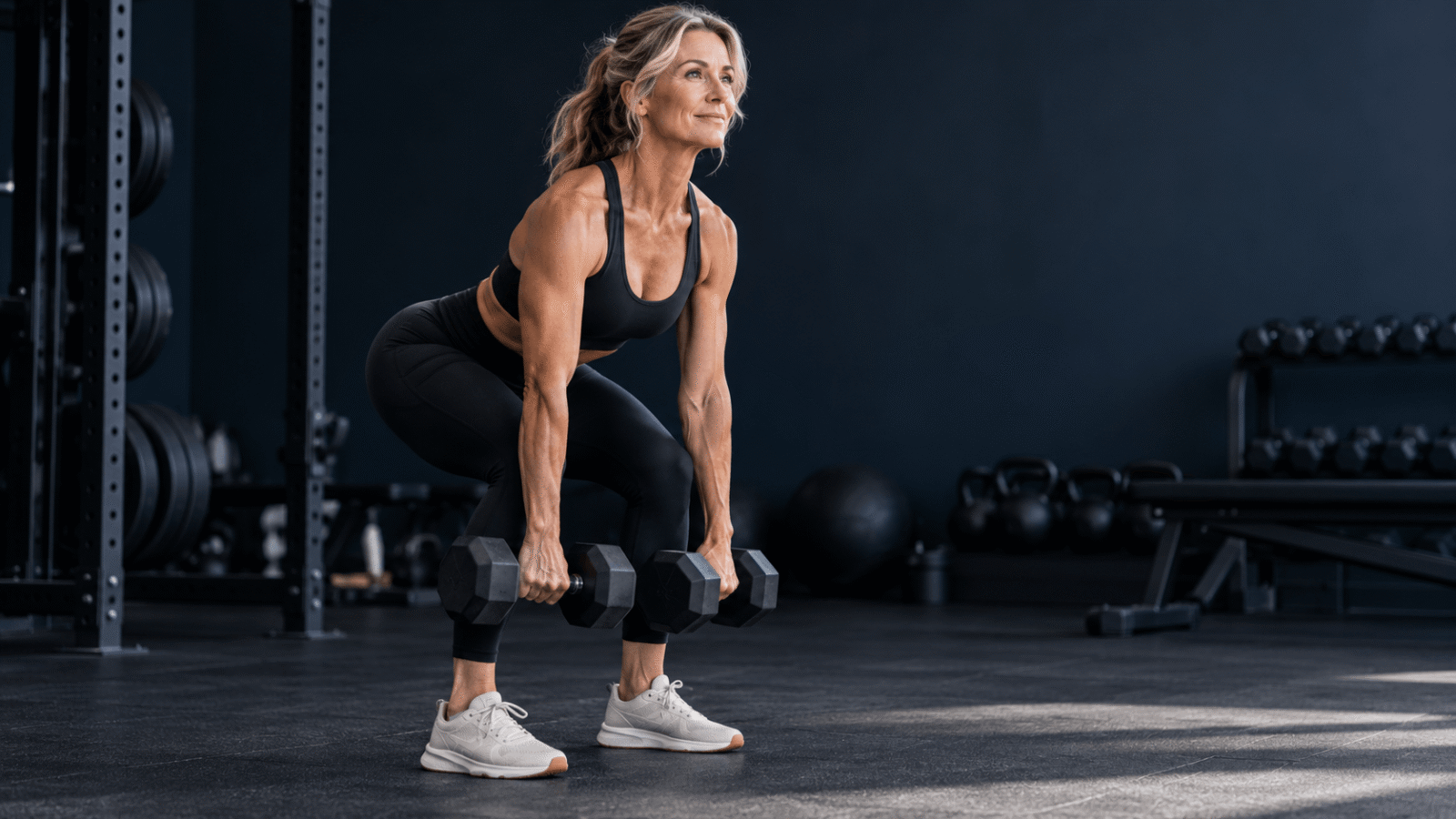
1. Progressive Resistance Training Is the Primary Stimulus
Walking and cardiovascular exercise support health, but they do not provide the same muscle-building signal as progressive resistance training.
Useful movement patterns include:
- Squats or leg presses
- Hinges or deadlift variations
- Rows
- Pulldowns
- Presses
- Lunges
- Split squats
- Carries
- Appropriately programmed isolation work
Progression can come from:
- More resistance
- More repetitions
- Additional sets
- Better range of motion
- Improved technique
- More challenging exercise variations
- Increased training density
U.S. physical activity guidelines recommend muscle-strengthening activity for all major muscle groups on at least two days each week as a public-health minimum.
2. Protein Matters, Especially When Dieting
Resistance training supplies the stimulus.
Dietary protein supplies the amino acids needed for muscle protein remodeling and repair.
Older adults and active women may benefit from protein intakes above the basic RDA, with commonly discussed evidence-based ranges often around 1.2–1.6 g/kg/day for active adults and higher in some athletic contexts.
Protein needs should be individualized based on:
- Body size
- Training
- Energy intake
- Weight-loss goals
- Kidney function
- Digestive tolerance
- Medical history
A simple practical question is:
Does each meal contain a meaningful source of high-quality protein?
3. Creatine May Be Useful, but It Is an Add-On
Recent systematic-review evidence in postmenopausal women suggests creatine monohydrate may provide a small additional benefit for lean mass and strength, particularly when combined with resistance training.
However, supplementation should not be used as a substitute for:
- Resistance training
- Adequate nutrition
- Sleep
- Recovery
Creatine is an optional addition, not the foundation.
4. Sleep and Recovery Can Change the Training Equation
Hot flashes, night sweats, insomnia, fragmented sleep, stress and fatigue can affect training quality and recovery.
A woman may have an excellent training program on paper but struggle to adapt if sleep and recovery are consistently poor.
This is why a whole-person health strategy matters.
Symptoms that interfere with training deserve attention rather than being dismissed as “just aging.”
5. Protect Muscle During Weight Loss
Scale weight alone can hide important changes in body composition.
During the menopause transition, fat mass may increase while lean mass declines even when overall weight changes are less dramatic.
For women pursuing fat loss, preserving lean mass should be an explicit goal.
That generally means combining:
- An appropriate calorie deficit
- Sufficient protein
- Progressive resistance training
Aggressive calorie restriction alone can make muscle preservation more difficult.
A 1st Optimal Framework for Muscle Health Through Perimenopause and Menopause
At 1st Optimal, Functional Health Coaching powered by Functional Medicine means evaluating the complete picture rather than treating one lab marker or symptom in isolation.
Focus on the Fundamentals
- Train for strength with progressive resistance.
- Eat enough protein for your body size, activity level and goals.
- Protect muscle when pursuing weight loss.
- Prioritize sleep, recovery and stress management.
- Use symptoms and health history to guide appropriate clinical evaluation and testing.
- Track progress beyond the scale.
Useful progress markers may include:
- Strength
- Waist circumference
- Body composition when appropriate
- Performance
- Sleep
- Metabolic markers
Why the Perimenopause Years May Be the Best Time to Act
If body-composition changes accelerate around the menopause transition, waiting until years after menopause to start thinking about muscle misses an opportunity.
Perimenopause may be an ideal time to become more intentional about:
- Strength training
- Protein intake
- Sleep
- Recovery
- Metabolic health
- Symptom management
Women who are already postmenopausal have not missed their chance.
The evidence shows that postmenopausal women can still improve strength, fitness and muscle-related outcomes through well-designed resistance training.
Frequently Asked Questions
Does menopause cause sudden muscle loss?
Current evidence does not support a universal, dramatic drop in muscle at menopause.
Cross-sectional studies show lower average lean mass after menopause, but aging explains part of the difference.
Longitudinal data suggest body-composition changes may temporarily accelerate around the transition.
Can you regain muscle after menopause?
Yes.
Postmenopausal women can improve strength, physical function and muscle-related outcomes with resistance training.
Does estrogen prevent muscle loss?
Estrogen may influence skeletal-muscle physiology, but human studies have not established estrogen decline as the sole or dominant cause of muscle loss across menopause.
Does HRT build muscle?
HRT is not considered a primary muscle-building treatment.
Evidence has not shown consistent improvements in lean mass or strength from hormone therapy alone.
HRT may still be appropriate for other individualized clinical reasons.
What is the best exercise for maintaining muscle during menopause?
Progressive resistance training is the most direct exercise stimulus for maintaining and building muscle.
At least two muscle-strengthening sessions per week is the general public-health minimum, while individualized programs may use more.
How much protein should a woman eat during menopause?
There is no single ideal amount for every woman.
Needs depend on body size, activity, training, calorie intake, health conditions and goals.
Many active adults use evidence-based targets around 1.2–1.6 g/kg/day, individualized as appropriate.
Is creatine helpful after menopause?
Creatine may modestly support lean mass and strength, especially when paired with resistance training.
It is an optional adjunct, not a replacement for the fundamentals.
The Bottom Line
The menopause-muscle story is more nuanced than the headlines suggest.
Studies show lower average lean mass in peri- and postmenopausal women, but age, study design and the distinction between lean mass and skeletal muscle all matter.
Longitudinal data suggest the years surrounding the final menstrual period may be a period when body-composition changes accelerate. Act early. Train progressively. Eat enough protein. Prioritize recovery. Protect muscle during weight loss. Evaluate the complete health picture.
Optimize the Complete Picture With 1st Optimal
1st Optimal combines Functional Health Coaching powered by Functional Medicine to help women understand the factors influencing how they feel, perform and age.
Our approach can consider:
- Hormones
- Thyroid health
- Metabolism
- Nutrition
- Body composition
- Sleep
- Stress
- Gut health
- Training
- Recovery
- Lifestyle
Start with a free health consultation.
There is no pressure to purchase treatment. The first conversation is designed to understand your symptoms, goals and health history and determine what next steps may make sense for you.
Book a free health consultation
Explore Functional Health Plans:
1st Optimal — Functional Health Coaching powered by Functional Medicine. Optimize You. Uplift Others.
Medical Disclaimer
This article is for educational purposes only and is not intended to diagnose, treat, cure or prevent any disease or replace individualized medical advice.
Hormone therapy, dietary changes, supplements and exercise programs should be discussed with an appropriate healthcare professional when relevant to your medical history, medications and health conditions.
Research References
- Menzies C, Bowtell R, Shur N, Brook MS. Menopause, Female Sex Hormones, Skeletal Muscle Mass and Muscle Protein Turnover in Humans. Journal of Cachexia, Sarcopenia and Muscle. 2026;17(1). DOI: 10.1002/jcsm.70232.
- Phillips SM. Menopause and Muscle: Closer to Answers, but Significant Questions Remain. Journal of Cachexia, Sarcopenia and Muscle. 2026.
- Greendale GA, et al. Changes in body composition and weight during the menopause transition. JCI Insight. 2019;4(5).
- González-Gálvez N, Moreno-Torres JM, Vaquero-Cristóbal R. Resistance training effects on healthy postmenopausal women: a systematic review with meta-analysis. Climacteric. 2024;27(3):296-304.
- Javed AA, et al. Association Between Hormone Therapy and Muscle Mass in Postmenopausal Women: A Systematic Review and Meta-analysis. JAMA Network Open. 2019.
- Xu Y, et al. Effect of hormone therapy on muscle strength in postmenopausal women: a systematic review and meta-analysis of randomized controlled trials. Menopause. 2020;27(7):827-835.
- International Society of Sports Nutrition. Position stand: nutritional concerns of the female athlete, including protein considerations across life stages.
- CDC. Physical Activity Guidelines for Adults.