

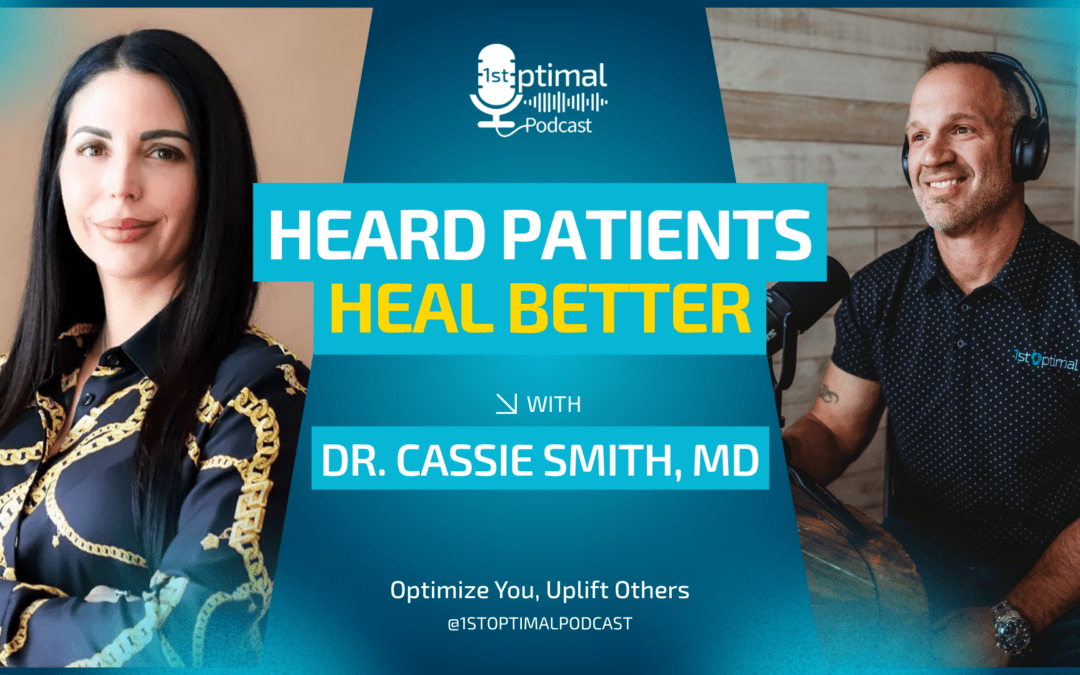
In this episode of the 1st Optimal Podcast, we sit down with Dr. Cassie Smith, a functional medicine endocrinologist who walked away from traditional healthcare after realizing something most patients already feel… the system wasn’t actually helping people get better. What started as a conversation around hormones quickly turned into a deeper discussion on why patients with “normal labs” still struggle, how gut health quietly drives many of these issues, and why the doctor–patient relationship may be the most overlooked factor in real healing.
Why Patients Heal Faster When Doctors Actually Listen
Most people don’t go to the doctor because they feel great. They go because something feels off.
And yet, somehow, they leave being told the same thing:
“You’re fine.”
Labs look normal. Nothing alarming. No clear diagnosis.
So the conversation ends there.
But the symptoms don’t. Fatigue sticks around. Weight won’t budge. Brain fog lingers. Hormones feel completely out of control. And now you’re left questioning yourself instead of the system. That’s where this whole thing starts to break.
The Moment Medicine Stops Making Sense
There’s a point where even doctors begin to notice something isn’t right. You follow all the rules. You train for over a decade. You learn the protocols. You prescribe what you’re told works. And yet… your patients aren’t actually getting better.
They’re managing symptoms.
They’re cycling through medications.
They’re coming back with the same issues, just labeled differently.
At some point, you either ignore it or you start asking better questions.
The Question That Changes Everything
Instead of asking: “What medication fixes this?”
You ask: “Why is this happening in the first place?”
That one shift completely changes the outcome.
Because most chronic symptoms aren’t random.
They’re signals.
Signals that something deeper isn’t working the way it should.
When “Normal” Isn’t Good Enough
Here’s the uncomfortable truth most people run into:
You can feel terrible and still have “normal” labs.
Because normal doesn’t mean optimal.
It just means you’re not sick enough… yet.
So people get stuck in this weird middle ground where:
-
They don’t qualify as “ill”
-
But they definitely don’t feel healthy
And no one is really responsible for fixing that gap.
The Hidden Pattern Most People Miss
There’s a specific group of patients that makes this problem obvious.
They do everything right. They eat well. They exercise. They take the supplements. They even optimize their hormones.
And still… something feels off.
That’s where things get interesting.
Because when you look deeper, there’s usually a pattern:
The gut isn’t working properly.
The Gut Changes Everything
It sounds simple, maybe even overhyped at this point. But it’s not.
When your gut is off, everything downstream starts to break.
Inflammation increases.
Your immune system stays activated.
Stress hormones stay elevated.
Your body stops responding the way it should.
And here’s the part most people never hear:
Your hormones can look fine on paper and still not work inside your body.
Because they can’t function properly in an inflamed environment.
Why People Stay Stuck
This is where frustration builds.
You’re doing the workouts.
You’re eating clean.
You’re trying to “be disciplined.”
But your body isn’t responding the way you expect.
So you push harder. Cut more calories. Add more supplements.
And somehow, that makes things worse.
Because you’re trying to fix a systems problem with surface-level solutions.
The System Was Never Built for This
Modern healthcare is excellent at handling emergencies.
But chronic, complex issues? Not so much.
The system is designed for:
-
Speed
-
Efficiency
-
Standard protocols
Not for:
-
Deep investigation
-
Individual patterns
-
Long-term optimization
So when your problem doesn’t fit neatly into a box, it often gets ignored.
What Actually Moves the Needle
Real progress usually starts in a place most people overlook:
Someone actually listens.
Not just to your labs.
Not just to your symptoms in isolation.
But to the full picture.
Your history.
Your patterns.
What changed and when.
That’s where the answers usually are.
The Difference Between Managed and Fixed
There’s a big difference between feeling “managed” and actually feeling good.
Managed looks like:
-
Symptoms slightly improved
-
Labs within range
-
Still not feeling like yourself
Fixed looks like:
-
Energy comes back
-
Weight responds normally
-
Mental clarity returns
-
You feel like you again
Most people settle for the first because they’ve never been shown the second is possible.
The Hard Truth No One Likes to Hear
If something feels off in your body, it probably is.
And ignoring it doesn’t make it go away.
It just delays the moment it becomes impossible to ignore.
The earlier you look deeper, the easier it is to fix.
Where This Leaves You
You’re not broken.
You’re likely just looking at incomplete information.
The real issue usually isn’t that nothing is wrong.
It’s that no one has taken the time to figure out what actually is.
And once that happens, things tend to change faster than people expect.
Connect with Dr. Cassie Smith:
Website: modern-endocrine.com
Instagram: @modernendocrine
Youtube: @modernendocrine
Tiktok: dr-cassie-smith-endocrinologist
Facebook: ModernEndocrine
Ready to Take the Next Step?
Ready to begin your own fitness journey and take control of your health? Book your free consultation with 1st Optimal today and let’s explore how personalized coaching and expert-led strategies can help you achieve your health goals!
🔗 Listen to the full episode on your favorite platform:
🎧 Spotify | Apple Podcasts | Amazon Music | Google Podcasts
📺 Watch it on YouTube: