

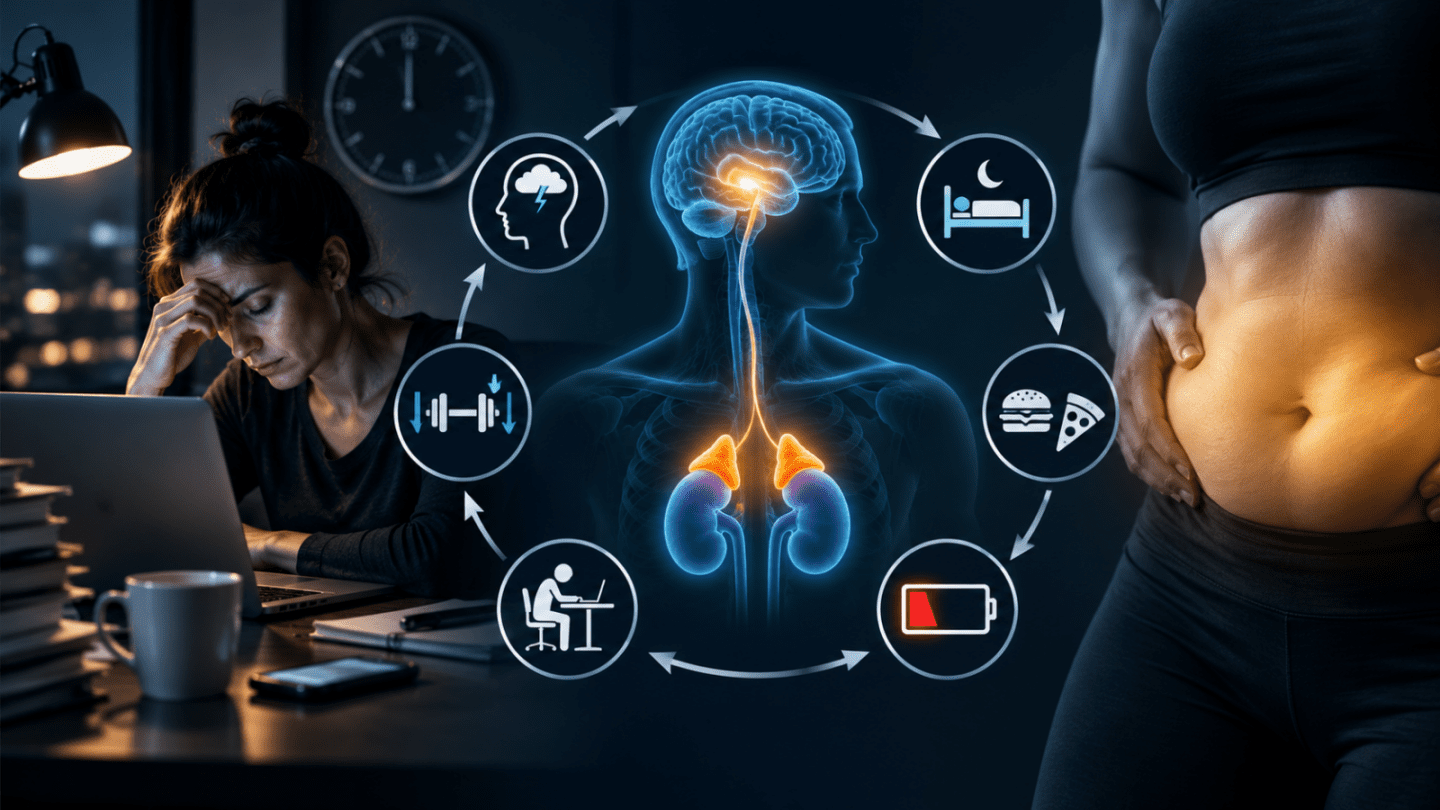
If you are eating well, exercising consistently, and still feel like your body is fighting your fat-loss efforts, stress may be part of the picture.
But the explanation is more complicated than the popular idea that “cortisol makes you fat.”
Cortisol is an essential hormone. You need it to wake up, respond to challenges, regulate energy availability, maintain blood pressure, and support normal metabolism.
The problem is not cortisol itself.
The problem can develop when chronic stress, poor sleep, inadequate recovery, appetite changes, and lifestyle disruption begin reinforcing one another.
Over time, this can create a hidden loop:
Stress → disrupted cortisol regulation → poor sleep and increased appetite → reduced recovery → harder training and nutrition adherence → increased stress → burnout
For adults trying to improve body composition, energy, and long-term health, understanding this loop matters far more than simply trying to “lower cortisol.”
What Is Cortisol?
Cortisol is a glucocorticoid hormone produced by the adrenal glands.
Its production is regulated through the hypothalamic-pituitary-adrenal axis, commonly called the HPA axis.
Cortisol is often described as the “stress hormone,” but that description is incomplete.
Cortisol helps regulate:
- Blood glucose
- Blood pressure
- Inflammation
- Energy availability
- Immune activity
- Sleep-wake rhythms
- The body’s response to physical and psychological stress
Cortisol is also naturally rhythmic.
Levels typically rise around waking and gradually decline throughout the day. Glucocorticoid secretion follows both circadian and shorter pulsatile rhythms, which means that a single cortisol measurement does not automatically tell you whether your stress system is “broken.”
In other words, cortisol is not something you want to eliminate.
You want an appropriately functioning stress-response system.
How Chronic Stress Can Affect Fat Storage
1. Cortisol Changes How the Body Manages Energy
During stress, your body wants energy available quickly.
Cortisol helps mobilize glucose and other energy sources so you can respond to a threat or demand.
That response is useful during short-term stress.
Problems may arise when psychological stress, sleep deprivation, excessive training, restrictive dieting, long work hours, illness, and other stressors become persistent.
Research increasingly supports an association between chronic stress, altered HPA-axis activity, glucocorticoid exposure, appetite regulation, and obesity-related metabolic changes. However, the relationship is complex and varies considerably between individuals.
That distinction matters.
Chronic stress does not guarantee weight gain.
But it can create conditions that make maintaining energy balance and healthy behaviors more difficult.
Does Cortisol Cause Belly Fat?
This is one of the most common claims online.
There is some biological basis for the connection between glucocorticoids and abdominal fat, but it should not be oversimplified.
Extreme cortisol excess, as occurs in Cushing’s syndrome, can contribute to characteristic changes in body-fat distribution. However, Cushing’s syndrome is uncommon and is very different from simply having a stressful job or a difficult month. The Endocrine Society notes that true hormone disorders such as Cushing’s syndrome are uncommon causes of obesity.
In everyday life, stress-related weight changes are usually influenced by several overlapping factors.
These may include:
- Increased appetite
- Greater preference for highly palatable foods
- Poorer sleep
- Reduced activity
- Lower training quality
- Emotional eating
- Alcohol consumption
- Less time for meal preparation
- Insulin-sensitivity changes
- Changes in circadian rhythms
So rather than saying:
“Cortisol causes belly fat.”
A more accurate explanation is:
Chronic stress can alter multiple biological and behavioral systems that influence energy intake, fat distribution, metabolic health, and body composition.
The Stress-Appetite Connection
One of the most important links between stress and fat gain may happen through appetite and food behavior.
Chronic stress can influence brain regions involved in reward, motivation, and eating behavior.
Highly stressed individuals may find themselves craving more calorie-dense foods, especially foods rich in sugar and fat.
Research examining stress and obesity suggests that stress-related brain pathways overlap with pathways regulating appetite and reward, potentially increasing motivation to consume highly palatable foods in some people.
This can create a very practical problem.
You might plan to eat:
- Lean protein
- Vegetables
- Whole-food carbohydrates
- Healthy fats
But after a 12-hour workday, four hours of sleep, two missed meals, and several stressful meetings, the brain may have very different priorities.
That is not simply a discipline problem.
Your physiological state influences your decision-making environment.
Poor Sleep Makes the Loop Worse
Stress and sleep are closely connected.
Stress can interfere with sleep.
Poor sleep can then make stress feel harder to manage.
And sleep deprivation can directly influence metabolic health.
A meta-analysis of randomized controlled trials found that sleep restriction increased subjective hunger and was associated with higher daily calorie consumption and reduced insulin sensitivity.
Another comprehensive review found that insufficient sleep and circadian misalignment are associated with weight gain and poorer metabolic health through effects involving appetite, food intake, metabolic regulation, and energy balance.
The National Institutes of Health has also reported evidence from a randomized trial showing that overweight adults who successfully extended their sleep consumed fewer calories.
So imagine the cycle:
Stress rises.
You sleep five hours.
The next day:
- Hunger increases
- Cravings become harder to manage
- Training performance declines
- Caffeine intake increases
- Energy crashes later
- Food choices become more reactive
- Sleep becomes difficult again
Repeat that for months and fat loss can become much more difficult.
Stress Can Also Change How You Train
Another overlooked part of the cortisol-fat storage conversation is exercise.
Exercise itself is a stressor.
That is not bad.
In fact, properly dosed exercise is one of the most beneficial stressors the body can experience.
The problem occurs when exercise is stacked on top of inadequate recovery.
For example:
Hard training + severe calorie restriction + poor sleep + demanding work + high life stress
may produce very different results from:
Hard training + adequate calories + sufficient protein + quality sleep + programmed recovery
People under significant stress often respond by doing more:
- More cardio
- More fasting
- More calorie restriction
- More training sessions
- More caffeine
- Fewer rest days
Sometimes the better solution is the opposite.
More recovery may allow you to train harder when it actually matters.
Cortisol and Severe Dieting
Aggressive dieting can become another source of physiological stress.
When calorie intake becomes too low for too long, people may experience:
- Poor training performance
- Reduced spontaneous movement
- Increased hunger
- Irritability
- Sleep disruption
- Menstrual-cycle changes in some women
- Reduced libido
- Fatigue
- Strong food preoccupation
The solution to stalled fat loss is therefore not always simply:
Eat less and exercise more.
In some situations, a better strategy may involve improving the entire metabolic environment around fat loss.
That means considering nutrition, protein intake, strength training, sleep, recovery, hormones, medications, metabolic health, and stress together.
Where Burnout Enters the Picture
People often use the word burnout to describe general exhaustion.
Clinically, the terminology is more specific.
The World Health Organization defines burnout as an occupational phenomenon resulting from chronic workplace stress that has not been successfully managed. It is characterized by exhaustion, increased mental distance or cynicism toward work, and reduced professional efficacy. WHO does not classify burnout itself as a medical condition.
That distinction is important because persistent exhaustion should not automatically be blamed on “burnout” or cortisol.
Similar symptoms can occur with:
- Sleep deprivation
- Sleep apnea
- Thyroid disorders
- Iron deficiency
- Anemia
- Depression
- Anxiety
- Nutrient deficiencies
- Perimenopause or menopause
- Testosterone deficiency
- Medication effects
- Undereating
- Overtraining
- Blood-glucose dysregulation
If persistent fatigue is interfering with daily life, widening the diagnostic lens is often more useful than assuming cortisol is the only explanation.
The Hidden Cortisol-Fat Storage-Burnout Loop
This is where everything connects.
Step 1: Chronic Stress Builds
Work, family demands, poor sleep, financial pressure, intense training, dieting, or illness increase total stress load.
Step 2: Recovery Starts Falling Behind
Sleep quality worsens.
Training recovery declines.
Mental fatigue increases.
Step 3: Appetite and Food Choices Become Harder to Manage
Hunger may increase.
Convenience foods become more attractive.
Meals become less structured.
Step 4: Daily Movement Drops
You may still exercise for 45 minutes, but spend far more of the rest of the day sitting because you are exhausted.
Step 5: Fat Loss Slows
Lower movement, inconsistent nutrition, poor recovery, and disrupted sleep collectively make maintaining an energy deficit more difficult.
Step 6: You Push Harder
Calories go lower.
Cardio goes higher.
Caffeine increases.
Rest decreases.
Step 7: Fatigue Gets Worse
Performance falls.
Motivation drops.
Sleep worsens.
The cycle repeats.
This is the hidden loop.
And breaking it usually requires addressing more than one variable.
Signs Your Recovery System May Need Attention
No single symptom proves that cortisol is abnormal.
However, patterns can tell you that recovery deserves closer attention.
Watch for combinations such as:
- Feeling tired but unable to relax
- Needing large amounts of caffeine to function
- Difficulty falling or staying asleep
- Persistent morning fatigue
- Declining exercise performance
- Increased cravings
- Irritability
- Reduced motivation
- Frequent soreness
- Lower libido
- Difficulty recovering between workouts
- Increasing reliance on alcohol to unwind
- Weight gain despite significant lifestyle effort
These symptoms deserve context rather than a self-diagnosis of “high cortisol.”
How to Break the Stress-Fat Storage Loop
1. Prioritize Sleep Before Adding More Cardio
For most adults, sleeping five hours and adding another hour of cardio is unlikely to be the optimal recovery strategy.
Start with consistent sleep and wake times.
Reduce late-night stimulation.
Keep the bedroom cool and dark.
Consider whether snoring, gasping, morning headaches, or excessive daytime sleepiness could suggest sleep apnea.
Adults generally need at least seven hours of sleep per night, although individual sleep needs vary. Improving sleep duration can also support appetite regulation.
2. Stop Treating Recovery Like Laziness
Recovery is part of training.
Useful strategies may include:
- Deload weeks
- Lower-intensity training days
- Walking
- Mobility work
- Rest days
- Sauna when appropriate
- Relaxation practices
- Social connection
- Recreation
- Time outdoors
You do not become fitter during the workout itself.
Training provides the stimulus.
Recovery allows adaptation.
3. Eat Enough Protein
Protein is particularly important during fat loss because it supports satiety and helps preserve lean mass.
Instead of aggressively cutting food across the board, build meals around:
- High-quality protein
- Vegetables and fruit
- Fiber-rich carbohydrates
- Healthy fats
For many active adults, distributing protein across several meals is more practical than trying to consume most of it at dinner.
4. Avoid Extreme Calorie Restriction
A sustainable calorie deficit generally works better than repeatedly alternating between aggressive dieting and overeating.
If you’re constantly:
- Starving
- Cold
- Exhausted
- Irritable
- Sleeping poorly
- Losing training performance
the diet may be too aggressive.
5. Strength Train
Resistance training helps preserve and build muscle while supporting metabolic health and physical function.
You do not necessarily need six hard workouts per week.
For many adults, several well-designed strength sessions with adequate recovery can outperform a high-volume program that cannot be sustained.
6. Audit Your Caffeine Intake
Caffeine can improve alertness and performance.
But caffeine cannot replace sleep.
If you need progressively larger doses simply to feel normal, look at why your baseline energy is so low.
Late-day caffeine can also interfere with sleep in susceptible individuals, creating another self-reinforcing cycle.
7. Build More Low-Intensity Movement Into the Day
Do not underestimate walking.
Daily movement can support:
- Energy expenditure
- Glucose regulation
- Cardiovascular health
- Recovery
- Stress management
Someone who trains hard for one hour but sits for the remaining 15 waking hours may still have relatively low total daily activity.
8. Reduce Unnecessary Stress Load
You cannot eliminate stress.
But you can audit it.
Ask:
- Which commitments are actually necessary?
- Which meetings could be shortened or removed?
- Am I saying yes automatically?
- Is my training schedule realistic?
- Am I using alcohol or food as my primary recovery strategy?
- Do I have any unstructured time?
- When was my last legitimate rest day?
Sometimes health optimization requires subtraction.
Should You Test Cortisol?
Possibly, but context matters.
Cortisol assessment is more complicated than ordering one random blood test.
Because cortisol follows circadian and pulsatile rhythms, interpretation depends heavily on timing, symptoms, medications, clinical suspicion, and the condition being investigated.
Testing may be clinically appropriate when a provider is investigating conditions involving cortisol excess or deficiency.
But testing should answer a meaningful clinical question.
A single abnormal number should not automatically trigger supplements or treatment without understanding the bigger picture.
Fat Loss Is Not Just About Cortisol
Cortisol gets enormous attention online because it offers an easy explanation for frustrating weight gain.
Real physiology is rarely that simple.
Persistent weight-loss resistance may involve:
- Total calorie intake
- Protein intake
- Sleep
- Physical activity
- Muscle mass
- Menopause
- Thyroid function
- Insulin resistance
- Medications
- Alcohol
- Stress
- Genetics
- Appetite regulation
- Medical conditions
Cortisol may be one piece.
It should not become the explanation for everything.
A Better Approach to Stress-Related Weight Gain
Instead of asking:
“How do I lower cortisol?”
Ask:
“What is creating the highest stress and recovery burden in my body right now?”
Then evaluate:
Sleep:
Are you consistently getting enough restorative sleep?
Nutrition:
Are you eating enough protein and calories to support your activity level?
Training:
Are you progressing, or simply accumulating fatigue?
Daily movement:
Are you moving outside your workouts?
Stress:
Which stressors can actually be changed?
Health:
Could thyroid function, iron status, hormone changes, metabolic health, sleep apnea, or another condition be contributing?
That approach is more useful than chasing a single hormone.
When to Consider a Medical Evaluation
Consider speaking with a qualified healthcare professional when unexplained fatigue, changes in weight, poor exercise recovery, sleep problems, menstrual changes, libido changes, mood symptoms, or metabolic concerns persist despite reasonable lifestyle efforts.
Depending on your symptoms and history, evaluation may include discussion of:
- Thyroid function
- Glucose and insulin-related markers
- Lipids
- Iron and ferritin
- Blood count
- Vitamin or nutrient status when appropriate
- Sex hormones when clinically indicated
- Sleep apnea risk
- Medications
- Cortisol testing when clinically justified
The goal is not to order every test possible.
It is to identify which questions are actually worth investigating.
The Bottom Line
Cortisol is not your enemy.
Stress is not automatically making you store fat.
And belly fat does not automatically mean your cortisol is high.
But chronic stress can influence sleep, appetite, metabolic health, food choices, exercise recovery, and daily movement.
When those changes accumulate, they can create an environment where fat loss becomes much harder.
Then the response is often to train harder, eat less, sleep less, and rely on more caffeine.
That can push the system in the wrong direction.
The answer is often not another aggressive fat-loss strategy.
It is restoring the conditions that allow your body to respond well to the strategy you already have.
At 1st Optimal, we take a broader approach to performance health. Rather than looking at one symptom or one hormone in isolation, provider-guided evaluation can consider sleep, metabolic health, hormone status, nutrition, training, recovery, and laboratory patterns together.
Because sometimes the missing piece in fat loss is not more effort.
It is better recovery and better information.
Frequently Asked Questions
Does cortisol directly cause belly fat?
Not necessarily. Significant cortisol excess can affect fat distribution, but everyday stress-related abdominal weight gain is usually influenced by multiple factors including appetite, sleep, calorie intake, activity, metabolic health, and genetics.
Can stress stop you from losing weight?
Stress does not override energy balance, but chronic stress can make maintaining the behaviors required for fat loss more difficult by affecting hunger, sleep, cravings, activity, recovery, and decision-making.
Can poor sleep increase cortisol?
Sleep and HPA-axis activity influence one another. Research has shown that sleep restriction can alter aspects of cortisol regulation, although results vary between studies. Poor sleep also appears to increase hunger and calorie intake independently of cortisol changes.
How do I know if my cortisol is too high?
Symptoms alone cannot diagnose abnormal cortisol levels. When conditions such as Cushing’s syndrome are suspected, clinicians use specific validated testing strategies rather than relying on a random cortisol measurement.
Does exercise raise cortisol?
Exercise can temporarily increase cortisol, particularly during prolonged or intense training. This is a normal physiological response. The larger issue is whether training stress is balanced with sufficient nutrition, sleep, and recovery.
Can burnout cause weight gain?
Burnout itself does not automatically cause weight gain. However, the chronic workplace stress associated with burnout may coincide with poorer sleep, reduced activity, emotional eating, alcohol intake, disrupted routines, and other behaviors that can influence body weight.
Should I take supplements to lower cortisol?
Not automatically. First identify the source of the problem. Persistent fatigue or suspected hormone abnormalities deserve appropriate medical evaluation rather than assuming cortisol supplements are necessary.
References
- Clarke SA, et al. Current Challenges and Future Directions in the Assessment of Glucocorticoid Status. Endocrine Reviews. 2024.
- World Health Organization. Burn-out an occupational phenomenon: International Classification of Diseases.
- Endocrine Society. Obesity: Endocrine Connection.
- Al Khatib HK, et al. Effects of sleep restriction on metabolism-related parameters in healthy adults: A comprehensive review and meta-analysis of randomized controlled trials. Sleep Medicine Reviews. 2019.
- National Institutes of Health. Getting sufficient sleep reduces calorie intake. 2022.
- The role of insufficient sleep and circadian misalignment in obesity. Review of human metabolic evidence.
- Sinha R, Jastreboff AM. Stress as a common risk factor for obesity and addiction. Biological Psychiatry. 2013.
- Glucocorticoids and HPA axis regulation in the stress-obesity connection: A comprehensive overview of biological, physiological and behavioural dimensions.


