

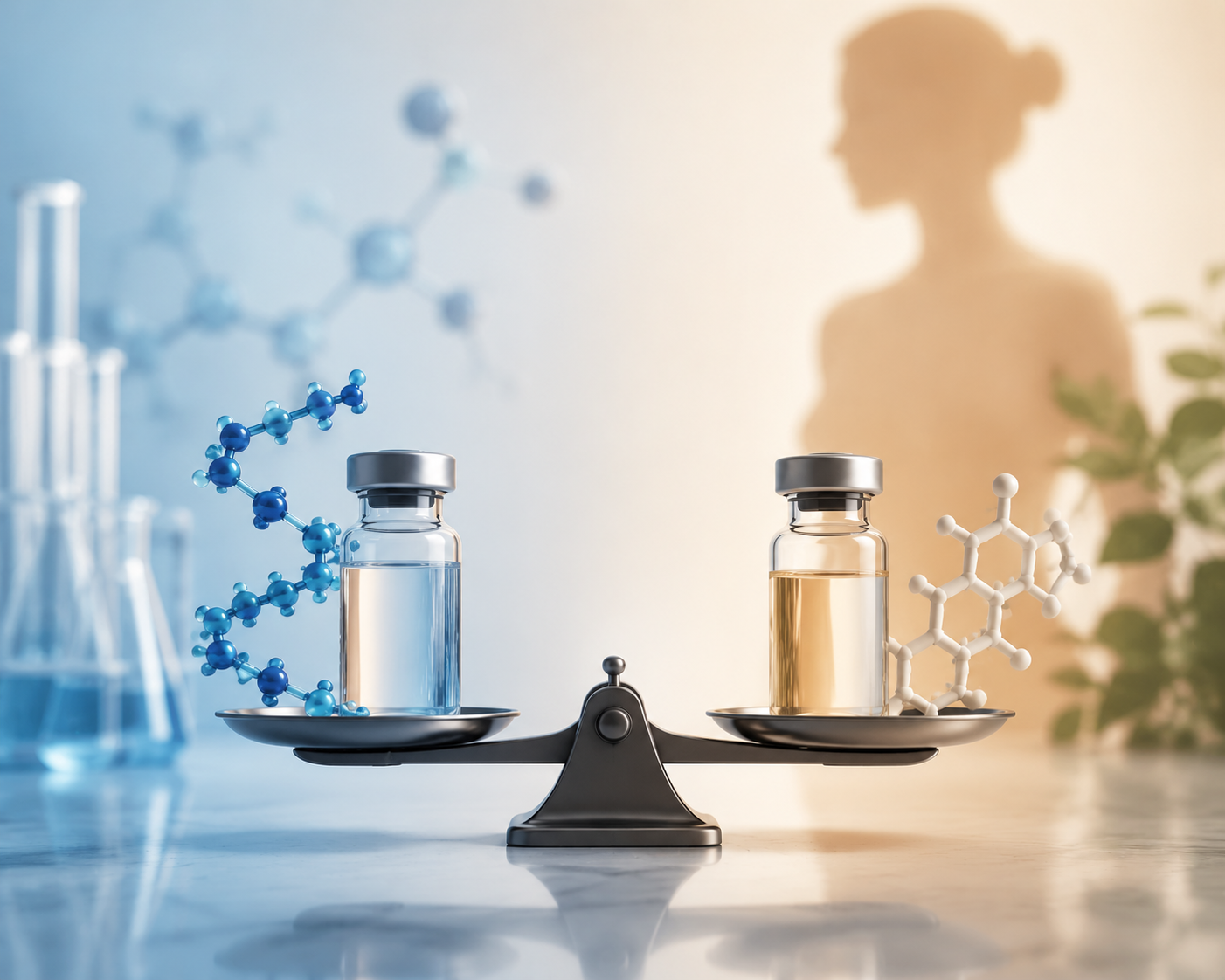
If you have been exploring your options in hormonal and functional health, you have almost certainly encountered this question either you have asked it yourself, or you have seen it debated in wellness forums and health communities. It is an important question, because the classification of peptides versus hormone replacement therapy has real implications for how these therapies are prescribed, regulated, accessed, and appropriately used.
The short answer is: for most therapeutic peptides, no, they are not classified as hormone replacement therapy. But the longer answer is considerably more interesting and clinically relevant.
Hormones are specific signaling molecules produced by glands in the endocrine system: estrogen, testosterone, progesterone, cortisol, thyroid hormones. Hormone replacement therapy is the deliberate supplementation of one or more of these hormones when deficiency is documented. Peptides are amino acid chains that act as biological messengers sometimes influencing hormonal secretion, sometimes not, but they are, in most cases, a distinct category of therapeutic agent.
Understanding this distinction is essential if you are going to make an informed decision about which therapies are right for you. Let me walk you through the classification, the regulatory landscape, and what it all means practically for your care.
Defining the Terms: What Makes Something a Hormone?
Hormones are chemical messengers produced by specific endocrine glands and released into the bloodstream to act on target organs and tissues. They are typically produced in one location and act at distant sites, the hallmark of endocrine signaling. Classic examples include estradiol (produced by the ovaries and adrenal glands), testosterone (produced by the testes and adrenal glands), and insulin (produced by the pancreas).
Hormones operate through a tightly regulated feedback system. When circulating levels of a hormone reach a certain threshold, the gland producing it receives a signal to slow or stop production. This is the hypothalamic-pituitary-gonadal (HPG) axis, the hypothalamic-pituitary-adrenal (HPA) axis, and other feedback loops that govern endocrine function. When we administer exogenous hormones in HRT, we are providing hormones from outside the body, which naturally suppresses the body’s own production through this feedback mechanism.
This distinction endogenous production suppression is one of the most clinically meaningful differences between HRT and most peptide therapies. HRT replaces a hormone and, in doing so, typically signals the body to reduce its own production. Many peptide therapies do the opposite.
What Makes Something a Peptide?
Peptides are short chains of amino acids linked by peptide bonds. They range from two amino acids (dipeptides) to approximately fifty amino acids in length. Longer chains are classified as proteins. Your body naturally synthesizes thousands of different peptides with diverse biological functions.
From a chemical standpoint, some hormones are actually peptides or peptide-derived. Insulin, oxytocin, and vasopressin are all peptide hormones they are made of amino acid chains and they function as hormones. So the categories of “peptide” and “hormone” are not mutually exclusive at a biochemical level.
However, when clinicians and researchers discuss “peptide therapy” in the context of functional and performance medicine, they are typically referring to a specific category of synthetic or bioidentical peptide sequences designed to act as signaling agents stimulating the release of growth hormone, supporting tissue repair, modulating inflammation, or influencing other biological processes. These are distinct from the classical hormones used in HRT, even though they are technically made of amino acids.
A useful way to think about it: all hormones are signaling molecules, but not all signaling molecules are hormones. And therapeutic peptides, in most cases, are the latter powerful biological signals that are not themselves hormones.
The Key Classification Difference
The most practically important classification difference is this: HRT involves administering a hormone, a molecule that your body’s endocrine system recognizes as a primary regulatory signal, and that binds directly to hormone receptors throughout the body to produce systemic effects.
Most therapeutic peptides work upstream of that. They stimulate or modulate the conditions under which your body produces or responds to hormones, rather than providing the hormone itself.
Consider growth hormone-releasing peptides as an example. These compounds bind to specific receptors in the hypothalamus and pituitary gland and stimulate the pulsatile release of growth hormone. Growth hormone (GH) then enters circulation and stimulates the liver to produce insulin-like growth factor 1 (IGF-1), which exerts anabolic and regenerative effects throughout the body. The peptide initiates a cascade, it does not replace growth hormone. This preserves the natural feedback loop: when growth hormone levels rise, the pituitary is signaled to reduce its release. The body retains regulatory control.
In contrast, directly administering growth hormone (as in HRT for growth hormone deficiency) provides GH exogenously, which can suppress the pituitary’s natural output and bypass the feedback mechanism.
Research in the Journal of Clinical Endocrinology and Metabolism has highlighted the clinical significance of preserving pulsatile growth hormone secretion versus continuous exogenous administration, noting that the pulsatile pattern is important for GH’s anabolic and metabolic effects (Ho et al., 2020).
Regulatory Status of HRT vs. Peptides
The regulatory landscape for these two categories is meaningfully different, and understanding this difference is important for anyone navigating treatment options.
FDA-Approved Hormones (HRT): Estradiol, progesterone, and testosterone formulations used in HRT have gone through rigorous FDA approval processes. There are FDA-approved estradiol patches, gels, injections, pellets, and oral formulations. FDA-approved testosterone formulations exist for men. While many HRT preparations used in functional medicine are compounded for individualized dosing (particularly bioidentical formulations), the active compounds themselves have FDA approval in standardized formulations.
Therapeutic Peptides: Many of the peptides used in functional medicine are obtained through compounding pharmacies rather than as FDA-approved medications. The FDA has regulatory authority over peptides and has, in recent years, placed certain peptides on lists that restrict their compounding. This regulatory landscape is evolving and clinically significant. Working with a licensed provider who stays current on regulatory developments is not optional, it is essential.
A 2023 update from the FDA regarding compounded preparations includes guidance on which peptides can and cannot be compounded under current regulations. Patients should always verify that the peptides in their protocol are obtained from licensed, accredited compounding pharmacies operating within current regulatory guidelines.
At 1st Optimal, we work only with licensed compounding pharmacies and maintain strict compliance with current regulatory standards in all of our peptide therapy programs. Learn about our clinical compliance standards here.
How Peptides Influence Hormones Without Being Hormones
This is where the biology gets interesting and clinically valuable. Even though most therapeutic peptides are not classified as hormones, many of them have significant effects on hormonal balance through indirect mechanisms.
Growth Hormone Axis Modulation: As discussed, peptides that stimulate growth hormone release affect the GH/IGF-1 axis profoundly, influencing body composition, metabolism, skin health, bone density, and recovery.
Insulin and Metabolic Signaling: Some peptides influence insulin sensitivity and glucose metabolism through effects on the gut-brain axis and metabolic signaling pathways. Research published in Cell Metabolism has highlighted the role of gut-derived peptide signals in regulating insulin secretion and appetite, a mechanism that has major implications for metabolic health (Muller et al., 2019).
Thyroid Axis Influence: Certain peptides appear to influence thyroid hormone sensitivity and conversion, though this area requires more robust clinical data.
Sex Hormone Interactions: Peptides that reduce inflammation and support tissue health can indirectly improve the environment in which sex hormones operate. Chronic inflammation impairs hormone receptor sensitivity, and addressing inflammation through peptide signaling may improve hormonal responsiveness even without changing hormone levels.
This web of indirect influence is one reason why the classification question matters clinically. Peptides are powerful not because they act as hormones, but because they influence the conditions and pathways through which hormones and other biological systems operate. Explore our comprehensive hormone optimization programs that integrate peptide therapy.
When the Line Gets Blurry
The classification clarity begins to blur in a few specific contexts that are worth understanding:
Peptide Hormones: As mentioned earlier, some clinically relevant hormones are peptides, insulin, glucagon, oxytocin, and several others. When these are administered therapeutically, they function as both hormone replacement and peptide therapy simultaneously. Insulin therapy is the most common example.
Human Growth Hormone (HGH) vs. GH-Releasing Peptides: Some patients and providers conflate GH-releasing peptides with growth hormone itself. They are not the same. HGH (recombinant human growth hormone) is actual exogenous hormone administration, it falls squarely within the definition of hormone replacement therapy for documented GH deficiency. GH-releasing peptides stimulate your pituitary to make more of your own GH. Clinically and regulatorily, these are distinct categories.
Bioidentical vs. Synthetic: The “bioidentical” label adds another layer of complexity. Bioidentical hormones are chemically identical to those the body produces. Many therapeutic peptides are also bioidentical in the sense that they replicate naturally occurring peptide sequences. But this does not make them hormones, it describes their structural relationship to natural compounds.
Understanding these nuances helps you ask better questions when evaluating your treatment options and ensures you are comparing apples to apples when discussing your protocol with a provider.
Compounding Pharmacies and the Peptide Supply Chain
Because many therapeutic peptides are not available as FDA-approved commercial products, they must be compounded prepared for individual patients by licensed compounding pharmacies based on a provider’s prescription. This is a legal and regulated process, but it requires vigilance on the part of both providers and patients.
Quality control in compounding pharmacies is not uniform. The difference between a well-accredited compounding pharmacy with rigorous testing standards and a lower-tier operation can be significant in terms of potency, purity, and sterility. Every patient receiving compounded peptide therapy should confirm that their pharmacy holds accreditation from the Pharmacy Compounding Accreditation Board (PCAB) or an equivalent quality standard.
Additionally, the regulatory status of specific peptides in compounded preparations has been subject to FDA guidance updates. Staying informed and working with a clinically current provider is the best protection against receiving outdated or non-compliant products.
At 1st Optimal, we partner exclusively with PCAB-accredited compounding pharmacies and review our pharmacy partnerships regularly to ensure ongoing compliance with current regulations. This is non-negotiable for us. Patient safety and legal compliance are the foundation of everything we do.
FAQs:
Q: Are peptides a form of hormone replacement therapy? In most cases, no. The majority of therapeutic peptides used in functional medicine are not classified as hormone replacement therapy. They are biologically active signaling molecules that may influence hormonal pathways without being hormones themselves. However, there are exceptions, such as peptide hormones like insulin or certain formulations that directly affect hormonal levels.
Q: Why is the classification of peptides vs. HRT important? The classification has practical implications for regulation, prescription requirements, pharmacy sourcing, insurance coverage, and clinical application. Understanding the difference helps patients ask informed questions and choose providers who are operating within appropriate clinical and regulatory frameworks.
Q: Do peptides require a prescription? Most therapeutic peptides used in clinical settings do require a prescription and must be obtained from a licensed compounding pharmacy. Over-the-counter peptide products (typically topical skincare products) are generally lower potency and do not carry the same regulatory considerations as injectable prescription peptides.
Q: Are peptides FDA-approved? The FDA has approved peptide-based drugs for a range of conditions. However, many peptides used in functional medicine and performance health contexts are not individually FDA-approved and must be prescribed through compounding pharmacies under current regulations. The regulatory status of specific peptides is subject to ongoing FDA guidance updates.
Q: Can peptides suppress natural hormone production? This depends on the specific peptide. Many growth hormone-releasing peptides are designed to work within the body’s natural feedback system and do not suppress endogenous production. This is one of their clinical advantages over direct hormone administration. However, the specific effects vary by compound, and proper clinical monitoring is always warranted.
Q: How do I know if a compounding pharmacy for peptides is legitimate? Look for PCAB (Pharmacy Compounding Accreditation Board) accreditation, verify that the pharmacy operates under a licensed pharmacist, confirm that products undergo third-party testing for purity and potency, and ensure that your provider has an established, vetted relationship with the pharmacy.
Q: Is bioidentical hormone therapy the same as peptide therapy? No. Bioidentical hormone therapy uses hormones that are chemically identical to those the body produces naturally primarily estradiol, progesterone, and testosterone. Peptide therapy uses amino acid chain compounds that signal biological processes. Both can use the term “bioidentical” to describe their structural relationship to naturally occurring molecules, but they are functionally and regulatorily distinct categories.
Conclusion
Peptides and hormone replacement therapy are distinct therapeutic categories that operate through different mechanisms, fall under different regulatory frameworks, and address different aspects of biological health. Understanding this distinction is not just academic, it shapes the clinical strategy you and your provider will use to address your specific health goals.
The most important takeaway is that both therapies, when properly applied by a knowledgeable clinician, can play valuable roles in comprehensive health optimization. They are not in competition. They are complementary tools in a sophisticated clinical toolkit. The question is always which tool or which combination is right for your unique biology, at this particular point in time.
At 1st Optimal, we take the time to explain the full landscape of your options before recommending any protocol. Your understanding is part of your treatment. Start the conversation with our team today.
References:
- Ho KKY, et al. Growth hormone: clinical review of secretion, physiology, and therapeutic applications. J Clin Endocrinol Metab. 2020;105(3):e776-e794.
- Muller TD, et al. Glucagon-like peptide 1 and metabolic control. Cell Metab. 2019;30(3):382-397.
- FDA Guidance on Compounding of Drugs. Federal Register updates, 2021-2023.
- Pharmacy Compounding Accreditation Board (PCAB). Standards for accreditation. pcab.info.
- Muttenthaler M, et al. Trends in peptide drug discovery. Nat Rev Drug Discov. 2021;20(4):309-325.