
Estrogen is often described as a “female reproductive hormone.”
That description is technically true, but it leaves out most of the story.
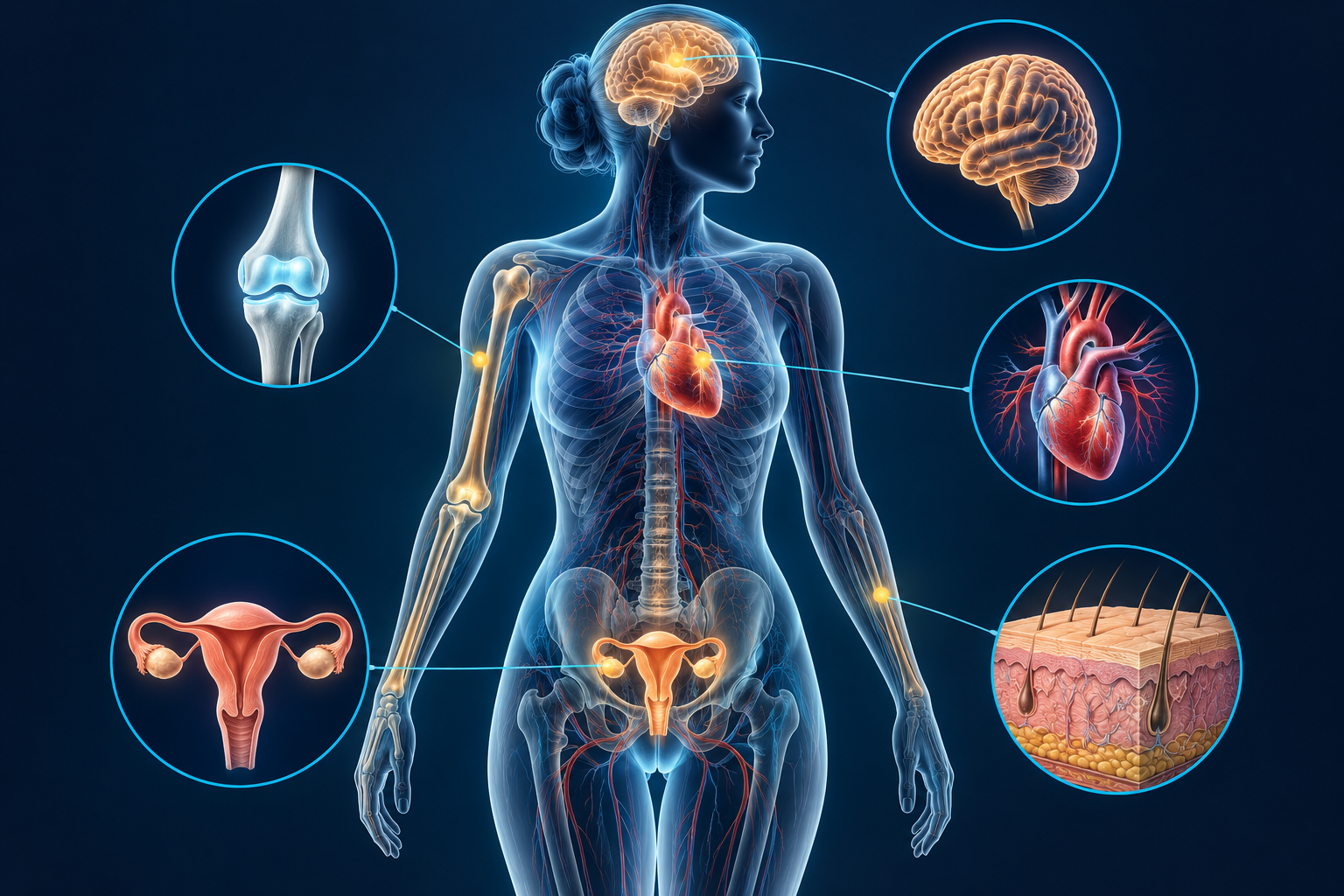
Estrogen receptors are found throughout the body, including in the reproductive system, bones, brain, cardiovascular system, skin, and other tissues. That means changing estrogen levels can affect far more than menstrual cycles or fertility.
Estrogen helps regulate reproductive function, maintain bone strength, influence brain signaling, support blood-vessel function, and affect the health and behavior of multiple tissues throughout the body.
Understanding these broader effects becomes especially important during perimenopause and menopause, when estrogen levels can fluctuate significantly and eventually decline.
Here is what estrogen actually does throughout the body.
What Is Estrogen?
Estrogen refers to a group of steroid hormones rather than one single hormone.
The three primary forms are:
- Estradiol (E2): The predominant estrogen during the reproductive years.
- Estrone (E1): Becomes relatively more prominent after menopause.
- Estriol (E3): Produced in much larger amounts during pregnancy.
Estradiol is generally considered the most biologically active form during the reproductive years.
Estrogen works by binding to estrogen receptors located throughout the body. Major receptors include estrogen receptor alpha, estrogen receptor beta, and the G protein-coupled estrogen receptor.
Once activated, these receptors can influence gene expression and cellular signaling, helping explain why estrogen has effects in so many different organs.
1. Estrogen and Reproductive Health
Estrogen’s most familiar role involves the reproductive system.
During the menstrual cycle, estrogen helps coordinate changes involving the ovaries, uterus, cervix, vagina, and brain.
Supporting the menstrual cycle
During the first portion of the menstrual cycle, developing ovarian follicles produce increasing amounts of estradiol.
Rising estrogen helps:
- Build the uterine lining
- Coordinate signaling between the ovaries and brain
- Participate in regulation of ovulation
- Support reproductive tissue function
Estrogen is therefore part of a larger communication system involving the hypothalamus, pituitary gland, ovaries, and reproductive organs.
Maintaining vaginal and urinary tissues
Estrogen also helps maintain the thickness, elasticity, blood flow, and moisture of vaginal and surrounding urogenital tissues.
When estrogen declines after menopause, some women experience symptoms such as:
- Vaginal dryness
- Burning or irritation
- Pain during intercourse
- Changes in urinary symptoms
- Recurrent urinary tract infections
These changes are often grouped under the term genitourinary syndrome of menopause, or GSM.
Estrogen’s reproductive effects are therefore not limited to fertility. It also contributes to tissue maintenance throughout adulthood.
2. Estrogen and Bone Health
One of estrogen’s most important non-reproductive roles involves the skeleton.
Bone is living tissue that is continually being broken down and rebuilt through a process called bone remodeling.
Estrogen helps maintain balance within that process.
When estrogen levels fall significantly, bone breakdown can begin occurring faster than bone formation. This is one reason bone loss can accelerate during and after the menopausal transition.
Conditions associated with estrogen deficiency, including early menopause and certain reproductive disorders, are linked with reduced bone mineral density and increased fracture risk.
Why bone loss matters after menopause
The decrease in estrogen surrounding menopause can contribute to declining bone density over time.
Depending on individual risk factors, that may eventually increase the likelihood of:
- Osteopenia
- Osteoporosis
- Hip fractures
- Vertebral fractures
- Other fragility fractures
Bone health is influenced by much more than estrogen alone.
Adequate protein, calcium, vitamin D, resistance training, impact exercise when appropriate, muscle mass, genetics, medications, smoking status, and overall health all matter.
Still, declining estrogen is an important piece of the bone-health equation.
3. Estrogen and the Brain
Estrogen receptors are also present throughout the brain.
Estrogen participates in nervous-system signaling and can influence areas involved in cognition, mood, temperature regulation, reproduction, sleep, and other functions. Research continues to investigate exactly how these effects translate into long-term neurological health.
Estrogen and temperature regulation
One of the clearest examples occurs during menopause.
Changes in estrogen signaling influence the brain’s temperature-regulating systems.
As estrogen fluctuates and declines, the body’s thermoregulatory zone can become more sensitive.
The result may be:
- Hot flashes
- Night sweats
- Sudden flushing
- Sleep disruption
This helps explain why hot flashes are not simply the body “getting hot.”
They involve changes in brain signaling related to temperature control.
Estrogen, mood, and cognition
Estrogen interacts with neurotransmitter and cellular signaling systems involved in mood and brain function.
Some women notice changes during perimenopause such as:
- Difficulty concentrating
- Forgetfulness
- Mood changes
- Increased irritability
- Sleep problems
However, these symptoms are rarely caused by estrogen alone.
Sleep disruption, stress, thyroid function, medications, iron status, mental health, lifestyle factors, and other hormonal changes may contribute.
That is why symptoms should be evaluated in context rather than automatically attributed to a single hormone.
4. Estrogen and Blood Vessels
Estrogen also interacts with the cardiovascular system.
Estrogen receptors are found in vascular and cardiac tissues, including cells lining the inside of blood vessels.
Research suggests estrogen can influence endothelial function, inflammation, vascular signaling, lipid metabolism, and production of nitric oxide, a molecule that helps regulate blood-vessel relaxation.
What happens after menopause?
Cardiovascular risk tends to increase as people age, and the hormonal transition surrounding menopause may be one contributor among many.
Cardiovascular health is influenced by factors including:
- Blood pressure
- LDL cholesterol
- HDL cholesterol
- Triglycerides
- Blood glucose
- Insulin resistance
- Smoking
- Body composition
- Physical activity
- Sleep
- Family history
Estrogen should therefore not be viewed as a simple cardiovascular “protective switch.”
The relationship between estrogen, menopause, cardiovascular disease, and hormone therapy is much more complex.
For example, the cardiovascular effects of menopausal hormone therapy can vary according to factors such as age, timing relative to menopause, route of administration, dose, and an individual’s underlying health risks.
Hormone therapy should not be started solely because someone assumes more estrogen automatically equals better heart health.
5. Estrogen and Skin
Skin is another estrogen-responsive tissue.
Estrogen signaling can influence:
- Collagen
- Skin thickness
- Elasticity
- Hydration
- Wound healing
- Blood flow
As estrogen levels decline with age and menopause, some women notice their skin becoming:
- Drier
- Thinner
- Less elastic
- More fragile
Not every change associated with aging is caused by estrogen, however.
Sun exposure, smoking, nutrition, genetics, hydration, stress, and normal chronological aging also influence skin health.
6. Estrogen and Connective Tissues
Estrogen receptors are found in several types of connective tissue.
Research continues to examine how changing estrogen levels may influence tendons, ligaments, muscles, cartilage, and other musculoskeletal tissues.
This is especially relevant during midlife because some women report new changes in:
- Joint comfort
- Muscle recovery
- Stiffness
- Tendon symptoms
- Physical performance
Again, these symptoms are multifactorial.
Training volume, muscle strength, sleep, inflammatory conditions, previous injuries, body composition, protein intake, and normal aging all need to be considered.
7. Estrogen and Breast Tissue
Breast tissue is highly responsive to estrogen.
During puberty and reproductive life, estrogen contributes to breast development and normal tissue activity.
However, estrogen signaling can also stimulate the growth of certain hormone-sensitive breast cancer cells.
This is why hormone exposure cannot be divided into simplistic categories of “good estrogen” and “bad estrogen.”
Hormones produce different effects depending on:
- The tissue involved
- Receptor type
- Hormone concentration
- Age
- Health history
- Duration of exposure
- Other hormones and signaling molecules
Understanding this becomes especially important when discussing menopausal hormone therapy or a personal history of hormone-sensitive cancer.
8. Estrogen Affects Men Too
Although estrogen is often discussed in relation to women’s health, men also produce and require estrogen.
In men, much of the body’s estradiol is produced when testosterone is converted into estrogen through an enzyme called aromatase.
Estrogen contributes to normal physiology in men, including bone and reproductive function.
Extremely low estrogen levels therefore are not necessarily desirable simply because testosterone is considered the predominant male sex hormone.
Hormonal health depends on balance and appropriate physiology, not maximizing one hormone while suppressing another.
What Happens When Estrogen Declines During Perimenopause?
Perimenopause is not simply a period of continuously falling estrogen.
Hormonal patterns can become highly variable.
Estrogen may rise significantly during some cycles and fall during others. Ovulation may become less consistent, and progesterone production may also change.
This variability helps explain why symptoms can seem unpredictable.
Someone might feel relatively normal one month and experience significant symptoms the next.
Common symptoms associated with the menopausal transition can include:
- Hot flashes
- Night sweats
- Menstrual changes
- Sleep disruption
- Vaginal dryness
- Mood changes
- Changes in sexual function
- Brain fog
- Changes in body composition
After menopause, ovarian estrogen production declines substantially and remains much lower than during the reproductive years.
The resulting effects extend beyond reproductive tissues and can involve skeletal, neurological, cardiovascular, dermatologic, and other systems.
Does Every Estrogen-Related Symptom Mean You Need Hormone Therapy?
No.
This is an important distinction.
Having fatigue, poor sleep, weight gain, low libido, mood changes, or brain fog does not automatically mean estrogen is low or that estrogen therapy is appropriate.
Similar symptoms can occur with:
- Thyroid disorders
- Iron deficiency
- Sleep apnea
- Insulin resistance
- Inadequate nutrition
- Chronic stress
- Depression or anxiety
- Medication effects
- Other hormonal changes
- Poor recovery
- Excessive training
The goal should be to understand the full clinical picture rather than treating a laboratory number or symptom in isolation.
For women experiencing significant menopausal symptoms, menopausal hormone therapy may be an option depending on their health history, symptoms, age, risk factors, and treatment goals.
Treatment decisions should be individualized with an appropriately qualified healthcare professional.
Estrogen Is a Whole-Body Hormone
Estrogen should not be thought of exclusively as a fertility or menstrual-cycle hormone.
Its receptors are distributed throughout the body, allowing estrogen to influence reproductive organs, bones, the nervous system, cardiovascular tissues, skin, metabolism, and other systems.
That helps explain why the hormonal transition through perimenopause and menopause can feel so different from person to person.
Changes occurring in the reproductive system are only one part of a much larger physiological transition.
And when symptoms appear, the best approach usually is not to ask:
“How do I increase my estrogen?”
A better question is:
“What is changing in my physiology, what else could be contributing, and what does my individual health picture show?”
That is where thoughtful evaluation becomes valuable.
Frequently Asked Questions
What is the main function of estrogen?
Estrogen has multiple functions rather than one single purpose. It helps regulate reproductive physiology while also influencing bone remodeling, brain signaling, blood vessels, skin, metabolism, and other tissues.
Does estrogen affect bones?
Yes. Estrogen plays an important role in maintaining skeletal homeostasis. Significant estrogen deficiency can accelerate bone loss and contribute to increased osteoporosis and fracture risk.
Does estrogen affect the brain?
Yes. Estrogen receptors are present in the brain, and estrogen influences neural pathways involved in reproductive signaling, temperature regulation, mood, cognition, and other functions.
Does estrogen affect cardiovascular health?
Estrogen interacts with cardiovascular tissues and can influence endothelial function, vascular signaling, nitric oxide production, inflammation, and metabolism. Cardiovascular disease risk is complex, however, and cannot be predicted from estrogen levels alone.
Why does low estrogen affect so many parts of the body?
Estrogen receptors are located in many different tissues. When hormone concentrations change, signaling through those receptors can change as well, which is why declining estrogen can have effects beyond the reproductive system.
Do men need estrogen?
Yes. Men naturally produce estrogen, primarily through conversion of testosterone into estradiol. Estrogen contributes to functions including bone and reproductive health in men.
Should estrogen levels always be tested during perimenopause?
Not necessarily. Hormone concentrations can fluctuate considerably during perimenopause, meaning a single laboratory result may provide limited information. Testing decisions should be based on symptoms, medical history, clinical context, and what question the clinician is attempting to answer.
Key Takeaway
Estrogen’s influence extends far beyond periods and fertility.
It participates in the maintenance and regulation of:
- Reproductive tissues
- Bone
- Brain function
- Blood vessels
- Skin
- Connective tissues
- Metabolism
- Multiple other estrogen-responsive tissues
That whole-body perspective is especially important when evaluating symptoms during perimenopause and menopause.
Rather than focusing on estrogen alone, effective care considers symptoms, health history, lifestyle, laboratory findings when appropriate, other hormones, and long-term risk factors together.
Educational only. This information is not intended to diagnose, treat, cure, or prevent any medical condition and should not replace individualized medical advice.