

You can track steps, sleep scores, calories, heart rate variability, recovery, and enough other metrics to turn your body into a quarterly performance report.
But one measurement deserves more attention than most: VO₂ max.
VO₂ max reflects how effectively your heart, lungs, blood vessels, and muscles work together to deliver and use oxygen during intense exercise. It is widely considered one of the best measures of cardiorespiratory fitness.
Higher cardiorespiratory fitness is consistently associated with a lower risk of cardiovascular disease, chronic illness, functional decline, and premature death. The American Heart Association has even argued that cardiorespiratory fitness should be treated as a clinical vital sign.
That does not mean VO₂ max guarantees a longer life.
It means your aerobic fitness provides valuable information about your body’s ability to handle physical stress, produce energy, and maintain function as you age.
The good news is that VO₂ max is trainable.
You do not need to become an endurance athlete. You need the right combination of consistent aerobic work, appropriately dosed intensity, strength training, recovery, and attention to any health issues limiting your performance.
What Is VO2 Max?
VO₂ max stands for maximal oxygen uptake.
It describes the greatest amount of oxygen your body can take in, transport, and use during strenuous exercise.
VO₂ max is typically expressed as:
Milliliters of oxygen per kilogram of body weight per minute, or mL/kg/min
For example, a VO₂ max of 40 mL/kg/min means your body can use approximately 40 milliliters of oxygen per kilogram of body weight each minute at maximal effort.
That number reflects several systems working together:
- Your lungs must bring oxygen into the body.
- Your heart must pump oxygen-rich blood.
- Your blood vessels must deliver that blood to active tissue.
- Your red blood cells must carry oxygen.
- Your muscles must extract and use oxygen.
- Your mitochondria must convert oxygen and fuel into usable energy.
Cardiorespiratory fitness is therefore not simply a measure of lung capacity. It reflects the performance of an entire oxygen-delivery and energy-production system.
Absolute vs. Relative VO2 Max
VO₂ max can be reported in two ways.
Absolute VO2 Max
Absolute VO₂ max measures total oxygen consumption, usually in liters per minute.
This measurement can be useful in sports and clinical settings because it reflects the body’s total oxygen-processing capacity.
Relative VO2 Max
Relative VO₂ max adjusts oxygen consumption for body weight and reports it in mL/kg/min.
This makes it easier to compare people of different sizes. It is also the number commonly shown on fitness watches and test reports.
However, body weight can influence the result.
If a person loses body fat while maintaining the same absolute oxygen capacity, relative VO₂ max may rise because the denominator, body weight, decreased. That improvement still matters because carrying less unnecessary mass can make walking, running, climbing, and everyday movement easier.
But it is useful to know whether your score improved because:
- Your heart and muscles became more capable.
- Your body weight decreased.
- Both happened at the same time.
Context matters. A single score rarely tells the entire story. Apparently even oxygen refuses to provide a simple answer.
Why Is VO2 Max Connected to Longevity?
VO₂ max does not directly measure how long you will live.
It measures cardiorespiratory fitness, which is strongly associated with long-term health outcomes.
A 2024 overview of meta-analyses included more than 20.9 million observations from 199 cohort studies. The researchers concluded that cardiorespiratory fitness was a strong and consistent predictor of illness and mortality in adults.
Another study followed more than 122,000 adults who completed exercise treadmill testing. Higher fitness was associated with lower all-cause mortality, with the most aerobically fit participants showing the lowest risk.
A major meta-analysis published in JAMA also found an inverse relationship between cardiorespiratory fitness and both all-cause mortality and cardiovascular events.
These associations appear for several reasons.
1. A Stronger Cardiovascular System
Aerobic training can improve the heart’s ability to pump blood efficiently.
With each heartbeat, a well-trained heart can generally move more blood. This helps deliver oxygen while reducing the amount of work required at a given exercise intensity.
2. Better Oxygen Delivery
Aerobic fitness supports blood vessel function, circulation, and the delivery of oxygen to working muscles.
Your VO₂ max partly reflects how well this delivery system performs under stress.
3. Greater Mitochondrial Capacity
Mitochondria help convert oxygen and stored fuel into adenosine triphosphate, or ATP, the energy cells use to perform work.
Aerobic exercise stimulates adaptations that help muscles produce energy more efficiently.
For a deeper explanation, read <a href=”https://1stoptimal.com/mitochondrial-health-science-supplements/“>Mitochondrial Health: What the Science Supports Beyond Supplement Marketing</a>.
4. Improved Metabolic Health
People with higher cardiorespiratory fitness often have better insulin sensitivity, blood pressure regulation, body composition, and metabolic flexibility.
Fitness does not erase every risk factor. However, it can improve the body’s ability to manage glucose, fat, physical stress, and recovery.
5. More Functional Reserve
A high VO₂ max gives you a larger reserve between the effort required for daily activities and your maximum capacity.
If climbing stairs requires 60% of your available capacity, it feels demanding.
If the same stairs require 30%, they feel manageable.
This reserve becomes especially important with age, illness, surgery, travel, physically demanding work, and unexpected stress.
Does a Higher VO2 Max Cause a Longer Life?
This is where responsible interpretation matters.
Most longevity research involving VO₂ max is observational. Researchers repeatedly find that fitter people tend to live longer, but association does not automatically prove that VO₂ max itself causes longevity.
Genetics, body composition, smoking status, income, access to healthcare, underlying disease, physical activity, and other behaviors can influence both fitness and mortality.
A 2025 Mendelian randomization analysis reported that VO₂ max was a strong predictor of mortality but did not establish a direct causal relationship with longevity.
That does not make VO₂ max unimportant.
It means VO₂ max should be viewed as a powerful marker of overall physiological capacity, not a standalone promise that adding five points to your score will add a specific number of years to your life.
Train the systems behind the number.
Do not worship the number.
How Is VO2 Max Tested?
There are several ways to measure or estimate VO₂ max.
Cardiopulmonary Exercise Testing
The most accurate method is a cardiopulmonary exercise test, commonly called a CPET.
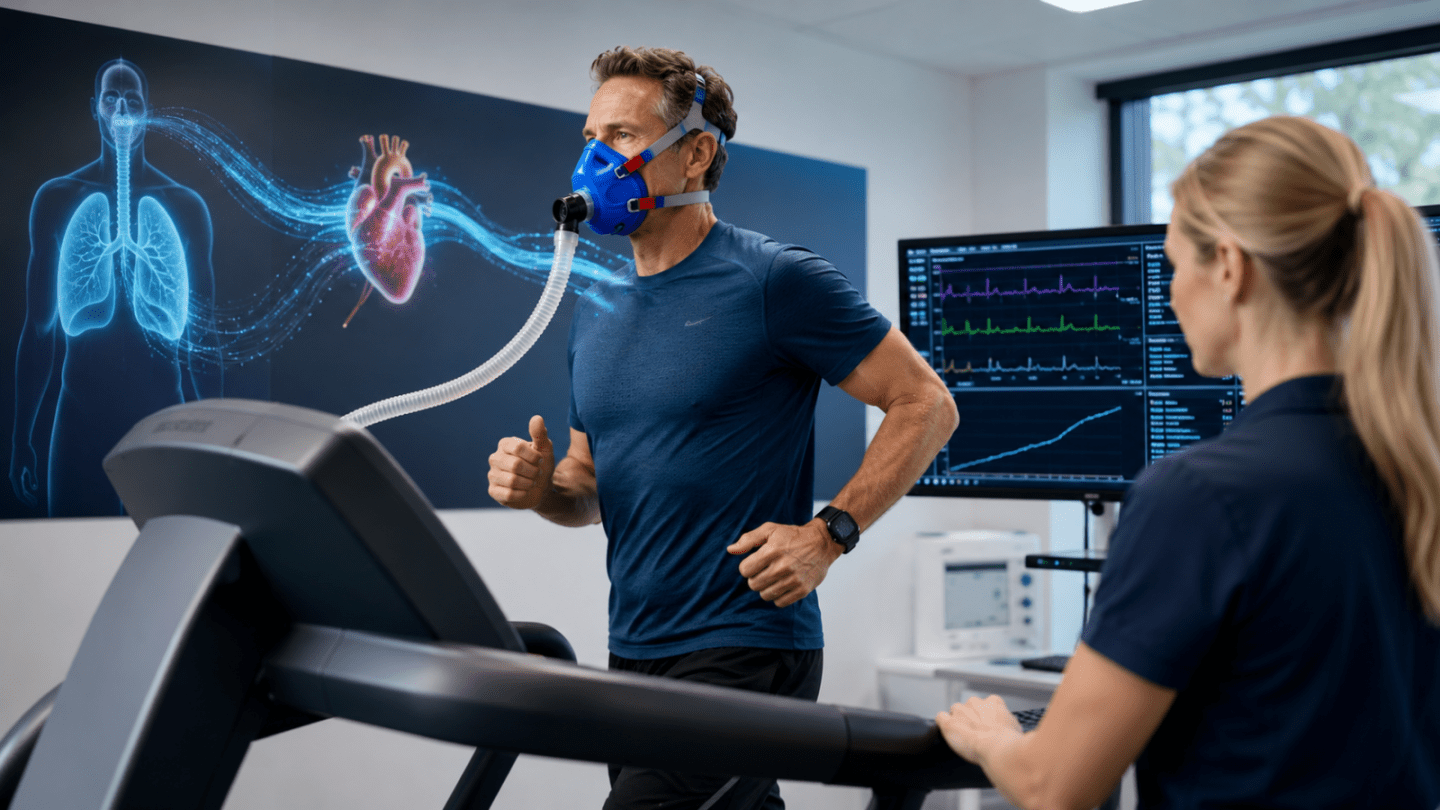
During a CPET, you exercise on a treadmill or stationary bike while wearing a mask connected to equipment that measures:
- Oxygen consumption
- Carbon dioxide production
- Breathing rate
- Ventilation
- Heart rate
- Exercise workload
The intensity gradually increases until you reach maximal effort or meet the test’s stopping criteria.
A CPET can provide more than a VO₂ max number. Depending on the test and setting, it may also help evaluate ventilatory thresholds, exercise tolerance, cardiovascular limitations, pulmonary limitations, and training zones.
Submaximal Exercise Tests
Submaximal tests estimate aerobic capacity without requiring an all-out effort.
Common options include:
- Treadmill walking protocols
- Stationary bike protocols
- Step tests
- Timed walking or running tests
These tests can be useful when laboratory testing is unavailable, but the result remains an estimate.
Smartwatch Estimates
Some fitness watches estimate VO₂ max using heart rate, pace, age, sex, body weight, and movement data.
They can be helpful for monitoring long-term trends, particularly when you use the same device under similar conditions.
They are not equivalent to direct gas analysis.
Research suggests exercise-based wearable estimates tend to be more accurate than estimates based primarily on resting data. Accuracy can still vary by device, fitness level, exercise type, terrain, temperature, and the quality of heart-rate data.
Use the watch to identify a direction.
Do not treat a two-point weekly fluctuation as a medical event.
What Is a Good VO2 Max?
A “good” VO₂ max depends on:
- Age
- Sex
- Body size
- Exercise mode
- Training background
- Test protocol
- Health status
- Medications
- Altitude
Men generally have higher average values than women because of differences in body composition, heart size, hemoglobin concentration, and other physiological factors.
VO₂ max also tends to decline with age. Longitudinal research suggests the rate of decline may accelerate later in adulthood, although staying physically active can slow the loss.
Because norms vary, compare your score with validated reference values for your:
- Age group
- Sex
- Testing method
Percentile rank is often more meaningful than chasing a universal number.
Your personal trend matters too.
Moving from below-average fitness toward average fitness may provide more meaningful benefit than an already well-trained athlete adding one more point to an elite score.
What Can Lower VO2 Max?
A low or declining VO₂ max can reflect more than inconsistent cardio.
Potential contributors include:
- Physical inactivity
- Aging
- Loss of muscle mass
- Increased body fat
- Poor sleep
- Smoking
- Anemia or low iron availability
- Cardiovascular disease
- Lung disease
- Uncontrolled blood pressure
- Metabolic disease
- Recent illness
- Overtraining
- Inadequate recovery
- Certain medications
- Thyroid dysfunction
- Low calorie or nutrient intake
This is why unexplained exercise intolerance should not automatically be labeled a motivation problem.
If your capacity has dropped significantly, or normal workouts suddenly feel unusually difficult, the right response may be evaluation rather than more intensity.
At 1st Optimal, advanced testing may examine relevant factors such as:
- Complete blood count
- Iron and ferritin
- Comprehensive metabolic panel
- Hemoglobin A1c
- Fasting glucose and insulin
- Lipid profile
- Thyroid markers
- Sex hormones when clinically appropriate
- Inflammation markers
- Nutrient status
Testing should follow symptoms and clinical context. Ordering every marker available is not a personality trait.
How to Improve VO2 Max
The best program combines lower-intensity aerobic volume with targeted higher-intensity work.
1. Build an Aerobic Base
Moderate aerobic training helps build the foundation needed to tolerate more intense work.
Options include:
- Brisk walking
- Incline treadmill walking
- Cycling
- Rowing
- Swimming
- Hiking
- Elliptical training
- Easy jogging
A common approach is conversational-pace training, often called Zone 2 training. You should be working, but you should still be able to speak in short sentences.
Zone 2 definitions vary, and heart-rate formulas are imperfect. The practical goal is a sustainable intensity that increases breathing without turning every session into a test of character.
Start with 20 to 30 minutes two or three times per week.
Gradually build toward 30 to 60 minutes per session, depending on your goals, schedule, fitness, and recovery.
2. Add High-Intensity Intervals
Higher-intensity intervals can provide a strong stimulus for improving VO₂ max.
A meta-analysis of controlled trials found that endurance interval training produced meaningful improvements in VO₂ max. Research has also shown that high-intensity aerobic intervals can improve VO₂ max more than lower-intensity continuous training in some populations and protocols.
One widely used interval session is:
- Warm up for 10 minutes.
- Work hard for 4 minutes.
- Recover easily for 3 minutes.
- Repeat for four rounds.
- Cool down for 5 to 10 minutes.
The hard intervals should feel challenging but controlled. You are not sprinting as if something with teeth is chasing you.
Beginners may start with:
- 30 seconds hard
- 90 seconds easy
- Six to eight rounds
Other useful formats include:
- 1 minute hard, 2 minutes easy
- 2 minutes hard, 2 minutes easy
- 3 minutes hard, 3 minutes easy
- Short hill intervals
One interval session per week may be enough initially.
Well-trained people may tolerate two, but more is not automatically better. High-intensity work creates a larger recovery demand and should be balanced with lower-intensity training.
3. Strength Train
Strength training does not replace aerobic training, but it supports it.
Stronger muscles can improve movement economy, preserve lean mass, support glucose regulation, protect joints, and make daily activity less physically demanding.
Aim for two to four resistance-training sessions per week based on your experience and recovery.
Prioritize movements such as:
- Squats or leg presses
- Hinges or deadlift variations
- Lunges or step-ups
- Rows
- Presses
- Carries
- Calf training
- Core stability
Adults should generally include muscle-strengthening work for all major muscle groups at least two days per week, alongside aerobic activity.
4. Progress Gradually
Your cardiovascular system can improve faster than your joints, tendons, and connective tissue adapt.
Increase one variable at a time:
- Duration
- Frequency
- Intensity
- Hills
- Speed
Avoid increasing everything during the same week.
A reasonable progression might add 5 to 10 minutes of total weekly aerobic work or one additional interval, depending on your starting point.
Consistency beats heroic workouts followed by five days of soreness and personal regret.
5. Improve Body Composition Without Sacrificing Muscle
Because relative VO₂ max accounts for body weight, losing excess body fat can improve your score.
However, aggressive dieting can reduce muscle, recovery, training performance, and total work capacity.
Prioritize:
- Adequate protein
- Progressive strength training
- A moderate calorie deficit when fat loss is appropriate
- Sleep
- Hydration
- Sufficient carbohydrates to support demanding exercise
- A sustainable rate of weight loss
The goal is not simply to become lighter.
The goal is to improve the amount of functional capacity you carry per unit of body weight.
6. Protect Sleep and Recovery
VO₂ max improves during recovery from training, not simply during the workout itself.
Poor sleep can reduce performance, increase perceived effort, disrupt appetite, and make high-quality training harder to sustain.
Build around:
- Seven or more hours of sleep opportunity
- Consistent sleep and wake times
- Lower-intensity days between hard sessions
- Adequate calorie and protein intake
- Hydration
- Stress management
- Planned easier training weeks
If performance continues to decline despite more effort, the answer may be less training, better recovery, or an evaluation for an underlying issue.
A Sample Weekly VO2 Max Training Plan
This example suits a generally healthy adult who already exercises and tolerates moderate activity.
Monday: Strength Training
Full-body strength workout for 45 to 60 minutes.
Tuesday: Aerobic Base
30 to 45 minutes of brisk walking, cycling, rowing, or easy jogging at a conversational pace.
Wednesday: Recovery
Easy walking, mobility, or rest.
Thursday: VO2 Max Intervals
- 10-minute warm-up
- Four rounds of 3 minutes hard
- 3 minutes of easy recovery between rounds
- 5 to 10-minute cool-down
Friday: Strength Training
Full-body strength workout for 45 to 60 minutes.
Saturday: Longer Aerobic Session
45 to 75 minutes at an easy-to-moderate pace.
Sunday: Rest or Easy Movement
Walking, mobility, light cycling, or recreational activity.
A beginner should reduce the duration and interval volume.
An experienced athlete may need more specific programming based on current fitness, sport, recovery, and testing data.
How Quickly Can VO2 Max Improve?
Changes depend on your starting fitness, age, genetics, training history, program design, and consistency.
Someone who has been inactive may see noticeable improvement within several weeks.
A well-trained athlete may improve more slowly because they are already closer to their current ceiling.
Training studies have reported average improvements of several mL/kg/min, but individual responses vary substantially.
Retesting after approximately 8 to 12 weeks can provide enough time to identify a meaningful trend.
Try to repeat the same:
- Testing protocol
- Equipment
- Time of day
- Pre-test nutrition
- Caffeine routine
- Environment
- Recovery status
Otherwise, you may end up comparing fitness with weather, fatigue, and whether the treadmill technician was feeling ambitious that morning.
When Should You Get Medical Guidance?
Most healthy adults can begin with light or moderate exercise and progress gradually.
Speak with a healthcare professional before maximal testing or vigorous training if you have:
- Known heart or lung disease
- Uncontrolled high blood pressure
- Chest pressure with activity
- Unexplained fainting or dizziness
- An irregular heartbeat
- Severe or unusual shortness of breath
- A major recent illness
- A significant unexplained decline in exercise capacity
- A condition or medication that affects exercise safety
Stop exercising and seek medical evaluation if activity causes chest pain, unusual shortness of breath, lightheadedness, confusion, or a fast or irregular heartbeat.
VO2 Max Is One Part of Longevity
VO₂ max matters, but longevity is not one-dimensional.
A complete healthspan strategy should also address:
- Muscle mass
- Strength
- Power
- Balance
- Blood pressure
- Glucose regulation
- Cholesterol and lipoproteins
- Sleep
- Nutrition
- Body composition
- Mental health
- Social connection
- Smoking and alcohol exposure
- Preventive healthcare
- Hormonal and metabolic health when clinically relevant
Someone can have an excellent VO₂ max and still ignore strength, sleep, blood pressure, or other major risk factors.
The strongest longevity plan builds several types of reserve:
- Aerobic reserve
- Strength reserve
- Metabolic reserve
- Cognitive reserve
- Emotional and social resilience
VO₂ max is an important piece of that system, not the entire system.
The Bottom Line
VO₂ max measures your body’s maximum ability to take in, transport, and use oxygen during intense exercise.
Higher cardiorespiratory fitness is strongly associated with better health outcomes and lower mortality risk. It also gives you more physical reserve for work, recreation, illness, recovery, and independent living.
The most effective approach includes:
- Regular moderate aerobic training
- One or two appropriately dosed interval sessions
- Strength training
- Gradual progression
- Adequate nutrition
- Sleep and recovery
- Evaluation of unexplained exercise intolerance
You do not need an elite score.
You need enough aerobic capacity to support the life you want now and preserve the function you will need later.
Track the trend. Train consistently. Investigate meaningful changes.
The goal is not simply to produce a better number.
The goal is to build a body that can keep doing more of what matters.
Frequently Asked Questions
Is VO2 max the best predictor of longevity?
VO₂ max is one of the strongest measurable predictors of long-term health outcomes, but it is not a complete longevity assessment. Strength, body composition, blood pressure, metabolic health, smoking status, sleep, and other factors also matter.
Can walking improve VO2 max?
Yes. Brisk walking can improve aerobic fitness, especially in sedentary or lower-fitness individuals. As fitness improves, you may need longer sessions, hills, faster walking, or intervals to continue progressing.
Is Zone 2 or HIIT better for VO2 max?
High-intensity interval training, or HIIT, often produces faster VO₂ max improvements. Zone 2 training builds aerobic volume with a lower recovery cost. Most people benefit from combining both rather than forcing every workout into one category.
How often should I train VO2 max?
Most people can start with one dedicated high-intensity session per week, supported by two or more moderate aerobic sessions. Experienced individuals may use two interval sessions if recovery remains strong.
Can strength training increase VO2 max?
Traditional strength training usually produces smaller VO₂ max improvements than aerobic exercise. However, it preserves muscle, improves movement efficiency, supports metabolic health, and complements aerobic training.
Are smartwatch VO2 max scores accurate?
They are estimates. They can be useful for tracking trends, but their accuracy varies. A laboratory cardiopulmonary exercise test provides a more direct measurement.
Does VO2 max decline with age?
VO₂ max generally declines with age, partly because of changes in heart function, muscle mass, activity, and training intensity. Regular aerobic and resistance training can slow that decline.
Should I get a VO2 max test?
Testing may be useful if you want a reliable baseline, individualized training zones, performance data, or more information about unexplained exercise limitations. The appropriate test depends on your health, symptoms, and goals.
References
- American Heart Association. Scientific statement on assessing cardiorespiratory fitness as a clinical vital sign.
- Lang JJ, et al. Overview of meta-analyses examining cardiorespiratory fitness, morbidity, and mortality. British Journal of Sports Medicine. 2024.
- Mandsager K, et al. Association of cardiorespiratory fitness with long-term mortality. JAMA Network Open. 2018.
- Kodama S, et al. Cardiorespiratory fitness as a predictor of mortality and cardiovascular events. JAMA. 2009.
- Molina-Garcia P, et al. Validity of wearable estimates of maximal oxygen consumption. 2022.
Educational only, not medical advice.


