

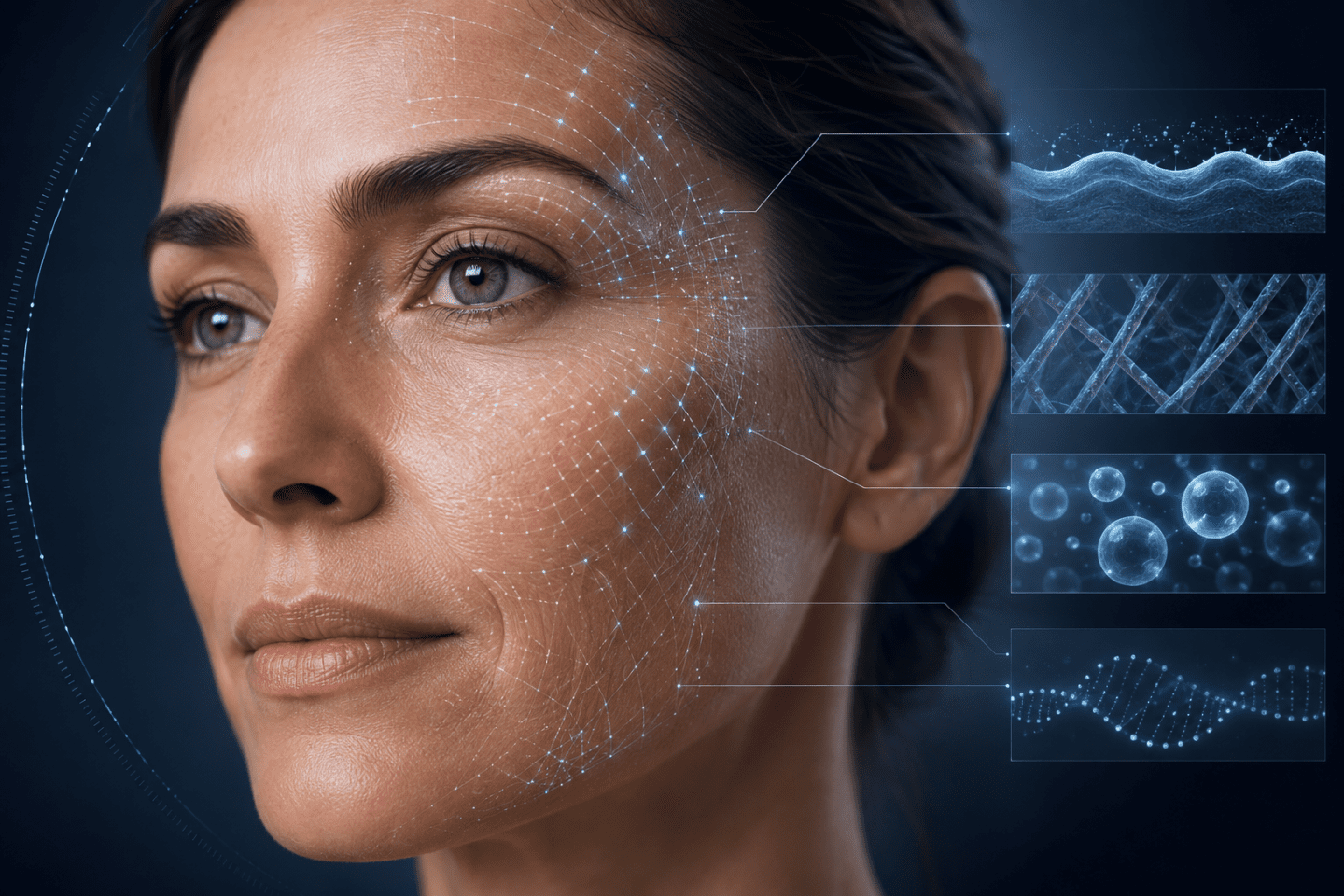
What If We Measured Skin Health the Way We Measure Heart Health?
For decades, conversations about aging skin have focused primarily on appearance.
Wrinkles. Fine lines. Pigmentation. Sagging. Dryness.
But longevity medicine is changing the question.
Instead of asking only, “How young does your skin look?”, researchers are beginning to ask:
“How well is your skin functioning for its age?”
That distinction is at the heart of an emerging concept called skinspan.
Similar to how healthspan describes the years of life spent in good health, skinspan aims to describe how long the skin maintains healthy structure, function, resilience, and appearance relative to chronological age.
The concept moved further into scientific discussion in 2025, when researchers published peer-reviewed frameworks specifically examining skinspan and its relationship to the biology of aging.
The bigger question is whether skinspan can evolve from an interesting concept into something we can actually measure, monitor, and potentially improve over time.
The answer appears to be: possibly, but the science is still developing.
What Is Skinspan?
Skinspan can be thought of as the period during which your skin maintains a relatively high level of:
- Barrier function
- Structural integrity
- Hydration
- Elasticity
- Repair capacity
- Immune protection
- Pigment regulation
- Cellular function
- Resistance to environmental stress
A 2025 review in the Journal of Cosmetic Dermatology described skinspan as the preservation of healthy, youthful skin relative to chronological age, while researchers writing in Mayo Clinic Proceedings proposed a broader healthy-longevity framework that connects skin aging with intrinsic biology, environmental exposures, and the established hallmarks of aging.
That is important because healthy skin does much more than determine how old someone looks.
Skin is a living organ involved in barrier protection, immune surveillance, temperature regulation, sensation, wound healing, water retention, and protection from environmental exposures.
So maintaining skin health throughout aging may eventually be viewed as another component of functional longevity, not simply cosmetic medicine.
Skin Age Is Not Necessarily the Same as Chronological Age
Two people can both be 48 years old and have very different skin physiology.
One may have relatively strong elasticity, consistent pigmentation, good barrier function, and minimal photodamage.
The other may have significant dryness, pigmentation changes, reduced elasticity, chronic inflammation, or substantial sun damage.
Why?
Because chronological age is only one contributor to skin aging.
Researchers frequently divide skin aging into two overlapping categories.
Intrinsic Aging
Intrinsic aging refers to biological changes that occur naturally over time.
These may include changes involving:
- Cellular renewal
- Collagen production
- Elastin organization
- Mitochondrial function
- Hormonal signaling
- DNA repair
- Cellular senescence
- Epigenetic regulation
Extrinsic Aging
Extrinsic aging results from accumulated environmental and behavioral exposures, sometimes described collectively as the skin exposome.
Important contributors may include:
- Ultraviolet radiation
- Smoking
- Air pollution
- Nutrition
- Sleep disruption
- Psychological stress
- Temperature and environmental exposure
UV radiation remains one of the most important external drivers of premature skin aging, while smoking and pollution also contribute significantly through pathways involving oxidative stress and inflammation.
In other words, your skin effectively carries a biological record of both time and exposure.
Can Skin Aging Actually Be Measured?
Potentially, yes.
And this is where the skinspan concept becomes particularly interesting.
Traditional assessments of skin aging have relied heavily on visible features such as wrinkles, pigmentation, roughness, and laxity.
Modern research can go considerably deeper.
Scientists can now evaluate multiple layers of skin biology, ranging from simple hydration measurements to cellular and molecular biomarkers.
A comprehensive 2026 review of skin-aging evaluation described potential measurements spanning physical appearance, barrier function, elasticity, advanced glycation products, inflammatory proteins, oxidative damage, and other biological features.
There is not yet one universally accepted “skinspan score.”
Instead, future assessments may combine several categories of measurement.
1. Skin Barrier Function
One of the skin’s primary jobs is preventing excessive water loss while protecting the body from the outside environment.
Researchers can assess this using measurements such as:
Transepidermal Water Loss (TEWL)
TEWL measures how much water escapes through the skin.
Changes may help researchers evaluate how effectively the skin barrier is functioning.
Stratum Corneum Hydration
Specialized devices can estimate hydration in the outermost layer of the skin.
Skin Surface pH
Changes in skin pH can influence barrier function and the skin microbiome.
These measurements are already widely used in dermatologic and cosmetic research and could become part of future skin-longevity assessments.
2. Skin Elasticity and Mechanical Strength
Healthy dermal tissue contains collagen and elastin that help skin maintain strength and recover after stretching.
With aging, these structural proteins become altered and fragmented.
Devices such as a Cutometer can measure how the skin responds to controlled suction and how efficiently it returns toward its original position.
This provides a more objective measurement of elasticity than simply looking at photographs.
Reduced elasticity is consistently associated with skin aging.
3. Pigmentation and Photoaging
Digital imaging systems can quantify changes including:
- Uneven pigmentation
- Sunspots
- Redness
- Wrinkle depth
- Surface texture
- Photodamage
High-resolution photography combined with computer-assisted analysis may eventually allow clinicians to track skin aging longitudinally instead of relying exclusively on subjective visual assessments.
Importantly, visible photodamage is not purely cosmetic.
Chronic UV exposure contributes to DNA damage, oxidative stress, abnormal pigmentation, collagen breakdown, and cellular senescence.
4. Advanced Glycation End Products
Another potentially measurable feature of tissue aging involves advanced glycation end products, or AGEs.
AGEs form when sugars react with proteins or fats.
Over time, accumulation of these compounds can alter structural proteins such as collagen.
Researchers can estimate AGE accumulation in the skin using techniques such as skin autofluorescence. Skin-aging reviews increasingly include AGE measurements among potential objective biomarkers of tissue aging.
This is one example of how skin assessment could move beyond appearance toward tissue biology.
5. Cellular Senescence
One of the most important topics in longevity research is cellular senescence.
Senescent cells are cells that have stopped dividing but remain biologically active.
They can release inflammatory and tissue-remodeling signals collectively known as the senescence-associated secretory phenotype, or SASP.
Senescence increases with aging and may contribute to changes in tissue repair, inflammation, and extracellular matrix integrity.
Markers associated with senescence and inflammatory signaling in aging skin are now being studied as potential components of more sophisticated skin-aging assessments.
6. Epigenetic Skin Age
One of the most intriguing areas of research involves epigenetic clocks.
Epigenetics refers to chemical modifications that influence how genes are expressed without changing the underlying DNA sequence.
Patterns of DNA methylation change as humans age.
Researchers have therefore developed algorithms designed to estimate biological age using these patterns.
Similar concepts are now being investigated specifically in skin.
Emerging research is examining whether skin-specific epigenetic profiles could help identify accelerated biological aging caused by factors such as UV exposure, smoking, pollution, diet, sleep, and chronic stress.
This could eventually make it possible to distinguish between:
Chronological skin age: how many years you have been alive.
and
Biological skin age: how old the tissue appears to be functioning at the cellular level.
That possibility is exciting, but epigenetic skin clocks are not yet routine clinical tools for directing treatment.
Is Your Skin a Window Into Whole-Body Aging?
This is where researchers need to be careful.
Skin aging and systemic aging share several biological mechanisms, including:
- Oxidative stress
- Chronic inflammation
- Mitochondrial dysfunction
- Cellular senescence
- DNA damage
- Epigenetic alteration
- Changes in protein maintenance
- Extracellular matrix degradation
These overlaps have led scientists to investigate whether skin biomarkers might provide clues about broader biological aging.
But healthy-looking skin does not necessarily mean someone has healthy arteries, strong metabolic health, normal blood pressure, good cardiovascular fitness, or low disease risk.
Likewise, someone can have substantial sun damage while being metabolically healthy.
Skinspan should therefore not be treated as a replacement for established longevity measurements.
Instead, it may eventually become one additional layer of biological information.
What Appears to Extend Skinspan?
The most interesting part of longevity science is not simply measuring aging.
It is identifying interventions that actually improve meaningful outcomes.
And this is where evidence quality matters.
Many products marketed for “anti-aging” have much stronger advertising than clinical evidence.
A skinspan approach asks a more rigorous question:
Does the intervention improve the biology, structure, or function of skin over time?
A 2025 peer-reviewed skinspan framework recommended emphasizing evidence-backed foundational interventions first, while treating many newer regenerative approaches as emerging or investigational.
Sun Protection Is Still One of the Strongest Interventions
Longevity sometimes becomes associated with highly advanced technology.
For skin, however, one of the most effective strategies remains remarkably basic:
Reduce excessive ultraviolet exposure.
A randomized controlled trial involving 903 adults found that participants assigned to daily broad-spectrum sunscreen had significantly less progression of skin aging over 4.5 years than those using sunscreen at their discretion.
That makes consistent sun protection one of the better-supported interventions for preserving skin health.
Practical strategies include:
- Broad-spectrum sunscreen
- Protective clothing
- Shade
- Avoiding intentional tanning
- Limiting excessive midday UV exposure
The goal is not to fear sunlight.
It is to reduce cumulative UV damage.
Retinoids Have Some of the Strongest Topical Evidence
Topical retinoids have decades of research supporting their effects on photoaged skin.
They influence epidermal turnover, collagen-related pathways, and dermal structure.
This is one reason evidence-based skinspan frameworks frequently place topical retinoids alongside sun protection as foundational interventions.
They are not appropriate for everyone, however, and strength, formulation, irritation risk, pregnancy considerations, and other factors matter.
A dermatologist or qualified healthcare professional can help determine whether prescription or over-the-counter retinoid therapy is appropriate.
Nutrition May Matter, but Supplements Are Not a Shortcut
Skin depends on adequate nutrition for normal cell turnover, collagen formation, antioxidant defense, wound healing, and barrier function.
Research examining lifestyle and skin aging suggests that dietary quality may influence pathways involving oxidative stress, glycation, inflammation, and tissue integrity.
That does not mean taking a collection of “anti-aging” supplements guarantees younger skin.
Instead, the foundational priorities remain:
- Adequate protein
- Sufficient micronutrients
- Fruits and vegetables
- Healthy fats
- Appropriate energy intake
- Good metabolic health
For someone who is under-eating, nutrient deficient, or rapidly losing weight, adding another supplement may be less useful than correcting the underlying nutritional problem.
Sleep and Stress May Show Up in the Skin
Skin does not operate independently from the nervous, endocrine, and immune systems.
Poor sleep and chronic psychological stress may influence:
- Skin barrier recovery
- Inflammatory signaling
- Oxidative stress
- Hormonal signaling
- Collagen-related pathways
Recent reviews of lifestyle and skin aging increasingly include restorative sleep and stress regulation among potentially modifiable contributors to healthy skin aging.
This reinforces an important longevity principle:
You cannot completely separate skin health from whole-body health.
Exercise May Influence Skin Biology Too
Exercise is usually discussed in longevity because of its powerful effects on cardiovascular fitness, muscle mass, insulin sensitivity, bone health, and mortality risk.
But emerging evidence suggests regular physical activity may also influence skin physiology through effects on circulation, inflammation, mitochondrial function, and dermal structure.
Recent reviews describe associations between physical activity and improved markers of skin structure and cellular function, although considerably more research is needed before specific exercise prescriptions can be recommended purely for skin longevity.
Exercise should therefore remain part of a broader healthspan strategy, with potential skin benefits considered an additional advantage rather than the primary reason to train.
Smoking Is the Opposite of a Skin-Longevity Strategy
Smoking accelerates visible skin aging and affects skin physiology through several mechanisms, including oxidative stress, vascular damage, inflammation, and collagen degradation.
Tobacco exposure is consistently identified alongside UV radiation and pollution as a major contributor to extrinsic skin aging.
For both skinspan and overall healthspan, avoiding tobacco remains far more evidence-based than most expensive anti-aging interventions.
What About NAD+, Peptides, Stem Cells, and Regenerative Treatments?
This is where the skin-longevity conversation becomes complicated.
Interest is growing in strategies involving:
- NAD+ biology
- Nicotinamide
- Sirtuins
- Peptides
- Growth factors
- Exosomes
- Stem-cell-derived treatments
- Senolytics
- Regenerative procedures
- Energy-based devices
Some approaches have interesting mechanistic or early clinical evidence.
But interesting biology does not automatically equal proven longevity benefit.
A 2025 review proposing a scientific framework for “longevity cosmeceuticals” argued that products claiming to extend skinspan should demonstrate measurable improvements in skin viability, structure, or function and ideally target established mechanisms of aging with adequate clinical validation.
Similarly, a separate 2025 skinspan review categorized several emerging regenerative approaches as later-line or investigational strategies and emphasized the continued need for stronger randomized controlled trials.
This distinction matters.
Mechanism is not outcome.
Showing that something activates a pathway in a laboratory is very different from demonstrating that it safely slows meaningful human skin aging for years.
Could We Eventually Have a Skinspan Score?
Possibly.
A future skin-longevity assessment could combine multiple categories.
For example:
Structural Measurements
Collagen organization, dermal thickness, wrinkles, elasticity.
Functional Measurements
Barrier integrity, TEWL, hydration, wound repair.
Environmental Damage
UV damage, pigmentation patterns, pollution exposure.
Molecular Aging
Epigenetic age, oxidative damage, cellular senescence, inflammatory markers.
Metabolic Context
Glucose regulation, glycation, nutritional status.
Lifestyle Factors
Smoking, alcohol exposure, sleep, stress, exercise, diet, and sun exposure.
Instead of receiving a vague declaration that your skin “looks good for your age,” you might eventually receive a longitudinal profile showing how different aspects of skin biology are changing.
That could be far more useful.
But no standardized, universally validated clinical skinspan score currently exists.
The Biggest Risk: Turning Skinspan Into Another Marketing Buzzword
Every new area of longevity science creates an opportunity for innovation.
It also creates an opportunity for exaggeration.
Consumers may soon encounter products promising to:
Reverse skin age.
Reset cellular aging.
Activate longevity genes.
Regenerate skin at the DNA level.
These claims should be treated cautiously unless supported by appropriate human data.
When evaluating a skin-longevity intervention, ask:
- What exactly was measured?
- Was the research performed in humans?
- Was there a placebo or comparison group?
- How long did the study last?
- Was the outcome appearance, a biomarker, or actual skin function?
- Has the result been independently replicated?
- Are there meaningful safety data?
A biomarker moving in the desired direction does not necessarily prove that biological aging has been reversed.
The same skepticism used elsewhere in longevity medicine should apply to skinspan.
A Practical Skinspan Strategy Today
You do not need an epigenetic skin-age test to start protecting your skin.
The most defensible current approach is surprisingly straightforward:
Protect
Reduce unnecessary UV exposure and avoid tobacco.
Support
Eat adequately, prioritize protein and nutrient-dense foods, exercise regularly, sleep consistently, and address chronic stress.
Maintain
Use a basic skincare routine that supports barrier function rather than constantly irritating the skin with excessive active ingredients.
Treat
When appropriate, discuss evidence-based therapies such as topical retinoids with a qualified clinician.
Screen
Do not confuse longevity skincare with skin cancer prevention. Suspicious or changing lesions deserve evaluation by a dermatology professional.
Measure Carefully
Emerging skin-aging technologies can be useful, but measurements should guide better decisions rather than become another score to obsess over.
Skinspan Fits Into a Bigger Longevity Picture
Perhaps the most valuable part of the skinspan idea is that it changes the objective.
The goal is no longer simply:
Look younger.
The better goal becomes:
Preserve healthy tissue function for as long as possible.
That is fundamentally what longevity medicine is supposed to be about.
Muscle should remain strong.
Bones should remain resilient.
The cardiovascular system should remain capable.
Metabolic health should remain stable.
Cognitive function should remain strong.
And perhaps skin should remain functional, resilient, and capable of repairing itself too.
Skinspan may ultimately become another useful dimension of healthspan.
But for that to happen, the field will need standardized measurements, long-term studies, validated biomarkers, and evidence showing that changes in those biomarkers actually translate into meaningful improvements in skin health.
Until then, skinspan is best viewed as a promising framework rather than a finished clinical metric.
Frequently Asked Questions About Skinspan
What does skinspan mean?
Skinspan describes the period during which skin maintains healthy structure, function, resilience, and appearance relative to chronological age. The concept applies healthspan principles specifically to skin aging.
Can you measure your biological skin age?
Researchers can measure individual components of skin aging, including elasticity, hydration, barrier function, pigmentation, advanced glycation end products, and certain molecular biomarkers. Experimental epigenetic approaches may also estimate biological skin aging. However, there is currently no universally accepted clinical test that produces a definitive biological skin age.
What ages skin the most?
Chronic UV exposure is one of the most important external drivers of premature skin aging. Smoking, pollution, nutrition, sleep, stress, and other cumulative environmental exposures may also contribute.
Can sunscreen slow skin aging?
Evidence suggests it can. In a randomized controlled trial, adults assigned to daily broad-spectrum sunscreen showed less progression of skin aging over 4.5 years compared with discretionary sunscreen users.
Can skin aging be reversed?
Certain features of photoaging and skin dysfunction may improve with appropriate interventions, but claims of completely “reversing biological skin age” go beyond current evidence. Skinspan is better understood as preserving or improving skin function and slowing preventable deterioration rather than literally returning tissue to a younger chronological state.
Are longevity supplements proven to extend skinspan?
Not broadly. Some compounds have promising biological mechanisms or early clinical evidence, but many longevity-related skincare and supplement claims lack long-term human outcome data. Researchers have specifically called for stronger clinical validation before products are considered proven skinspan interventions.
Final Takeaway
Skin health may eventually become a much more measurable part of longevity medicine.
We already have tools capable of measuring hydration, barrier integrity, elasticity, pigmentation, glycation, inflammation, and other aspects of skin biology. Research into cellular senescence, molecular biomarkers, and epigenetic aging could add even more precision.
But we are not yet at the point where a single test can accurately tell someone their true skin age or prove that a treatment has extended their skinspan.
For now, the strongest approach remains remarkably consistent with the rest of evidence-based longevity medicine:
Protect the tissue. Reduce damaging exposures. Support healthy physiology. Measure what matters. Be skeptical of shortcuts.
Because the future of skin longevity may not be about looking 25 forever.
It may be about keeping your skin functioning well at 50, 60, 70, and beyond.
Educational only. This article is not medical advice. Individual skin concerns, changing lesions, or treatment decisions should be discussed with an appropriately qualified healthcare professional.


