
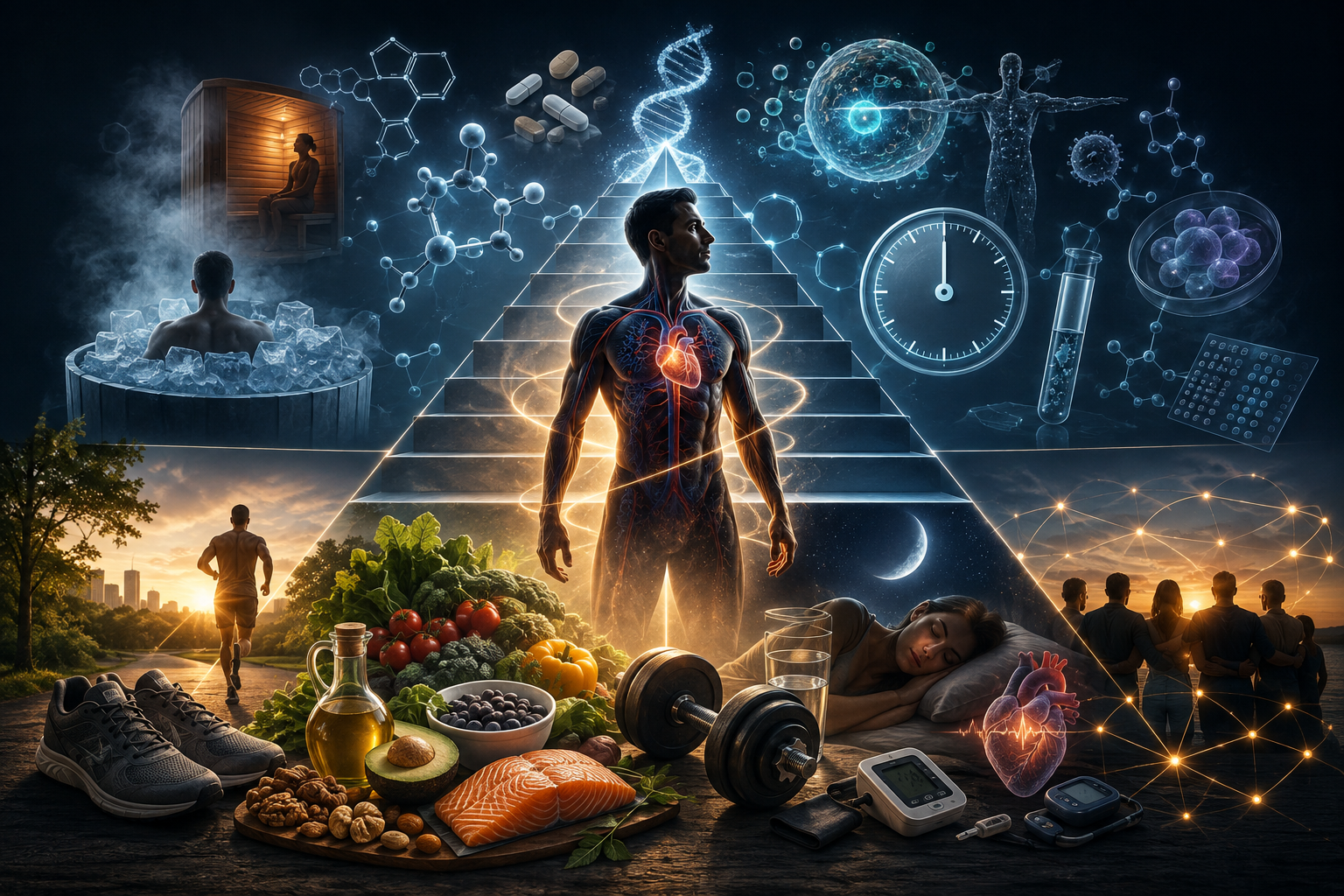
The longevity habits supported by the strongest human evidence are surprisingly familiar: do not smoke; move regularly; build and preserve cardiorespiratory fitness, strength, and muscle; follow a nutrient-dense dietary pattern; sleep consistently; manage blood pressure, glucose, lipids, and excess body fat; limit alcohol; and maintain meaningful social connection. These behaviors are not guaranteed to add a specific number of years to any individual life, but they repeatedly track with lower rates of cardiovascular disease, diabetes, several cancers, disability, and premature death.
Fasting, sauna bathing, cold exposure, supplements, biological-age tests, and experimental medicines are more complicated. Some can improve selected symptoms or biomarkers. A few have encouraging observational or early clinical data. None should be treated as a proven substitute for the fundamentals, and most have not been shown in randomized human trials to extend lifespan.
That distinction matters. Are we measuring a change in a laboratory value, a change in disease risk, an improvement in function, or actual years of healthy life? Those outcomes are related, but they are not interchangeable.
Why longevity conversations can outrun longevity evidence
In the supplied Joe Rogan–David Sinclair conversation, the appeal of longevity science is easy to understand. The discussion ranges from exercise, sleep, fasting, diet, alcohol, and stress to biological-age testing, NAD-related supplements, rapamycin, and partial cellular reprogramming. It also raises an optimistic possibility: perhaps aging is not merely something to accept, but a collection of biological processes that science may eventually influence.
That possibility deserves investigation. It also requires careful language.
Longevity research sits on an unusually long evidence ladder:
- A mechanism works in cells.
- It changes a biomarker in animals.
- It improves health or lifespan in animals.
- It appears acceptably safe in a small human study.
- It changes a human risk factor or surrogate endpoint.
- It prevents disease, disability, or death in adequately powered human trials.
Popular conversations often move quickly from steps one or two to step six. Responsible interpretation asks where each claim actually sits today.
There is another challenge: a true association is not always proof of cause. People who exercise, use saunas, or eat particular diets may differ from nonusers in income, education, smoking, medical care, and other behaviors. Randomized trials reduce many of those biases, but few longevity trials can follow participants for decades. The best conclusions therefore combine randomized trials, prospective cohorts, mechanistic evidence, clinical guidelines, and humility about uncertainty.
What does “longevity” actually mean?
Lifespan is how long a person lives. Healthspan is the period lived with good physical, cognitive, and metabolic function. Most people want both, but a practice that changes a biomarker is not automatically extending either one.
A useful longevity strategy therefore asks at least four questions:
- Does this reduce a major cause of illness or premature death?
- Does it preserve strength, mobility, cognition, or independence?
- Are the benefits supported in humans, not only animals?
- Are the risks, costs, and opportunity costs reasonable for this person?
Seen through that lens, preventing a heart attack, preserving muscle, detecting hypertension, improving sleep apnea, or stopping smoking may be more meaningful than obtaining a younger-looking biological-age score.
An evidence hierarchy for popular longevity habits
Tier 1: Strongest and most actionable human evidence
- Avoid tobacco and seek evidence-based help to quit.
- Accumulate aerobic activity, reduce prolonged sitting, and improve cardiorespiratory fitness.
- Perform resistance training and preserve strength and lean mass.
- Follow a high-quality dietary pattern rich in vegetables, fruit, legumes, whole grains, nuts, and appropriate protein sources.
- Maintain regular, adequate sleep and evaluate persistent sleep problems.
- Identify and manage blood pressure, glucose, lipids, and unhealthy body composition.
- Reduce alcohol exposure, particularly heavy or binge drinking.
- Maintain supportive relationships and address chronic isolation.
Tier 2: Promising or useful for selected outcomes, but not proven to extend human lifespan
- Time-restricted eating or intermittent fasting when it improves adherence, weight, or metabolic health.
- Sauna bathing as an optional practice for people who can use heat safely.
- Cold exposure for preference, alertness, or recovery goals not as a proven longevity therapy.
- Wearables and selected biomarker tracking when the data lead to sensible decisions.
Tier 3: Investigational for human longevity
- NMN, NAD-boosting products, and resveratrol.
- Rapamycin or metformin in otherwise healthy people solely for anti-aging purposes.
- Consumer biological-age tests used to direct treatment.
- Senolytics, gene therapy, and partial epigenetic reprogramming.
The tiers are not moral judgments. They describe the maturity of evidence for longer or healthier human life.
1. Exercise, fitness, and strength: the most defensible longevity investment
The podcast emphasizes exercise as a form of beneficial adversity. Human research strongly supports the practical conclusion, even if every proposed molecular explanation is not settled.
U.S. guidance recommends 150 to 300 minutes of moderate-intensity aerobic activity each week, or 75 to 150 minutes of vigorous activity, plus muscle-strengthening activity on at least two days. It also emphasizes a simple principle: move more and sit less, because even smaller amounts of activity can provide benefit. The World Health Organization makes similar recommendations and adds balance-focused activity for many older adults.
Large cohort analyses consistently associate more daily movement with lower mortality. A meta-analysis of 15 international cohorts found that risk fell as steps increased, with the apparent benefit leveling at roughly 6,000–8,000 daily steps for adults age 60 and older and 8,000–10,000 for younger adults. These are population estimates, not mandatory thresholds. A person moving from 3,000 to 5,000 steps may gain more than someone forcing a move from 10,000 to 12,000.
Fitness may matter as much as an exercise label. A meta-analysis involving more than two million participants found that higher objectively measured cardiorespiratory fitness was strongly associated with lower all-cause mortality. Resistance training also matters: a systematic review and meta-analysis associated muscle-strengthening activity with lower all-cause, cardiovascular, cancer, and diabetes-related risk, although dose and causality remain less certain than the general conclusion that strength is valuable.
Why might exercise support healthspan? It can improve insulin sensitivity, blood pressure, endothelial function, cardiorespiratory capacity, mood, sleep, bone health, balance, and the ability to perform daily tasks. Resistance training helps counter age-related losses in muscle mass and power, which can threaten independence long before they threaten lifespan.
Questions worth asking: Is your program improving aerobic capacity as well as appearance? Are you training movements that preserve balance, power, grip, and the ability to get off the floor? If pain, fatigue, or recovery problems keep disrupting exercise, is the answer more discipline, or a clinical evaluation?
2. Tobacco: removing a major risk can outweigh adding another “hack”
If a person smokes, quitting is among the highest-impact longevity actions available. The Centers for Disease Control and Prevention reports that smoking cessation reduces premature-death risk and can add as much as 10 years to life expectancy compared with continuing to smoke. Benefits occur at any age, while risks of heart attack, stroke, lung disease, and multiple cancers decline over time.
This illustrates an important longevity principle: subtracting a major harmful exposure can matter more than adding a supplement, device, or laboratory panel. Nicotine dependence is a medical and behavioral condition, not a character flaw, and evidence-based counseling and medication can improve quit success.
3. Diet: pattern quality appears more important than a perfect label
The podcast contrasts plant-rich eating, protein intake, ketosis, and fasting. Nutrition debates often ask which camp is correct. Longevity research more consistently points toward dietary pattern quality than toward one universal macronutrient formula.
Mediterranean-style patterns emphasize vegetables, fruit, legumes, nuts, whole grains, olive oil, fish, and relatively less refined food and processed meat. A dose-response meta-analysis of prospective cohorts associated greater Mediterranean-diet adherence with lower all-cause mortality. The PREDIMED randomized trial found fewer major cardiovascular events among high-risk adults assigned to Mediterranean diets supplemented with extra-virgin olive oil or nuts than among those assigned to a reduced-fat control diet.
This does not prove that every person must eat identically, that all animal foods are harmful, or that a Mediterranean pattern is the only defensible approach. DASH and other minimally processed, plant-forward patterns also improve cardiovascular risk factors. Protein needs vary with size, age, training, health, and calorie intake. Older adults and people losing weight may need particular attention to adequate protein and resistance training to preserve lean mass.
The more useful questions may be:
- Does the pattern help maintain a healthy energy balance without chronic hunger?
- Does it provide enough protein, fiber, micronutrients, and unsaturated fat?
- Is it dominated by minimally processed foods or by refined, hyperpalatable products?
- Does it improve or worsen blood pressure, glucose, lipids, digestion, and adherence?
Diet quality should be judged by the full pattern and the person’s response, not by one “superfood.”
4. Sleep: a foundational behavior, but not a simple race for one number
The podcast correctly treats sleep as central to feeling and functioning well. It discusses deep sleep and the brain’s waste-clearance system, but the popular idea that one hour of deep sleep can compensate for very short total sleep should be treated cautiously. Sleep stages interact, consumer devices estimate rather than directly measure them, and individual stage scores do not establish brain “detoxification.”
The American Academy of Sleep Medicine and Sleep Research Society recommend that adults obtain at least seven hours of sleep per night on a regular basis to promote optimal health. Prospective evidence often shows a U-shaped relationship: both short and very long reported sleep are associated with higher mortality, although long sleep may be a marker of underlying illness rather than a cause.
Regularity, timing, quality, and untreated disorders matter alongside duration. Loud snoring, witnessed pauses in breathing, morning headaches, resistant hypertension, insomnia, or severe daytime sleepiness warrant clinical attention. Alcohol may make sleep onset feel easier while fragmenting sleep later in the night.
Before optimizing a wearable’s “deep sleep” score, should a person first protect a consistent sleep window, morning light exposure, a dark bedroom, appropriate caffeine timing, and evaluation for sleep apnea?
5. Cardiometabolic risk: longevity often looks like preventive medicine
Blood pressure, atherogenic lipoproteins, glucose regulation, kidney health, and body composition are not glamorous, but they sit close to the major pathways that produce heart attack, stroke, diabetes, and disability.
Hypertension is often silent. The U.S. Preventive Services Task Force recommends screening adults and confirming a diagnosis with measurements outside the clinical setting before treatment. LDL-containing particles play a causal role in atherosclerotic cardiovascular disease, and randomized evidence shows that lowering LDL cholesterol reduces cardiovascular events, with the absolute benefit depending on a person’s baseline risk.
For people with prediabetes and excess weight, the Diabetes Prevention Program demonstrated the power of structured lifestyle change. The CDC summarizes a 58% lower incidence of type 2 diabetes after participants achieved approximately 5%–7% weight loss through calorie reduction and at least 150 minutes of weekly activity; benefits persisted, though attenuated, over long follow-up.
Body weight alone is incomplete. Waist circumference, blood pressure, strength, fitness, sleep, liver markers, glycemia, and lipid measures can provide a more useful picture. Likewise, a normal-looking body does not rule out hypertension, dyslipidemia, insulin resistance, sleep apnea, or hormonal and nutritional concerns.
The practical question is not “Are all my numbers optimal?” It is “Which findings meaningfully change my risk, and which intervention has evidence that acting on them improves health?”
6. Alcohol: “less is safer” is more defensible than “a little is healthy”
The podcast discusses how alcohol can affect well-being and sleep. Observational studies once encouraged the idea that moderate drinking might protect the heart, but comparisons between drinkers and nondrinkers can be distorted by prior illness, socioeconomic factors, diet, and other behaviors.
Alcohol is a Group 1 carcinogen, and risk rises with exposure. The World Health Organization states that available evidence does not identify a risk-free threshold for cancer and summarizes the practical message as “the less you drink, the safer it is.” This does not require alarmist language or the claim that every drink causes measurable harm to every individual. It does mean alcohol should not be prescribed as a longevity practice.
Useful questions include: What does alcohol do to your sleep, blood pressure, appetite, mood, training, and relationships? Would reducing frequency or quantity create benefits you can actually notice?
7. Social connection, purpose, and stress: difficult to quantify, difficult to dismiss
The transcript highlights stress and the possibility that social environment influences aging. The mechanisms are complex, but the human association is substantial. A systematic review and meta-analysis of 90 cohort studies found that social isolation and loneliness were associated with higher all-cause mortality. Association does not prove that one prescribed number of social encounters will extend life, and poor health can itself cause isolation. Still, the evidence supports treating connection as a health factor rather than a luxury.
Chronic stress can also shape sleep, blood pressure, substance use, food choices, and adherence. A longevity plan that produces constant anxiety, social withdrawal, or an unsustainable daily burden may defeat its own purpose.
What relationships give your life meaning? Does your health strategy help you participate in them, or turn health into a solitary performance?
What did the podcast get right about fasting—and what remains uncertain?
Fasting can describe anything from avoiding late-night snacks to multi-day food restriction. Those are not equivalent interventions.
Time-restricted eating can help some people simplify intake, reduce calories, lose weight, or align eating with daytime rhythms. A meta-analysis of randomized trials found that adding time restriction to calorie restriction produced modest additional reductions in weight and fat mass, but did not clearly improve blood pressure, glucose, or lipids beyond calorie restriction alone. Other trials and reviews show mixed results depending on timing, adherence, comparator diet, and population.
Claims that fasting “cleans out” old proteins usually refer to autophagy, a real cellular recycling process. The uncertainty is whether a specific consumer fasting schedule reliably produces a clinically meaningful increase in human autophagy and, more importantly, whether that translates into longer life. Direct measurement in living humans is difficult.
Longer fasting is not automatically better. It may be inappropriate for people who are pregnant, have a history of eating disorders, use glucose-lowering medication, have certain chronic diseases, are frail, or struggle to preserve lean mass. A better question than “What is the longest fast I can tolerate?” may be “Does this eating schedule safely improve a meaningful outcome without compromising protein intake, training, sleep, or adherence?”
Sauna and heat exposure: intriguing associations, not a longevity guarantee
Frequent sauna bathing has been associated with lower cardiovascular and all-cause mortality in Finnish observational cohorts. Heat exposure can acutely increase heart rate, circulation, and sweating, and repeated use may affect blood pressure and vascular function.
However, sauna users were not randomized to decades of exposure, and Finnish sauna practices may not generalize to every population or device. The evidence does not establish that sauna adds years of life independently of fitness, socioeconomic status, or other habits.
Sauna may be an enjoyable adjunct for appropriately screened people, but it is not a replacement for exercise. Dehydration, low blood pressure, acute illness, alcohol use, pregnancy, and some cardiovascular conditions can change the safety calculation. If someone enjoys sauna and tolerates it well, the relevant question is not whether it is magic, it is whether the practice fits safely into an already sound plan.
Cold plunges: a strong sensation with limited longevity evidence
Cold exposure can alter alertness, stress responses, and recovery perceptions. A recent systematic review found some time-dependent effects on stress, sleep, and quality of life, while emphasizing limited studies, small samples, and heterogeneous protocols. There is no convincing evidence that cold plunges extend human lifespan.
Cold water can provoke abrupt breathing, blood-pressure, and cardiac responses. Risk rises with unsupervised open water, extreme temperatures, alcohol, and certain heart conditions. Enjoying cold exposure is not the same as proving it is necessary for longevity.
Supplements: plausible biology is not the same as a proven outcome
The podcast discusses NMN, resveratrol, and pathways involving NAD. NAD is essential to cellular metabolism, and NAD biology is scientifically important. Small human trials suggest that NMN can raise NAD-related metabolites and may affect selected measures. A review of early clinical trials, however, concluded that studies remain limited by small samples, short durations, varied doses, and a lack of hard clinical outcomes.
Resveratrol has extensive laboratory literature but inconsistent clinical findings. A systematic review of human trials identified major variation in formulations, doses, populations, bioavailability, and endpoints. Neither NMN nor resveratrol has been shown to extend human lifespan.
Supplements may be appropriate for a demonstrated deficiency, a specific condition, or a well-supported therapeutic goal. But “biologically active” is not synonymous with “beneficial,” and purity, dose, interactions, and product quality matter.
Before taking a longevity supplement, consider asking:
- What human outcome am I trying to improve?
- Is the evidence based on people like me?
- Was the endpoint a symptom, a biomarker, disease prevention, or survival?
- Could this interact with medication or create false reassurance?
- Would the same money or attention produce more benefit if applied to sleep, food quality, exercise, or clinical prevention?
Rapamycin and metformin: important medicines, unanswered anti-aging questions
Rapamycin extends lifespan in multiple animal models and targets the mTOR pathway, making it one of geroscience’s most compelling candidates. Yet a candidate is not a conclusion. A 48-week randomized trial in generally healthy adults found similar overall adverse-event rates across placebo and intermittent low-dose groups and reported selected subgroup improvements, but it did not demonstrate longer life, broad disease prevention, or a general anti-aging effect. The authors also disclosed employment and equity ties to the sponsoring longevity company, a relevant consideration when interpreting findings.
Rapamycin is an immunosuppressive prescription drug with recognized risks. Its use in healthy people for longevity remains investigational.
Metformin is a foundational treatment for type 2 diabetes and may reduce diabetes incidence in selected high-risk people. Observational findings have generated interest in aging, but confounding by diabetes status, treatment selection, and comparator drugs complicates the claim that it slows aging in healthy individuals. It has not been proven to extend the lifespan of healthy humans.
The thought-provoking question is not whether these drugs are “good” or “bad.” It is whether the expected benefit for a particular person and indication is supported strongly enough to justify the known and unknown risks.
Biological-age tests: informative signal or premature scorekeeping?
Biological clocks use patterns in DNA methylation, proteins, metabolites, clinical measures, or other data to estimate aspects of aging. Research shows that some clocks predict disease and mortality risk beyond chronological age. A 2026 critical review described considerable potential for risk prediction, prevention research, and measuring interventions, while also emphasizing that clock types capture different biology and still require clinical validation.
A score is not a diagnosis. Two clocks can disagree, short-term changes may reflect technical variation or transient physiology, and there is not yet a universally accepted treatment algorithm for a person whose test says they are “older” than their calendar age.
Testing may be most useful when it creates a good question rather than a dramatic verdict. Did the result reproduce? Does it add information beyond blood pressure, lipids, glucose, fitness, body composition, family history, and symptoms? Would it change a decision supported by outcome evidence?
Can aging be reversed? What partial epigenetic reprogramming actually shows
The podcast’s most striking discussion concerns OSK, three Yamanaka-related factors used for partial epigenetic reprogramming. In a 2020 Nature study, researchers restored youthful gene-expression patterns, promoted optic-nerve regeneration, and improved vision in mouse models. That is important preclinical evidence. It is not proof of whole-body age reversal in humans.
A registered early-phase clinical study is now evaluating ER-100 in people with glaucoma or non-arteritic anterior ischemic optic neuropathy, with safety and tolerability as central questions. A first-in-human trial represents scientific progress, but it does not establish efficacy, durability, generalizability, or whole-body rejuvenation. Until results are published and replicated, language such as “human age reversal has arrived” would go beyond the evidence.
Could cellular reprogramming eventually repair age-related damage? Possibly. Could unforeseen effects emerge when cell identity, growth pathways, immune responses, and gene delivery are manipulated? Also possibly. Both curiosity and caution belong in the same conversation.
A practical longevity framework: measure what can change care
A thoughtful longevity plan can begin with ordinary but consequential information:
- Personal and family history, medications, symptoms, and health goals.
- Blood pressure measured correctly, sometimes including home readings.
- Lipid and glucose assessment appropriate to age and risk.
- Body composition and waist trends interpreted alongside strength and fitness.
- Sleep duration, regularity, and screening for sleep apnea when indicated.
- Tobacco, alcohol, nutrition, activity, and psychosocial context.
- Age- and risk-appropriate preventive screening and vaccination.
- Hormonal, thyroid, nutritional, or other testing when symptoms and history justify it.
More testing is not always better. False positives, incidental findings, normal biological variation, and poorly validated markers can trigger cost and anxiety. The value of a test depends on analytical validity, clinical meaning, and whether the result can guide an action that improves outcomes.
Where 1st Optimal may fit into a longevity conversation
1st Optimal is a telehealth-based health optimization platform serving men and women through provider-guided care. Its published care pathways include hormone health, metabolic and medical weight management, performance and recovery, gut-health evaluation, peptide discussions, advanced and at-home laboratory testing, and ongoing monitoring.
In a longevity context, the most responsible role is not to promise immortality or treat every biomarker deviation. It is to help a person organize the questions that matter: What symptoms or risks deserve evaluation? Which foundational behaviors are being overlooked? Which conventional prevention targets need attention? Is a hormone, metabolic, sleep, nutritional, or other clinical issue impairing the ability to exercise, recover, think clearly, or maintain healthy body composition?
When treatment is considered, decisions belong within a licensed clinician-patient relationship and should account for medical history, contraindications, monitoring, realistic endpoints, and alternative options. Hormone therapy, weight-loss medication, peptides, supplements, and off-label approaches are not generic longevity requirements. They may be appropriate for selected people and inappropriate for others.
This is also where a health consultation can be valuable even without a forceful call to action. A good consultation should leave room for “not indicated,” “let’s measure first,” “let’s address the basics,” or “this requires another specialist.” The goal is not to collect the largest protocol. It is to identify the smallest set of defensible actions most likely to improve health and function.
Frequently asked questions about evidence-based longevity
What is the single best habit for longevity?
There is no universal single habit. For a person who smokes, quitting may dominate. For a sedentary person, regular movement and improved fitness may offer the greatest opportunity. For someone with severe hypertension or sleep apnea, diagnosis and treatment may matter more than any supplement. The highest-value action depends on baseline risk.
How much exercise is associated with better health and longevity?
For most adults, a reasonable evidence-based target is 150–300 minutes of moderate aerobic activity per week, or the vigorous equivalent, plus strength training at least twice weekly. Benefits can begin below that threshold, particularly when someone moves from inactive to somewhat active.
Is walking enough?
Walking is valuable and accessible, especially when pace or terrain challenges the cardiovascular system. A complete health span plan should usually also address strength, balance, and when appropriate higher-intensity capacity. “Enough” depends on current fitness, limitations, and goals.
Does intermittent fasting make you live longer?
It has not been proven to extend human lifespan. It may help selected people manage calorie intake, weight, or metabolic markers. Its value depends on timing, diet quality, safety, and whether it is sustainable.
Does sauna use increase lifespan?
Frequent sauna use is associated with lower mortality in observational Finnish research, but that does not prove causation. Sauna can be considered an optional adjunct, not a substitute for exercise or risk-factor management.
Do NMN or resveratrol slow aging?
They affect biologically relevant pathways, and early human studies are ongoing. Current trials do not establish that either supplement prevents major disease or lengthens human life.[19,20]
Is rapamycin proven for longevity?
No. Animal data are compelling, but human evidence is not sufficient to establish lifespan extension or routine use in healthy people. It is a prescription immunosuppressant with meaningful risks.
Are biological-age tests accurate?
Some clocks predict population-level risk, but different tests measure different signals and may produce different results. Their use for making individual treatment decisions is still evolving.
Can aging already be reversed in humans?
No intervention has been shown to broadly reverse human aging. Partial epigenetic reprogramming has produced notable results in animal models, and early human safety research has begun for specific eye diseases not for whole-body rejuvenation.
The more useful longevity question
The most interesting question may not be, “Which protocol can make me younger?” It may be, “Which preventable risk is most likely to shorten my health span, and what evidence-based action can I sustain now?”
The future of geroscience may include biological clocks, targeted senolytics, gene therapies, or cellular reprogramming. Those possibilities are worth following. But the strongest human evidence still points toward a less futuristic truth: protect the cardiovascular system, maintain metabolic health, preserve muscle and fitness, sleep consistently, avoid tobacco, reduce harmful exposures, and remain connected to other people.
Perhaps longevity is not one finish line. Perhaps it is the repeated practice of protecting the capacities that let a person work, serve, create, move, and uplift others for as long as possible.
If you are unsure which findings or habits matter most in your case, consider discussing your symptoms, risks, medications, laboratory history, and goals with a qualified health professional. The purpose of that conversation should be clarity not a predetermined treatment.
Medical disclaimer
This article is educational and does not provide medical advice, diagnosis, or treatment. Research findings describe groups and cannot predict an individual outcome. Consult an appropriately licensed healthcare professional before changing medication, starting fasting, using supplements, beginning heat or cold exposure, or pursuing hormone, metabolic, or investigational therapies. Availability and appropriateness of telehealth services vary by location and clinical circumstances.
References
- U.S. Department of Health and Human Services. Physical Activity Guidelines for Americans, 2nd edition. 2018.
- World Health Organization. WHO Guidelines on Physical Activity and Sedentary Behaviour: At a Glance. 2020.
- Paluch AE, et al. Daily steps and all-cause mortality: a meta-analysis of 15 international cohorts. Lancet Public Health. 2022;7(3):e219-e228.
- Han M, et al. Objectively assessed cardiorespiratory fitness and all-cause mortality risk: an updated meta-analysis of 37 cohort studies involving 2,258,029 participants. Br J Sports Med. 2022.
- Momma H, et al. Muscle-strengthening activities are associated with lower risk and mortality in major non-communicable diseases: a systematic review and meta-analysis of cohort studies. Br J Sports Med. 2022;56:755-763.
- Centers for Disease Control and Prevention. Benefits of Quitting Smoking. Updated May 15, 2024.
- Soltani S, et al. Adherence to the Mediterranean diet in relation to all-cause mortality: a systematic review and dose-response meta-analysis of prospective cohort studies. Adv Nutr. 2019;10(6):1029-1039.
- Estruch R, et al. Primary prevention of cardiovascular disease with a Mediterranean diet supplemented with extra-virgin olive oil or nuts. N Engl J Med. 2018;378:e34.
- Watson NF, et al. Recommended amount of sleep for a healthy adult: a joint consensus recommendation of the American Academy of Sleep Medicine and Sleep Research Society. Sleep. 2015;38(6):843-844.
- Cappuccio FP, et al. Sleep duration and all-cause mortality: a systematic review and meta-analysis of prospective studies. Sleep. 2010;33(5):585-592.
- U.S. Preventive Services Task Force. Hypertension in Adults: Screening. 2021.
- Silverman MG, et al. Association between lowering LDL-C and cardiovascular risk reduction among different therapeutic interventions: a systematic review and meta-analysis. JAMA. 2016;316(12):1289-1297.
- Centers for Disease Control and Prevention. Prevent Type 2 Diabetes: Talking to Your Patients About Lifestyle Change. Updated May 15, 2024.
- World Health Organization Regional Office for Europe. No level of alcohol consumption is safe for our health. January 4, 2023.
- Wang F, et al. A systematic review and meta-analysis of 90 cohort studies of social isolation, loneliness and mortality. Nat Hum Behav. 2023;7:1307-1319.
- Sun JC, et al. Time-restricted eating with calorie restriction on weight loss and cardiometabolic risk: a systematic review and meta-analysis. Eur J Clin Nutr. 2023;77:1014-1025.
- Laukkanen T, et al. Association between sauna bathing and fatal cardiovascular and all-cause mortality events. JAMA Intern Med. 2015;175(4):542-548.
- Cain M, et al. Effects of cold-water immersion on health and wellbeing: a systematic review and meta-analysis. PLoS One. 2025.
- Hosseini L, et al. The safety and antiaging effects of nicotinamide mononucleotide in human clinical trials: an update. Adv Nutr. 2023.
- Thaung Zaw JJ, et al. Resveratrol for the management of human health: how far have we come? A systematic review of resveratrol clinical trials to highlight gaps and opportunities. Int J Mol Sci. 2024.
- Moel M, et al. Influence of rapamycin on safety and healthspan metrics after one year: PEARL trial results. Aging (Albany NY). 2025;17(4):908-936.
- Wyss-Coray T, Topol EJ. Biological aging clocks in health and disease. Nat Med. 2026;32(7):2383-2394.
- Lu Y, et al. Reprogramming to recover youthful epigenetic information and restore vision. Nature. 2020;588:124-129.
- ClinicalTrials.gov. NCT07290244: Evaluating ER-100 for Safety in People With Glaucoma or Non-Arteritic Anterior Ischemic Optic Neuropathy. Accessed August 20, 2026.
Evidence was reviewed through August 20, 2026. This article intentionally distinguishes randomized human evidence, observational associations, biomarker findings, animal research, and early-phase clinical investigation.