

Most people track health with numbers like body weight, cholesterol, blood pressure, blood sugar, or steps per day.
Few think about how hard they can squeeze something.
Yet grip strength may provide surprisingly useful information about overall physical health, muscle function, resilience, and aging.
A handgrip test takes only seconds. It requires no treadmill, imaging machine, or complicated fitness assessment. In research involving adults across different countries and age groups, lower grip strength has repeatedly been associated with higher risks of disability, cardiovascular events, cognitive decline, and premature death.
That does not mean your handshake can predict exactly how long you will live.
Grip strength is better viewed as a signal.
It gives us another window into how well the muscular and nervous systems are functioning, especially when we track it alongside body composition, exercise capacity, metabolic markers, symptoms, and other health data.
For adults in their 30s, 40s, 50s, and beyond, that makes grip strength worth paying attention to.
What Is Grip Strength?
Grip strength measures the amount of force your hand and forearm muscles can generate when squeezing an object.
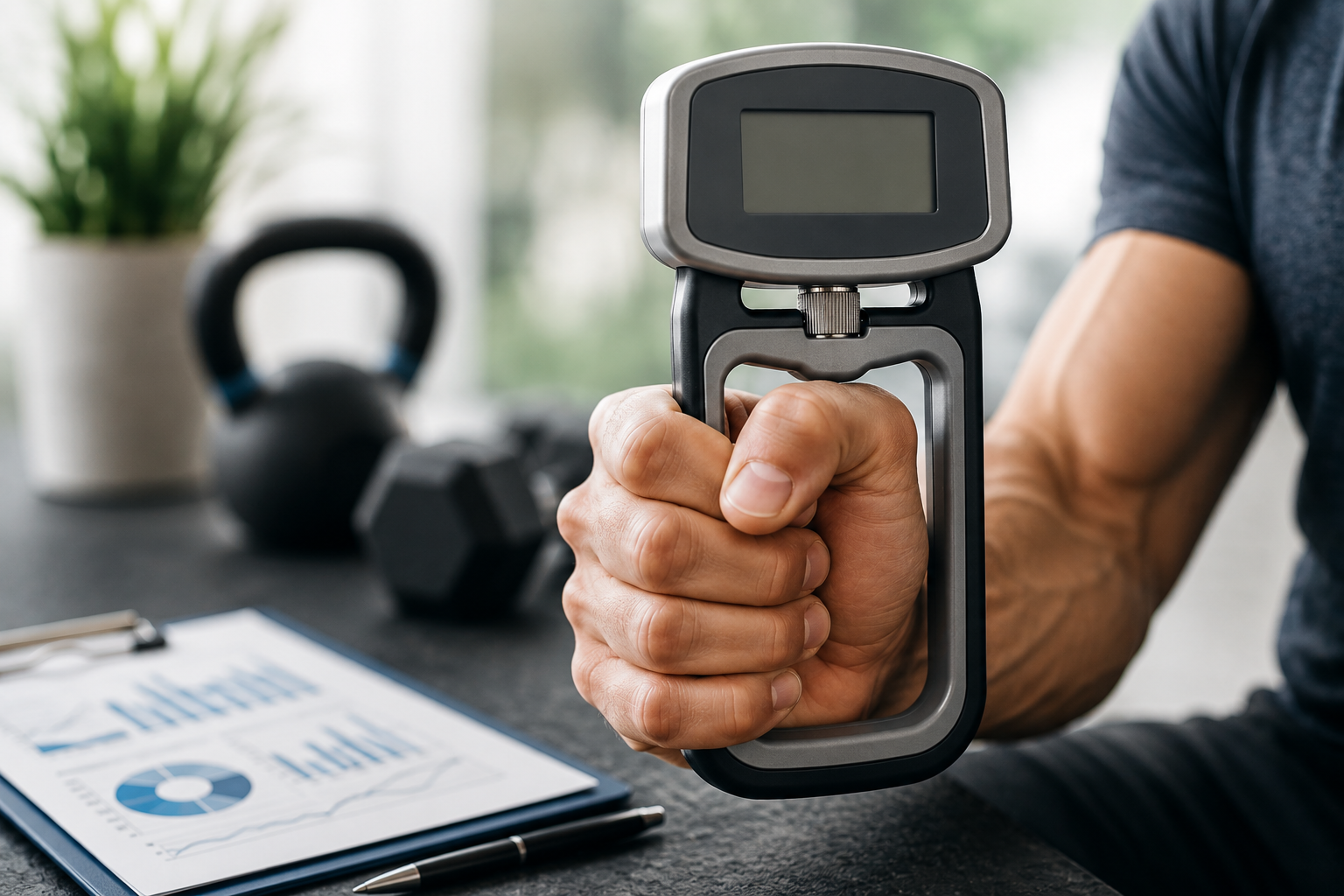
In clinical and research settings, it is usually measured with a device called a handgrip dynamometer. You squeeze the handle as hard as possible, and the device records the force, typically in kilograms or pounds.
Simple enough.
The interesting part is what that number appears to represent.
Grip strength obviously depends on the muscles of your hands and forearms, but researchers often use it as a practical indicator of broader muscular strength and physical function.
Research published in 2025, for example, found strong relationships between handgrip strength and measures including squat strength, leg press strength, jumping power, thigh muscle size, and overall lean body mass in adults studied.
That does not make a grip test a substitute for a full strength assessment.
Other research has cautioned that grip strength alone should not be treated as a complete measurement of muscle mass or physical performance.
Think of it more like checking the dashboard of your car.
One gauge cannot tell you everything happening under the hood. But if the gauge starts moving in the wrong direction, you probably should not ignore it.
Why Is Grip Strength Considered a Health Marker?
The body does not operate as a collection of unrelated parts.
Strength depends on several systems working together:
- Skeletal muscle
- Motor nerves
- Brain-to-muscle signaling
- Joint function
- Energy availability
- Nutrition
- Recovery
- Physical activity
- Overall health status
A meaningful decline in strength may therefore reflect more than smaller forearm muscles.
It can accompany reduced physical activity, loss of muscle function, aging, illness, injury, poor recovery, nutritional problems, or other changes in health.
This is one reason grip strength appears repeatedly in research on aging and physical function.
It is inexpensive, quick, objective, and easy to repeat.
And unlike simply asking someone whether they “feel strong,” it gives you a measurable number that can be tracked over time.
Grip Strength and Longevity
One of the most frequently cited studies on grip strength came from the Prospective Urban Rural Epidemiology, or PURE, study.
Researchers evaluated grip strength in nearly 140,000 adults across 17 countries. Lower grip strength was associated with higher risks of all-cause mortality, cardiovascular mortality, heart attack, and stroke.
For every 5-kilogram reduction in grip strength, the researchers reported approximately:
- 16% higher risk of all-cause mortality
- 17% higher risk of cardiovascular mortality
- 7% higher risk of heart attack
- 9% higher risk of stroke
Importantly, this was an observational study.
It does not prove that weak hands cause cardiovascular disease or that increasing your grip strength by 5 kilograms automatically lowers your mortality risk by a certain percentage.
Human biology, mercifully, refuses to be that tidy.
Instead, grip strength may capture aspects of muscular health, physical activity, chronic disease burden, nutritional status, and overall physiological reserve that influence long-term outcomes.
The PURE researchers even found grip strength had a stronger statistical association with mortality than systolic blood pressure in their analysis.
That does not make a dynamometer more important than measuring blood pressure.
It means muscular strength may contain health information that conventional screening often overlooks.
Strength in Midlife May Matter Decades Later
Grip strength becomes particularly interesting when researchers measure it long before people become elderly.
A landmark study followed initially healthy men who were 45 to 68 years old when their grip strength was assessed.
Approximately 25 years later, lower midlife grip strength was strongly associated with greater functional limitations and disability in older age.
That is an important concept for anyone currently in their 40s or 50s.
Healthy aging does not suddenly begin at age 70.
The physical reserve you build during midlife may determine how much capacity you have available decades later.
Consider two people who both lose some strength as they age.
One begins with high levels of muscle and strength. The other enters later life already close to the threshold where stairs, carrying luggage, getting off the floor, or recovering from illness becomes difficult.
Both may experience age-related decline.
But one has much more reserve.
That is why maintaining strength matters long before everyday activities become difficult.
Grip Strength and Physical Independence
Longevity gets attention because humans are understandably fascinated by not dying.
But healthspan may be just as important.
Healthspan describes the years of life spent healthy, active, and capable.
Grip strength has been associated with future disability and limitations in activities of daily living. Research reviews have also repeatedly identified lower grip strength as a marker associated with worse aging-related outcomes.
This makes intuitive sense.
Muscle strength helps determine whether you can:
- Carry groceries
- Pick up a child
- Lift luggage
- Open heavy doors
- Get up from the floor
- Perform household tasks
- Train safely
- Recover from physical stress
- Maintain independence as you age
Grip strength does not perform all those jobs by itself.
Rather, it can reflect part of the broader muscular capacity that makes those activities possible.
Grip Strength and Brain Health
The association becomes even more interesting when we look at cognitive health.
Researchers studying UK Biobank participants found that lower handgrip strength was associated with poorer cognitive measures, greater dementia risk, and differences in neuroimaging outcomes.
Other longitudinal research has also found associations between lower grip strength and cognitive decline.
Again, this does not mean squeezing a hand gripper prevents dementia.
That would certainly make neurological health more convenient.
Instead, muscle strength and brain health may share several underlying influences, including physical activity, vascular health, inflammation, nutrition, metabolic health, neurological function, and aging itself.
Grip strength may therefore act as another piece of the larger healthy-aging puzzle.
What Grip Strength May Tell Us About Metabolic Health
Researchers have also explored the relationship between grip strength and metabolic health.
One useful concept is relative grip strength.
Absolute grip strength simply asks:
How many kilograms of force can you produce?
Relative grip strength adjusts that result for body size.
A simple version is:
Relative grip strength = grip strength ÷ body weight
For example:
Grip strength = 36 kg
Body weight = 72 kg
36 ÷ 72 = 0.50 kg of grip force per kilogram of body weight
Why make the adjustment?
A larger person may naturally produce more absolute force. Looking at strength relative to body weight can sometimes provide additional information about functional capacity.
In a prospective cohort of 15,820 adults, higher relative grip strength was associated with a lower incidence of metabolic syndrome during follow-up, while absolute grip strength did not show the same relationship.
Another prospective study found higher relative grip strength was associated with lower diabetes risk.
These findings do not make grip strength a diabetes test.
If you want to understand metabolic health, markers such as fasting glucose, hemoglobin A1C, fasting insulin, lipids, waist circumference, and blood pressure provide much more direct information.
But grip strength may add something those numbers cannot:
How well is your body performing?
Grip Strength vs. Muscle Mass
This distinction matters.
Having muscle and being able to use that muscle effectively are not identical.
Two people can have similar amounts of lean mass while producing very different levels of strength.
Muscular function depends on factors including:
- Muscle size
- Neuromuscular coordination
- Motor-unit recruitment
- Training experience
- Joint health
- Technique
- Motivation during testing
- Recovery
- Age
Research has found relationships between handgrip strength and skeletal muscle mass, although those relationships vary by population and sex.
That is why evaluating aging or performance solely through body composition can miss part of the picture.
A body composition scan might show how much lean tissue you have.
A strength test tells you something about what that tissue can actually do.
Ideally, you want both.
How to Test Your Grip Strength
The best way to measure grip strength is with a handgrip dynamometer.
Research-grade and clinical devices provide measurements in kilograms or pounds and allow standardized testing. Jamar-style dynamometers have been widely studied and used in grip-strength research.
For personal tracking, consistency matters more than designing a laboratory-grade experiment in your living room.
Use the same device and testing method each time.
Simple Grip Strength Testing Protocol
- Use a dynamometer that fits your hand comfortably.
- Test when you are reasonably rested.
Avoid testing immediately after a heavy pulling workout, climbing session, or anything else that has exhausted your forearms. - Keep your position consistent.
Sit or stand upright. Keep your shoulder relaxed and avoid dramatically changing elbow or wrist position between tests. - Squeeze as hard as possible for several seconds.
- Test both hands.
- Perform two or three attempts per hand.
Rest briefly between maximal attempts. - Record the best result for each hand.
- Repeat under similar conditions in the future.
Studies have found standardized dynamometer testing to be highly reproducible, although testing procedures vary somewhat across research settings.
The objective is not to manipulate the setup until you produce the biggest number.
It is to create a repeatable test.
What Is a Good Grip Strength?
This is where internet fitness charts often become unnecessarily confident.
There is no single “healthy grip strength” number for everyone.
Grip strength differs significantly according to:
- Age
- Sex
- Height
- Body size
- Hand dominance
- Training status
- Occupation
- Testing device
- Testing technique
Large reference datasets show clear differences in average grip strength across age and sex groups. Strength generally peaks earlier in adulthood and declines with increasing age.
For that reason, interpreting your result against an appropriate age- and sex-specific reference range is more useful than comparing yourself with a random number from social media.
And for personal health tracking, your trend may sometimes matter more than a single measurement.
If your grip strength moves from 34 kg to 38 kg after several months of progressive resistance training, that improvement tells you something useful.
If it drops substantially without an obvious explanation, that may also be worth paying attention to.
Why Tracking the Trend Matters
Health assessments are often snapshots.
You get one blood test.
One body composition scan.
One blood pressure reading.
One grip test.
But physiology changes.
Tracking grip strength every few months can provide another objective measure of whether your physical capacity is improving, staying stable, or declining.
That becomes particularly relevant during:
Weight Loss
The scale cannot tell you whether weight loss came entirely from fat.
Strength measurements provide additional context. If body weight is falling while strength remains stable or improves, that is generally a more reassuring performance trend than watching strength steadily collapse while celebrating a smaller number on the scale.
Midlife
Adults often pay close attention to weight while barely monitoring strength.
Yet preserving physical capacity becomes increasingly relevant with age. 1st Optimal’s existing guidance on strength after 40 similarly emphasizes muscle, mobility, resilience, and independence as important parts of long-term health.
Changes in Training
A grip test can provide a simple performance metric alongside lifts, repetitions, walking capacity, or other fitness measures.
Healthy Aging
Grip strength can become one component of a broader physical baseline that also includes balance, gait speed, lower-body strength, cardiorespiratory fitness, and body composition.
No single metric deserves to become your entire personality.
The value comes from combining them.
How to Improve Grip Strength
If your grip strength is lower than you would like, do not train your hands while ignoring the rest of your body.
Your real goal should be building and preserving whole-body strength.
1. Prioritize Resistance Training
Train major movement patterns such as:
- Squats
- Hinges
- Rows
- Presses
- Pulling movements
- Loaded carries
Progressive resistance training gives the body a reason to maintain and build muscular capacity.
2. Add Loaded Carries
Farmer carries and suitcase carries require you to maintain grip while moving under load.
They also challenge the upper back, shoulders, trunk, hips, and overall work capacity.
3. Use Dead Hangs
Hanging from a pull-up bar can challenge grip endurance.
Start conservatively if you have shoulder, elbow, wrist, or hand problems.
4. Train With Dumbbells and Free Weights
Rows, Romanian deadlifts, lunges, and other exercises requiring you to physically hold the weight create a natural grip-training stimulus.
Straps can be useful in certain training situations, but using them for every pulling exercise can reduce the amount of grip work your hands receive.
5. Use Direct Grip Training When Appropriate
Hand grippers, pinch-grip exercises, towel holds, and similar movements can provide additional targeted work.
They should supplement a good resistance-training program, not replace one.
6. Support Muscle Recovery
Training provides the stimulus.
Recovery allows adaptation.
Adequate nutrition, sufficient dietary protein, sleep, and sensible training progression all matter when the goal is maintaining muscle and strength.
When Should a Drop in Grip Strength Get Your Attention?
Normal daily variation happens.
One poor grip test is not a medical diagnosis.
Your score can temporarily change because of:
- Fatigue
- Recent exercise
- Hand pain
- Poor sleep
- Testing position
- Motivation
- Device differences
But a persistent or unexplained decline deserves more attention, particularly when it accompanies broader changes such as loss of physical function, unexpected muscle loss, repeated falls, numbness, pain, or generalized weakness.
A clinician can determine whether additional assessment is appropriate.
Do not diagnose a hormone deficiency, neurological disorder, nutritional deficiency, or other condition from a dynamometer result alone.
Grip strength is a clue.
Not a diagnosis.
Grip Strength Should Be Part of a Bigger Health Picture
One of the biggest problems with modern health tracking is our tendency to become obsessed with isolated numbers.
Body weight.
Testosterone.
Glucose.
A1C.
VO2 max.
Grip strength.
Each can provide useful information.
None tells the entire story.
A stronger approach combines multiple layers of data:
Blood markers help assess metabolic, cardiovascular, hormonal, and nutritional health.
Body composition helps distinguish fat mass from lean mass.
Symptoms tell us how someone actually feels and functions.
Lifestyle data provides context around sleep, nutrition, stress, and exercise.
Performance markers such as grip strength tell us what the body can actually do.
That combination creates a much more useful picture than chasing a supposedly “optimal” number in isolation.
The Bottom Line
Grip strength is one of the simplest physical measurements you can track.
It takes seconds.
It is inexpensive.
It can be repeated over time.
And decades of research suggest it carries meaningful information about physical function and long-term health.
Lower grip strength has been associated with higher risks of mortality, cardiovascular events, disability, metabolic problems, and cognitive decline.
But the message is not:
“Buy a hand gripper and live forever.”
The useful message is:
Strength matters.
Grip strength gives you an accessible way to measure one part of it.
If you are focused on optimizing health after 35 or 40, do not monitor only what your body weighs or what your laboratory report says.
Pay attention to what your body can do.
Build muscle.
Maintain strength.
Track performance.
And give yourself as much physical reserve as possible for the decades ahead.
Frequently Asked Questions About Grip Strength
Is grip strength really a marker of overall health?
Grip strength is associated with several measures of physical health and long-term outcomes, including disability and mortality. It should be treated as a screening or tracking metric rather than a standalone diagnostic test.
Does stronger grip strength mean you will live longer?
Not necessarily. Studies show an association between greater grip strength and lower mortality risk, but they do not prove that increasing grip strength alone extends lifespan. Grip strength probably reflects several underlying dimensions of health and physical capacity.
How often should I test my grip strength?
For general health tracking, testing every few months is usually more useful than checking constantly. Use the same device, position, and testing conditions so you can compare results meaningfully.
Should men and women have the same grip strength?
No. Population reference data show substantial differences by sex and age. Compare results with appropriate reference values rather than using one universal target.
Does grip strength measure muscle mass?
Not directly. Grip strength correlates with muscle mass and other strength measures, but it is primarily a functional measurement. Body composition testing provides more direct information about lean mass.
Can I improve grip strength after 40?
Strength remains trainable in midlife. Progressive resistance training, loaded carries, pulling movements, direct grip exercises, adequate nutrition, and recovery can all be incorporated into a program designed to preserve physical capacity.
Take a More Complete Look at Your Health
A grip-strength score can be useful.
It becomes much more valuable when you combine physical performance with body composition, symptoms, metabolic health, hormone health, nutrition, sleep, and appropriate laboratory testing.
At 1st Optimal, the goal is not simply to chase isolated numbers. It is to understand the bigger picture behind your energy, strength, body composition, recovery, and long-term health.
Book a free health consultation with 1st Optimal to take a deeper look at the factors influencing how you feel and perform.
Educational only, not medical advice.