

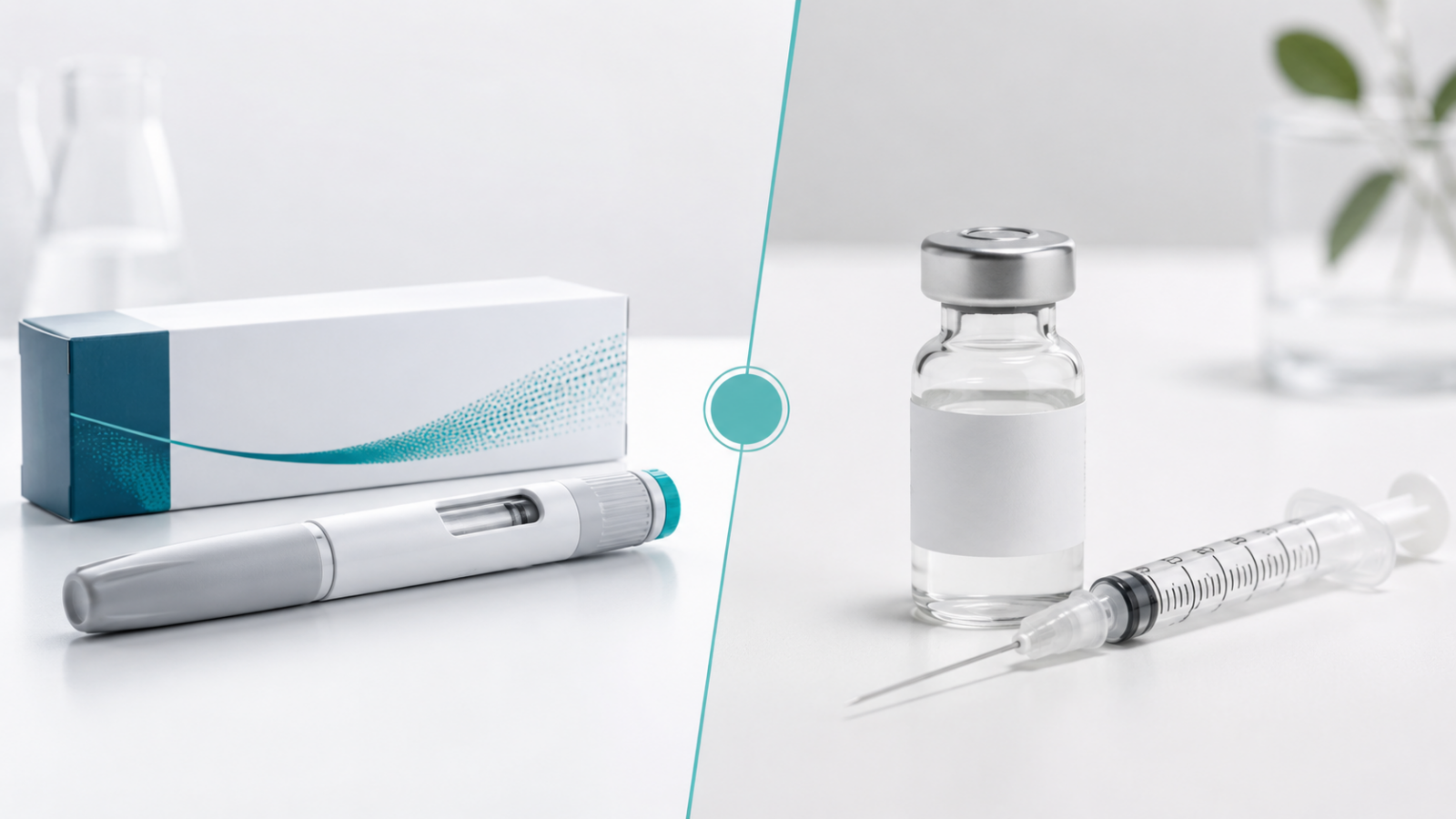
GLP-1 medications have changed the conversation around obesity treatment, metabolic health, and type 2 diabetes.
Medications containing semaglutide and tirzepatide have become especially well known because of their ability to improve blood sugar regulation and, for certain FDA-approved products and indications, support significant weight loss.
Their popularity has also created another market: compounded GLP-1 medications.
At first glance, the distinction can seem simple. One medication comes from a pharmaceutical manufacturer, while another is prepared by a compounding pharmacy.
But the differences go much deeper.
FDA-approved and compounded GLP-1 medications differ in how they are evaluated, manufactured, regulated, packaged, prescribed, and monitored. They should not automatically be treated as equivalent products.
Here is what patients should understand before deciding which option to discuss with their healthcare provider.
What Are GLP-1 Medications?
GLP-1 stands for glucagon-like peptide-1, a naturally occurring hormone involved in appetite, digestion, and blood sugar regulation.
GLP-1 receptor agonist medications mimic some of the effects of this hormone. Depending on the specific medication, they may:
- Reduce appetite
- Increase feelings of fullness
- Slow stomach emptying
- Improve insulin secretion when glucose is elevated
- Help improve blood sugar control
- Support clinically meaningful weight loss in appropriate patients
Semaglutide is a GLP-1 receptor agonist.
Tirzepatide is slightly different. It activates both GLP-1 and GIP receptors, so technically it is a dual GIP/GLP-1 receptor agonist rather than a GLP-1-only medication.
Despite that distinction, semaglutide and tirzepatide are frequently discussed together under the broader category of GLP-1-based therapies.
What Are FDA-Approved GLP-1 Medications?
An FDA-approved medication has gone through the Food and Drug Administration’s formal review process.
Before approval, manufacturers must provide evidence supporting the drug’s safety, effectiveness, manufacturing quality, dosing, labeling, and intended use.
Examples include semaglutide products such as Wegovy and Ozempic, as well as tirzepatide products such as Zepbound and Mounjaro.
Importantly, different brand names containing the same or similar active ingredients may have different FDA-approved indications.
For example, Wegovy is approved for chronic weight management in qualifying patients and also has an indication for reducing the risk of major cardiovascular events in certain adults with cardiovascular disease and overweight or obesity. Zepbound is approved for chronic weight management in qualifying adults and is also approved for moderate-to-severe obstructive sleep apnea in adults with obesity.
Mounjaro is approved to improve blood sugar control in adults with type 2 diabetes when used alongside diet and exercise.
These distinctions matter because the evidence, dosage, labeling, and monitoring recommendations are tied to a specific FDA-approved product and indication.
What Is a Compounded GLP-1 Medication?
Compounding involves preparing a medication to meet a patient’s specific medical need.
For example, compounding may be appropriate when a patient cannot use an available FDA-approved medication because of a particular ingredient, formulation, or dosage requirement.
Compounding can serve an important role in medicine.
However, compounded medications are not FDA-approved medications.
The FDA does not evaluate each compounded product for safety, effectiveness, or manufacturing quality before it reaches the patient.
That does not automatically mean every compounded medication is unsafe.
It does mean there is a fundamentally different level of premarket regulatory review.
Compounded vs. FDA-Approved GLP-1 Medications
Here is a simplified comparison.
| Feature | FDA-Approved GLP-1 Medication | Compounded GLP-1 Medication |
|---|---|---|
| FDA approval | Yes | No |
| Premarket FDA review for safety and effectiveness | Yes | No |
| Standardized formulation | Yes | May vary |
| Standardized concentration | Yes | May vary by compounder |
| FDA-approved labeling | Yes | No |
| Packaging | Standardized by manufacturer | May vary |
| Dosing device | Often manufacturer-designed pen or device | May include vial and syringe |
| Clinical trial evidence | Product-specific trials required | Finished compounded product generally not separately studied for FDA approval |
| Availability | Depends on prescription, insurance and supply | Depends on legal compounding circumstances and pharmacy |
| Customization | Limited | Possible when medically appropriate |
The critical point is that a compounded version should not automatically be described as a generic version of an FDA-approved GLP-1.
Generic medications themselves receive FDA approval and must meet specific regulatory requirements. Compounded drugs do not go through that same approval pathway.
Why Did Compounded Semaglutide and Tirzepatide Become So Common?
Demand for GLP-1 medications increased rapidly.
During national shortages, federal law allowed certain compounding activities that helped address medication availability when specific conditions were met.
That landscape has since changed.
The FDA determined that the tirzepatide injection shortage was resolved in December 2024 and that the semaglutide injection shortage was resolved on February 21, 2025.
As of the FDA’s April 1, 2026 update, semaglutide and tirzepatide were not on the FDA drug shortage list. The agency reiterated that compounders must meet the requirements of federal law and that restrictions generally apply to routinely making products that are essentially copies of commercially available FDA-approved medications.
This is important because the legality and appropriateness of compounding do not depend simply on whether a patient would prefer a lower-cost version.
There must be a legally permissible basis for compounding.
Are Compounded GLP-1 Medications FDA Approved?
No.
This is one of the most important points patients should understand.
The FDA explicitly states that compounded drugs are not FDA approved.
The agency does not review each compounded GLP-1 product before marketing to confirm its safety, effectiveness, or quality.
Be cautious of language such as:
- “FDA-approved compounded semaglutide”
- “Generic Ozempic”
- “Generic Wegovy”
- “Generic Zepbound”
- “FDA-approved compounding pharmacy”
These descriptions may create a misleading impression.
In 2026, the FDA issued warning letters to companies over marketing that suggested compounded GLP-1 products were equivalent to or the same as FDA-approved drugs.
What About Compounded Semaglutide Salt Forms?
This is another important distinction.
The FDA has specifically raised concerns about compounded products using semaglutide sodium or semaglutide acetate.
These salt forms are chemically different from the active ingredient used in FDA-approved semaglutide medications.
According to the FDA, it does not have information showing that these salt forms have the same chemical and pharmacologic properties as the active ingredient in approved drugs, and the agency has stated that it is not aware of a lawful basis for their use in compounding.
Patients considering compounded semaglutide should know exactly what form of semaglutide is being prescribed and dispensed.
Dosing Can Be More Complicated With Some Compounded GLP-1s
One advantage of FDA-approved injectable GLP-1 products is standardized dosing and packaging.
Some compounded products instead arrive in multi-dose vials.
Patients may then need to withdraw medication with a syringe and translate a prescription written in milligrams into milliliters or syringe “units.”
That creates additional opportunities for confusion.
The FDA has received reports of dosing errors involving compounded injectable semaglutide. Some patients accidentally administered five to 20 times the intended dose, and some required medical care or hospitalization.
Errors may occur because:
- Concentrations vary between compounded products
- Different syringe sizes may be used
- “Units” may be confused with milligrams or milliliters
- Patients may misunderstand vial instructions
- Providers may incorrectly convert between units
- Dose escalation may occur too rapidly
If a compounded medication is prescribed, patients should receive clear written instructions showing exactly how much medication to draw into the syringe.
Never guess.
Are Side Effects Different?
Both FDA-approved and compounded products containing GLP-1-based medications may produce gastrointestinal symptoms such as:
- Nausea
- Vomiting
- Diarrhea
- Constipation
- Abdominal discomfort
- Reduced appetite
Other clinically important risks depend on the specific medication and the patient’s individual health history.
The difference is not simply that FDA-approved products have side effects while compounded medications do not.
Rather, FDA-approved medications have undergone controlled studies and standardized manufacturing, giving clinicians a more established evidence base for understanding dosing, expected side effects, contraindications, and treatment outcomes.
Compounded products introduce additional variables related to preparation, concentration, labeling, and administration.
As of May 31, 2026, the FDA reported receiving 990 adverse-event reports associated with compounded semaglutide and more than 730 involving compounded tirzepatide, while noting that the reports do not necessarily establish that the compounded drug caused the event. The agency also cautions that adverse events from compounded medications may be underreported.
Does FDA Approval Mean a Medication Is Risk-Free?
No.
FDA approval does not mean that a drug has zero risk.
Every prescription medication has potential side effects and contraindications.
FDA approval means the medication has undergone a standardized regulatory review in which available evidence was evaluated to determine whether its benefits outweigh its known risks for specific uses.
That is very different from saying the medication is universally safe or appropriate.
GLP-1 treatment should still be individualized based on:
- Medical history
- Current medications
- Weight and metabolic history
- Diabetes status
- Gastrointestinal history
- Kidney and liver function when relevant
- Pregnancy plans
- Previous treatment response
- Potential medication interactions
- Contraindications and warnings associated with the specific drug
Is Compounded Semaglutide Cheaper?
It can be.
Cost has been one of the major reasons patients have looked toward compounded GLP-1 medications.
FDA-approved medications may be expensive without insurance coverage, and insurance policies differ dramatically in their coverage of obesity treatment.
However, price should not be considered separately from questions of quality, sourcing, dosing, and regulatory status.
A lower advertised monthly price does not necessarily mean two products are clinically or regulatorily equivalent.
Patients should know exactly:
- What medication they are receiving
- Who manufactured or compounded it
- What concentration is being dispensed
- How it should be measured
- Where the active ingredient came from
- Whether the pharmacy is appropriately licensed
- Why a compounded formulation is medically appropriate
- What monitoring is included
Is a Compounding Pharmacy FDA Approved?
Not in the way that phrase is commonly understood.
Some outsourcing facilities register with the FDA, and the FDA has regulatory authority over certain aspects of compounding.
But registration or inspection does not mean an individual compounded medication has received FDA approval.
The FDA specifically warned in 2026 that referring to a compounding pharmacy or outsourcing facility as “FDA-approved” or “FDA-licensed” can be misleading because the agency does not create such a designation for pharmacies or their compounded products.
When Might Compounding Still Have a Role?
Compounded medications remain an important part of medicine.
For example, a patient may require a formulation that removes an ingredient they cannot tolerate or another clinically meaningful modification that an available commercial drug cannot provide.
The FDA notes that compounded medications may serve patients whose medical needs cannot be met by an available FDA-approved medication.
That is different from mass-producing copies of commercially available medications simply because demand is high.
The medical need should drive the decision.
Questions to Ask Before Starting a Compounded GLP-1
If your healthcare provider recommends a compounded GLP-1-based medication, ask:
1. Why is compounding medically necessary in my case?
There should be a clear rationale for using a compounded product rather than an available FDA-approved medication.
2. Which active ingredient am I receiving?
Know whether the prescription contains semaglutide, tirzepatide, or another ingredient.
3. What exact concentration is in the vial?
Do not rely only on instructions such as “inject 20 units.”
You should understand how those units relate to the prescribed dose.
4. Where is the prescription being filled?
The FDA advises patients to obtain prescription medicines through appropriately licensed pharmacies.
5. What is the titration schedule?
GLP-1 medications are usually increased gradually to improve tolerability.
Faster is not automatically better.
6. What should I do if I experience side effects?
You should know whom to contact and what symptoms warrant urgent evaluation.
7. What ongoing monitoring is included?
Medication should not replace clinical follow-up.
Weight, symptoms, side effects, nutrition, body composition, metabolic health, and other relevant markers may need to be reviewed over time.
GLP-1 Treatment Is More Than Getting the Prescription
Whether treatment involves an FDA-approved medication or another legally appropriate option, the medication is only part of the strategy.
Successful medical weight management should also consider:
Protein intake
Reduced appetite can make it harder to consume adequate protein. Maintaining sufficient protein becomes especially important when trying to preserve lean mass during weight loss.
Resistance training
Strength training helps support muscle and physical function while body weight decreases.
Hydration
Nausea, vomiting, diarrhea, and reduced food intake can increase dehydration risk.
Micronutrient intake
Eating significantly less food can make nutritional quality more important, not less.
Sleep
Poor sleep affects appetite, glucose regulation, recovery, and weight management.
Long-term strategy
Obesity is often a chronic condition. Patients and clinicians should discuss what happens after the initial weight-loss phase rather than focusing exclusively on the first few months.
FDA-Approved vs. Compounded GLP-1: Which Is Better?
There is no universal medication decision that applies to every patient.
However, FDA-approved medications provide a level of standardized evidence, manufacturing controls, labeling, dosing, and regulatory review that compounded medications do not.
The FDA’s current recommendation is that compounded medications should be used when a patient’s medical needs cannot be met by an available FDA-approved drug.
That makes the starting question less about:
“Which one is cheaper?”
and more about:
“Which medication and treatment pathway is medically appropriate, legally available, properly monitored, and supported by the strongest evidence for me?”
The Bottom Line
Compounded and FDA-approved GLP-1 medications are not interchangeable categories.
FDA-approved GLP-1 medications have undergone formal review for safety, effectiveness, manufacturing quality, labeling, and specific indications.
Compounded medications can play an important role for certain patients, but they are not FDA approved and do not undergo the same premarket evaluation.
The regulatory environment has also changed considerably since the GLP-1 shortages that helped drive widespread compounding. Semaglutide and tirzepatide are no longer on the FDA drug shortage list, and federal restrictions apply to routinely compounding products that are essentially copies of commercially available FDA-approved drugs.
Before starting any GLP-1-based therapy, understand exactly what you are being prescribed, why it was selected, where it is coming from, how it is dosed, and how your progress will be monitored.
At 1st Optimal, the goal is not simply to prescribe a medication. A responsible weight-management strategy considers the larger picture, including metabolic health, nutrition, muscle preservation, hormones when clinically appropriate, lifestyle, symptoms, and ongoing monitoring.
Educational only. This article is not medical advice and does not replace evaluation or treatment by a qualified healthcare professional.
Frequently Asked Questions
Is compounded semaglutide the same as Ozempic or Wegovy?
No. Compounded semaglutide is not the same FDA-approved product as Ozempic or Wegovy. Compounded medications do not undergo FDA premarket review for safety, effectiveness, or quality and should not be described as FDA-approved generics.
Is compounded tirzepatide the same as Zepbound or Mounjaro?
No. Zepbound and Mounjaro are FDA-approved branded medications containing tirzepatide. A compounded tirzepatide preparation is not itself FDA approved.
Are compounded GLP-1 medications legal?
Compounding is legal when the product and compounder meet applicable federal and state requirements. However, regulations restrict routine compounding of products that are essentially copies of commercially available FDA-approved medications. The rules can vary depending on whether compounding takes place under section 503A or 503B of federal law.
Are semaglutide and tirzepatide still in shortage?
As of the FDA’s April 1, 2026 update, semaglutide and tirzepatide were not on the FDA drug shortage list. The tirzepatide shortage was declared resolved in December 2024, and the semaglutide injection shortage was declared resolved on February 21, 2025.
Is compounded semaglutide safe?
Compounded medications may be clinically appropriate in certain situations, but the FDA does not review compounded drugs before marketing for safety, effectiveness, or quality. The FDA has also reported dosing errors and adverse events involving compounded semaglutide. Patients should discuss the potential benefits and risks with a qualified healthcare provider.
Can compounded GLP-1 medications use different doses?
Compounded preparations may be available in different concentrations and packaging, which can increase the potential for dosing confusion. The FDA has reported medication errors involving conversions among milligrams, milliliters, and syringe units.
Are compounded GLP-1 medications generic drugs?
No. FDA-approved generic drugs must meet FDA requirements demonstrating, among other things, therapeutic equivalence to the corresponding brand-name drug. Compounded medications are not FDA-approved generic drugs.
Which GLP-1 medication is right for me?
The appropriate option depends on your diagnosis, treatment goals, medical history, insurance coverage, contraindications, medication tolerance, and other individual factors. A qualified healthcare provider should determine whether GLP-1 therapy is appropriate and which specific medication best fits your situation.