
You may be eating the same foods.
You may still be exercising.
The number on the scale may not have changed dramatically.
Yet somewhere after 40, your body starts looking different.
Your waist feels thicker. Jeans fit differently. Fat that once seemed to settle around your hips and thighs now seems more interested in your stomach.
This change is often called the “perimenopause belly.”
And no, it is not simply a matter of suddenly losing discipline.
Research shows that the menopause transition can change where the body stores fat, even when overall weight gain is relatively modest. Aging, declining estrogen, changes in muscle mass, sleep disruption, activity levels, and metabolic health can all contribute.
Understanding what is happening can help you respond more effectively than simply eating less and exercising harder.
What Is the “Perimenopause Belly”?
“Perimenopause belly” is not a medical diagnosis.
It is a common term used to describe the increase in abdominal fat many women notice during their 40s and 50s as they move through the menopause transition.
Before menopause, women are more likely to store a larger proportion of body fat around the hips, thighs, and buttocks.
As reproductive hormones change, fat distribution can shift toward the abdomen and waist.
The important distinction is that this does not always mean you are gaining a large amount of weight.
Your body composition can change even when your body weight does not change very much.
Research examining women during the menopause transition has repeatedly found increases in central or abdominal fat, with menopause appearing to play a particularly important role in fat distribution while aging itself remains a major contributor to total weight gain.
That is why a woman may say:
“My weight hasn’t changed much, but my stomach definitely has.”
She may be right.
Why Does Belly Fat Increase During Perimenopause?
There is rarely one single cause.
The change usually reflects several biological and lifestyle factors happening at the same time.
1. Estrogen Begins to Change
One of the biggest shifts during perimenopause involves estrogen.
Estrogen does far more than regulate the menstrual cycle. It also interacts with tissues involved in:
- Fat storage
- Glucose metabolism
- Muscle function
- Appetite regulation
- Energy expenditure
- Insulin sensitivity
During perimenopause, estrogen levels can fluctuate significantly before eventually declining.
These hormonal changes appear to influence where fat is stored, favoring greater accumulation around the abdomen rather than the hips and thighs.
The Menopause Society notes that while aging is a major driver of midlife weight gain, menopause plays an important role in redistributing fat toward the abdomen.
This helps explain why simply looking at the scale does not tell the whole story.
2. Visceral Fat Can Increase
Not all belly fat is the same.
There are two major types of abdominal fat.
Subcutaneous fat sits underneath the skin.
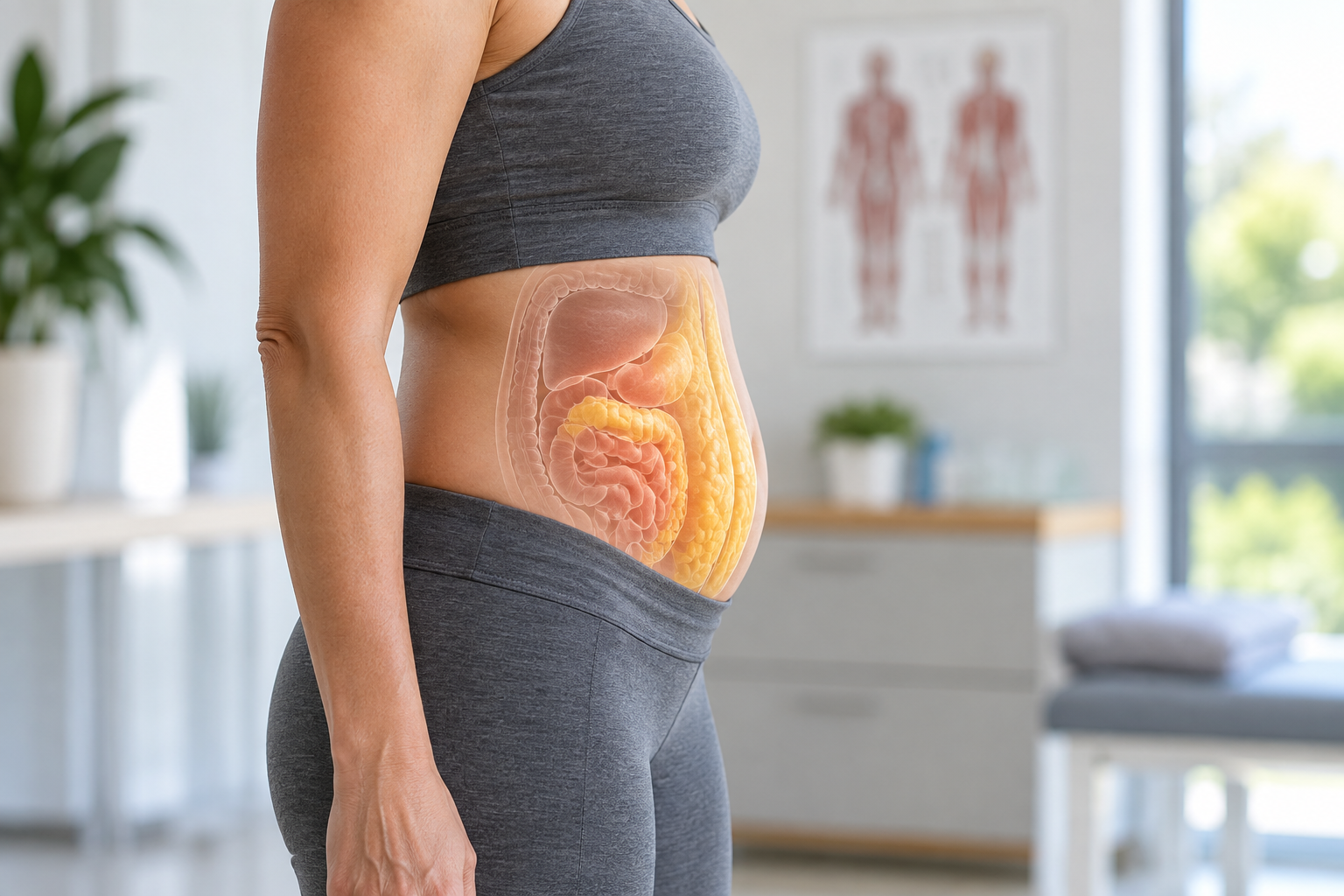
Visceral fat sits deeper inside the abdomen and surrounds organs.
It is visceral fat that deserves particular attention from a health perspective.
Studies from the Study of Women’s Health Across the Nation, or SWAN, have demonstrated increases in visceral abdominal fat during the menopause transition. One analysis found that visceral fat accumulation accelerated beginning approximately two years before the final menstrual period.
Visceral fat is metabolically active and is associated with greater cardiometabolic risk, including insulin resistance, abnormal cholesterol, cardiovascular disease, and Type 2 diabetes.
This is one reason changes around the waist after 40 are not only a cosmetic issue.
They can provide useful information about what may be happening metabolically.
3. Muscle Mass Becomes Harder to Maintain
Another major piece of the perimenopause metabolism puzzle is muscle.
Adults gradually lose muscle with age unless they actively work to preserve it.
This matters because skeletal muscle plays an important role in:
- Glucose disposal
- Insulin sensitivity
- Physical strength
- Metabolic health
- Maintaining functional independence
- Daily energy expenditure
If muscle decreases while fat mass increases, body composition may shift significantly without producing a dramatic change on the scale.
You could technically weigh almost the same while having:
less muscle + more abdominal fat.
This is why relying only on scale weight can be misleading after 40.
The Menopause Society specifically recommends resistance training and adequate dietary protein as important strategies for helping women preserve muscle during midlife.
4. Daily Energy Needs May Gradually Change
There is another uncomfortable reality of getting older.
Your body may not require exactly the same amount of energy at 45 that it required at 25.
Age-related changes in muscle mass, spontaneous physical activity, and energy expenditure can gradually reduce daily calorie requirements.
That does not mean your metabolism suddenly “shuts down.”
It means that small differences between food intake and energy expenditure can accumulate over months or years.
A 2024 review on weight gain in midlife women concluded that age-related reductions in energy expenditure and physical activity are important contributors to weight gain, while menopause contributes additionally to changes in body composition and central fat accumulation.
That distinction matters.
Aging influences weight. Menopause influences where some of that weight is stored.
Both may be happening simultaneously.
5. Insulin Sensitivity Can Change
Insulin helps move glucose from the bloodstream into cells where it can be used or stored.
During midlife, several factors can negatively influence insulin sensitivity, including:
- Increasing visceral fat
- Declining muscle mass
- Lower physical activity
- Poor sleep
- Changes in reproductive hormones
- Excess calorie intake
- Genetics
- Existing metabolic dysfunction
When insulin sensitivity worsens, the body may have more difficulty regulating blood sugar effectively.
That does not mean every woman with abdominal fat has insulin resistance.
But increasing waist circumference can be a reason to look beyond body weight and evaluate markers such as glucose, blood pressure, lipids, and other cardiometabolic factors when clinically appropriate.
Recent research continues to describe perimenopause as a period when changes in body composition and metabolic health can become more apparent, sometimes even without major increases in total body weight.
6. Sleep Often Gets Worse During Perimenopause
Sleep may be one of the most underestimated components of body composition.
Perimenopause commonly brings challenges such as:
- Night sweats
- Hot flashes
- Difficulty falling asleep
- Waking during the night
- Earlier awakening
- Anxiety
- Changes in mood
Poor sleep can influence appetite, food choices, physical activity, and metabolic health.
Research in midlife women has found that sleep disruption may contribute to weight gain, particularly when menopausal symptoms repeatedly interfere with sleep quality.
This creates a frustrating cycle.
Poor sleep makes exercise harder.
It makes hunger more difficult to manage.
Energy drops.
Movement decreases.
Food choices often become more convenience-driven.
And simply telling someone to “have more discipline” misses the physiology underneath the behavior.
7. Your Activity May Have Changed More Than You Realize
Exercise is only one part of daily movement.
There is also everything you do outside the gym:
Walking.
Taking stairs.
Standing.
Cleaning.
Running errands.
Playing with your kids.
Moving around at work.
Small amounts of movement accumulate throughout the day.
During busy midlife years, work demands, family responsibilities, injuries, stress, and fatigue can gradually reduce this activity without being particularly noticeable.
Someone might still complete three workouts each week while moving significantly less during the other 165 hours.
That matters.
For general health, current U.S. physical activity guidance recommends adults accumulate approximately 150 to 300 minutes of moderate-intensity aerobic activity each week and perform muscle-strengthening exercise at least two days per week.
Is Cortisol Causing Your Perimenopause Belly?
Cortisol gets blamed for almost everything online.
The reality is more complicated.
Cortisol is an essential hormone involved in your stress response, blood pressure, glucose regulation, immune function, and circadian rhythm.
Normal cortisol is not the enemy.
Chronic stress, however, can indirectly make weight management more difficult by affecting:
- Sleep
- Appetite
- Alcohol intake
- Food choices
- Recovery
- Exercise consistency
- Emotional eating
Certain medical conditions involving abnormal cortisol levels can also affect fat distribution, but they are different from the everyday stress most people experience.
So rather than assuming every increase in abdominal fat is caused by “high cortisol,” it is more useful to examine the bigger picture.
Why Doing More Cardio Is Not Always the Best Answer
When belly fat appears, many women immediately increase cardio while dramatically cutting calories.
That approach can backfire if it makes it harder to preserve lean muscle.
The goal after 40 should not simply be:
Make the scale smaller.
A better goal is:
Improve body composition while protecting muscle and metabolic health.
That means resistance training becomes increasingly important.
Strength training can help maintain or build lean tissue, improve physical function, support bone health, and help preserve muscle during weight loss. Federal physical activity guidelines recommend muscle-strengthening activity involving the major muscle groups on at least two days per week.
Walking, cycling, running, and other cardiovascular exercise still have tremendous benefits.
But cardio should complement strength training rather than automatically replacing it.
Can You Specifically Burn Perimenopause Belly Fat?
Unfortunately, you cannot choose where your body removes fat first.
Doing hundreds of crunches may strengthen your abdominal muscles, but it does not selectively force your body to remove fat from your stomach.
Your genetics, hormones, age, sex, and overall body composition influence where fat is lost.
The better strategy is improving whole-body metabolic health and reducing excess fat over time while preserving muscle.
As total fat decreases, abdominal and visceral fat may decrease as well.
What Actually Helps With Belly Fat After 40?
There is no single “menopause belly” diet.
Successful strategies tend to address several areas simultaneously.
Prioritize Protein
Protein becomes increasingly important when the goal is losing fat while protecting lean muscle.
Good protein sources can include:
- Eggs
- Greek yogurt
- Cottage cheese
- Chicken
- Turkey
- Fish
- Lean beef
- Tofu
- Tempeh
- Beans
- Lentils
- Protein supplements when appropriate
The ideal amount depends on factors such as body size, activity level, overall calorie intake, health conditions, and goals.
The Menopause Society’s midlife weight guidance emphasizes adequate protein alongside resistance training to help preserve lean mass.
Strength Train Consistently
You do not need to become a competitive powerlifter.
You do need enough resistance to challenge your muscles.
A quality program might include movements such as:
- Squats or leg presses
- Hip hinges
- Rows
- Chest presses
- Overhead presses
- Lunges
- Pulldowns
- Carries
- Core exercises
The important word is progression.
Muscles adapt when they are given a reason to adapt.
Increase Daily Movement
Do not underestimate walking.
A structured workout may last 45 minutes.
Your daily lifestyle lasts all day.
Look for opportunities to:
- Walk after meals
- Take walking meetings
- Use stairs
- Break up long periods of sitting
- Add short walks throughout the workday
- Spend more recreational time moving
Small increases become meaningful when repeated consistently.
Build Meals Around Minimally Processed Foods
Instead of searching for a complicated hormone-balancing diet, start with foods that make it easier to manage appetite and meet nutrient needs.
Build most meals around:
Protein + vegetables or fruit + high-fiber carbohydrates + healthy fats.
Examples might include:
Salmon + roasted vegetables + potatoes
Greek yogurt + berries + chia seeds
Chicken + rice + vegetables + avocado
Eggs + whole-grain toast + fruit
Lean beef + beans + vegetables
The goal is not dietary perfection.
It is creating an eating pattern you can consistently maintain.
Pay Attention to Fiber
Fiber supports more than digestion.
High-fiber foods can help with fullness and are part of dietary patterns associated with better metabolic health.
Sources include:
- Vegetables
- Berries
- Beans
- Lentils
- Whole grains
- Chia seeds
- Flaxseed
- Nuts
- Seeds
Increase fiber gradually if your current intake is low, especially if you are prone to bloating or digestive symptoms.
Make Sleep Part of Your Metabolic Plan
If you are training hard and eating well but consistently sleeping five hours, there may be an important piece missing.
Treat sleep problems as something worth investigating rather than simply accepting them as part of getting older.
If hot flashes, night sweats, anxiety, snoring, restless legs, or insomnia repeatedly disrupt sleep, talk with an appropriate healthcare professional.
Better sleep will not magically remove abdominal fat.
But poor sleep can make nearly every other behavior required for successful weight management more difficult.
What About Hormone Replacement Therapy?
Menopausal hormone therapy can be highly effective for appropriate women experiencing certain menopause symptoms.
It is not, however, a weight-loss treatment.
The Menopause Society notes that hormone therapy itself is not associated with weight gain. Some research suggests hormone therapy may have favorable effects on body composition and metabolic health, but it should not be prescribed solely as a treatment for abdominal obesity.
The decision to use hormone therapy should instead be individualized based on factors such as symptoms, medical history, age, time since menopause, risk factors, and personal preferences.
When Belly Fat May Be a Signal to Look Deeper
Sometimes the conversation should go beyond calories and exercise.
If your body composition changes significantly, especially alongside other symptoms, a broader health evaluation may be appropriate.
Depending on your history and symptoms, a clinician may consider looking at areas such as:
- Blood pressure
- Fasting glucose
- Hemoglobin A1c
- Lipid profile
- Thyroid function when clinically indicated
- Menstrual history
- Menopause symptoms
- Sleep quality
- Medication use
- Alcohol intake
- Nutrition
- Exercise
- Muscle mass and strength
- Family history
- Other relevant laboratory markers
The goal should not be to order every possible hormone test.
The goal is to understand the entire clinical picture.
Your Waistline Is Data, Not a Character Judgment
One of the most damaging messages women receive during perimenopause is that changes in their body automatically mean they have stopped trying.
That is not how human physiology works.
The menopause transition can alter body composition.
Aging can reduce muscle mass and energy requirements.
Sleep can deteriorate.
Life becomes busier.
Exercise needs may change.
Hormones shift.
Metabolic risk can change.
None of this means results are impossible after 40.
It means the strategy that worked at 25 may not be the strategy you need at 45.
The Better Goal After 40
Instead of obsessing exclusively over losing pounds, consider tracking outcomes that tell you more about your health:
- Waist circumference
- Strength
- Muscle mass
- Blood pressure
- Blood sugar
- Cholesterol
- Sleep
- Energy
- Exercise performance
- Daily movement
- How your clothes fit
- Overall body composition
The scale is one piece of information.
It is not the entire story.
Final Thoughts: The Perimenopause Belly Is More Than “Calories In, Calories Out”
Energy balance still matters.
But understanding why energy balance becomes harder to manage and why fat distribution changes matters too.
After 40, the combination of aging, declining estrogen, reduced muscle mass, sleep problems, lifestyle changes, and increasing visceral fat can create a different metabolic environment than the one you experienced in your 20s or 30s.
The solution is rarely another extreme diet.
Start with the fundamentals:
Protect muscle.
Strength train.
Eat enough protein.
Prioritize minimally processed foods.
Move throughout the day.
Address poor sleep.
Evaluate metabolic health when appropriate.
And most importantly, treat changes in your body as information that can help guide your next step.
At 1st Optimal, we look beyond a single number on the scale. Understanding hormones, metabolic health, body composition, lifestyle, symptoms, and your health history can provide a more complete picture of what may be changing and what deserves attention.
Frequently Asked Questions
Why am I suddenly gaining belly fat in perimenopause?
Several factors may contribute. Hormonal changes during the menopause transition can alter fat distribution toward the abdomen, while aging, declining muscle mass, reduced activity, sleep disruption, food intake, and metabolic changes can influence overall body fat.
Does estrogen loss cause belly fat?
Declining estrogen appears to contribute to the redistribution of fat toward the abdominal area. However, estrogen is only one factor. Aging, muscle loss, activity, sleep, genetics, nutrition, and other metabolic factors also influence body composition.
Can you lose perimenopause belly fat?
Yes, abdominal fat can decrease, although you cannot selectively choose where your body loses fat first. Sustainable nutrition, resistance training, aerobic activity, daily movement, adequate protein, quality sleep, and appropriate medical care can all contribute to improved body composition.
Why is my stomach getting bigger even though my weight is the same?
Body composition can change without a major change in scale weight. You may lose some lean mass while accumulating more abdominal fat, which can change your waistline and how your clothes fit without producing a dramatic change in total weight.
Does menopause slow your metabolism?
Midlife changes in energy expenditure are strongly influenced by aging, activity, and loss of lean muscle. Menopause itself appears to have a particularly important effect on fat distribution, increasing the tendency to store fat centrally.
Does hormone replacement therapy get rid of menopause belly fat?
Hormone therapy is not approved or recommended specifically as a weight-loss or abdominal-fat treatment. It may influence body composition in some women and is effective for certain menopause symptoms, but decisions about hormone therapy should be based on an individualized assessment of symptoms, benefits, risks, and medical history.
Is belly fat during perimenopause dangerous?
Some abdominal fat, particularly visceral fat located around internal organs, is associated with greater risk for insulin resistance, Type 2 diabetes, abnormal cholesterol, high blood pressure, and cardiovascular disease. Increasing waist circumference can therefore be useful information when evaluating overall metabolic health.
References
- The Menopause Society. Midlife Weight Gain. Guidance on aging, menopause, abdominal fat accumulation, nutrition, protein intake, and physical activity.
- The Menopause Society. Perimenopause. Patient education covering symptoms, menopause transition, and weight management.
- Kozakowski J, et al. / Journal of Mid-Life Health. Weight, Shape, and Body Composition Changes at Menopause. Review of visceral fat accumulation, energy expenditure, body composition, and metabolic consequences.
- Samargandy S, et al. Abdominal Visceral Adipose Tissue Over the Menopause Transition and Carotid Atherosclerosis: The SWAN Heart Study. Menopause. 2021.
- Janssen I, et al. Testosterone and Visceral Fat in Midlife Women: The Study of Women’s Health Across the Nation Fat Patterning Study. Obesity.
- Karaflou M, et al. Body Composition Analysis: A Snapshot Across the Perimenopause. Review discussing estrogen, abdominal adiposity, insulin resistance, and cardiometabolic health.
- Kapoor E, et al. Weight Gain in Women at Midlife. Review of aging, menopause, lifestyle, body composition, and management strategies.
- U.S. Office of Disease Prevention and Health Promotion. Physical Activity Guidelines for Americans. Recommendations for aerobic and muscle-strengthening activity.
Educational purposes only. This article is not intended to diagnose, treat, cure, or prevent any disease and does not replace individualized medical advice.