

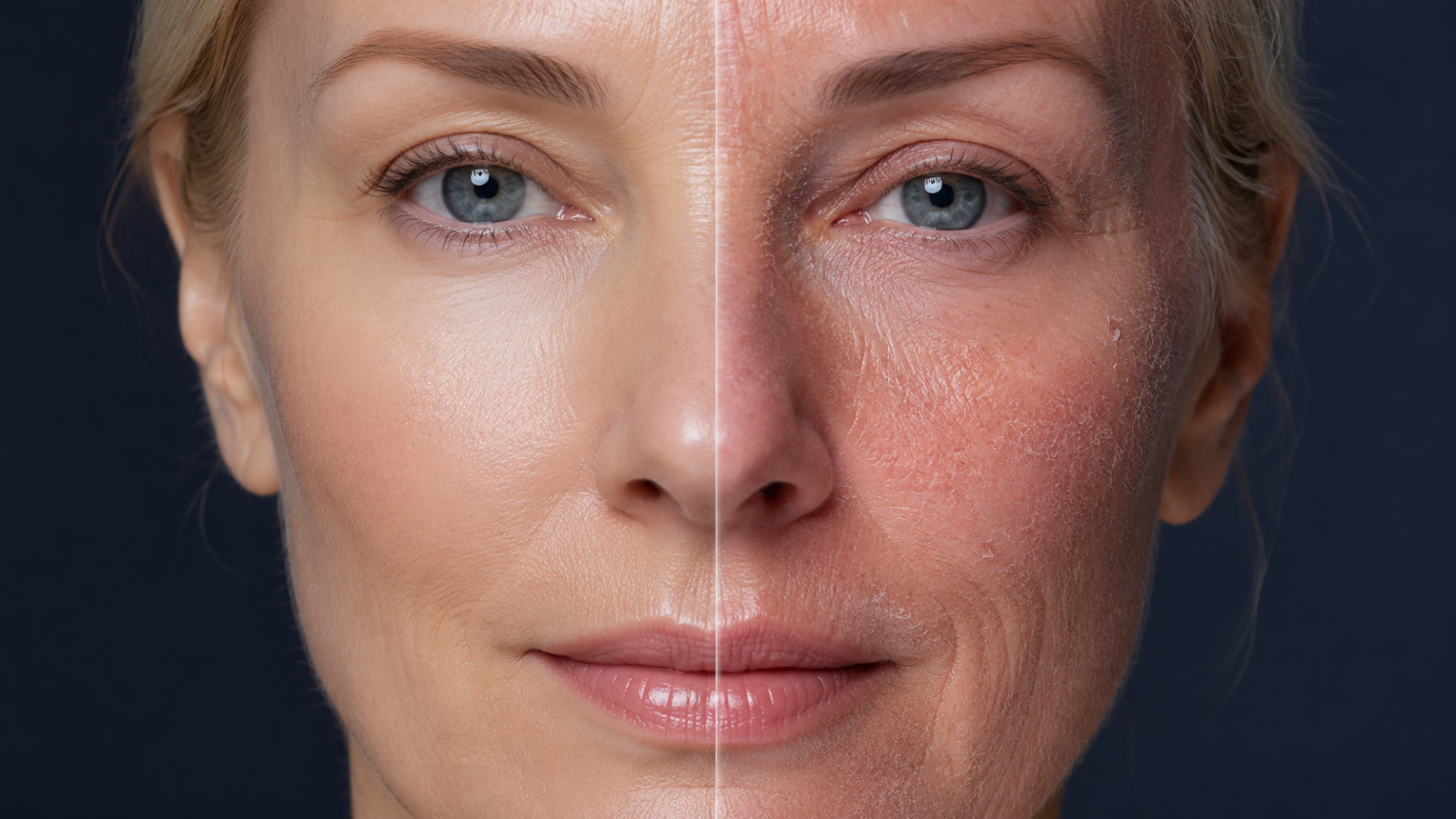
If your skin suddenly burns when you apply moisturizer, looks red after cleansing, flakes despite constant hydration, or seems unable to tolerate products you used for years, your routine may be doing more than simply “working.”
It may be irritating your skin barrier.
This can become especially relevant after age 40.
Skin naturally tends to become drier with age, making hydration and gentle skin care increasingly important. The American Academy of Dermatology recommends daily moisturizer, mild cleansing, and avoiding aggressive scrubbing as part of healthy skin care in the 40s and 50s.
At the same time, many people become more aggressive with skin care during these decades.
Retinol gets stronger.
Exfoliating acids become more frequent.
Vitamin C is layered with multiple serums.
Cleansers promise deeper purification.
At-home peels, scrubs, masks, and devices enter the routine.
The goal is usually healthier, younger-looking skin.
But when too many potentially irritating steps are combined, the result can be the opposite: dryness, inflammation, increased sensitivity, breakouts, and persistent redness.
The answer is not necessarily to abandon effective skin care ingredients.
It is to understand when your skin is telling you that the total routine has become too aggressive.
What Is the Skin Barrier?
The outermost portion of the epidermis, particularly the stratum corneum, acts as an important protective barrier between your body and the outside environment.
Think of it less like a sheet covering your skin and more like a highly organized defensive system.
A healthy skin barrier helps:
- Limit excessive water loss
- Protect against environmental irritants
- Maintain hydration
- Support normal skin function
- Reduce the penetration of potentially irritating substances
When this barrier becomes disrupted, water can escape more easily while ingredients and environmental triggers may become more irritating.
That is why compromised skin can feel simultaneously dry, oily, tight, sensitive, and inflamed.
Simply applying more active ingredients does not necessarily solve the problem.
Sometimes it makes it worse.
Why Skin Can Become More Vulnerable After 40
There is nothing magical about your 40th birthday that suddenly damages the skin barrier.
Skin changes gradually.
But age-related shifts can make aggressive routines less forgiving.
The American Academy of Dermatology notes that skin becomes drier with age and recommends moisturizing consistently to help trap water in the skin.
For some women, perimenopause and menopause may introduce additional changes in skin texture, hydration, and overall appearance as hormone levels change.
Environmental exposure accumulated across decades may matter as well.
Sun exposure, climate, smoking, medications, medical conditions, cleansing habits, and previous skin treatments can all influence how skin behaves.
The practical consequence is simple:
The routine your skin tolerated at 30 may not be the routine it tolerates at 45.
That does not necessarily mean your skin has suddenly become “bad.”
Its needs may have changed.
8 Signs Your Skin Care Routine May Be Too Aggressive
A damaged or irritated skin barrier does not always announce itself with dramatic peeling.
The signs can be subtle.
1. Your Moisturizer Suddenly Burns
Moisturizer should generally feel soothing.
If a basic product you previously tolerated now causes intense stinging or burning, your skin may be irritated.
The AAD specifically advises stopping nonprescription anti-aging products that sting, burn, or tingle because these sensations can indicate irritation.
One exception is when your clinician has specifically told you to expect temporary irritation from a prescribed medication.
Persistent burning should not automatically be interpreted as proof that a product is “working.”
2. Your Face Feels Tight Immediately After Cleansing
That extremely clean, squeaky feeling is not necessarily a sign of healthy skin.
It may indicate that your cleansing routine is removing more surface oil than your skin comfortably tolerates.
For adults in their 40s and 50s, dermatologists recommend washing with warm water and a mild cleanser rather than aggressively scrubbing the skin.
Consider your cleanser if your face consistently feels tight before you even leave the bathroom.
3. You Are Flaking Constantly
Some peeling can occur when beginning ingredients such as retinoids.
Persistent scaling is different.
If your skin repeatedly flakes around the nose, mouth, chin, or eyes despite moisturizer, your routine may need adjustment.
Retinoids can improve signs of photoaging, pigmentation, texture, and fine lines, but they can also irritate dry or sensitive skin. The AAD recommends beginning cautiously and notes that people with significant redness, inflammation, or dryness may not tolerate them well.
4. Your Skin Looks Redder Than Usual
Redness can come from many causes, including rosacea, eczema, allergies, sun exposure, infection, or medication reactions.
But persistent redness that appeared after increasing retinol, exfoliation, peels, or other actives should make you reconsider the routine.
More irritation does not equal faster anti-aging.
In fact, excessive inflammation can make skin look rougher and less healthy.
5. Products You Used for Years Suddenly Sting
Your tolerance for certain ingredients can change.
A vitamin C serum, exfoliating toner, acne treatment, or retinol that once caused no problems may begin to feel uncomfortable.
Do not assume you need to “push through.”
Your entire skin environment may have changed because of age, weather, medications, hormonal changes, recent procedures, or the addition of other products.
Look at the routine as a whole.
6. You Are Breaking Out and Dry at the Same Time
Breakouts do not automatically mean you need stronger acne products.
Irritation itself can contribute to an unhappy complexion.
The AAD warns that exfoliating while using products such as retinol, prescription retinoids, or benzoyl peroxide can worsen dryness and may contribute to breakouts.
Before adding another acne treatment, ask whether excessive treatment is part of the problem.
7. Your Skin Seems Shiny but Feels Dehydrated
Shiny skin is not always well-hydrated skin.
Surface oil and hydration are different.
Skin can produce oil while still feeling tight, rough, uncomfortable, or dehydrated.
Adding stronger cleansers because the surface looks oily can sometimes create an even more aggressive cycle.
8. Almost Everything Feels Irritating
One of the clearest warning signs is when products that should be relatively bland start causing discomfort.
Cleanser burns.
Moisturizer burns.
Sunscreen burns.
Makeup burns.
At that point, piling on another serum marketed as “barrier repairing” may not be enough.
The more useful intervention may be simplification.
The Most Common Problem: Active Ingredient Stacking
One potentially irritating ingredient may be perfectly manageable.
Five at once may not be.
Consider a routine containing:
Morning
- Foaming cleanser
- Glycolic toner
- Vitamin C serum
- Niacinamide serum
- Acne spot treatment
- Sunscreen
Evening
- Double cleanse
- Retinoid
- Exfoliating acid
- Peptide serum
- Treatment mask
- Moisturizer
No single product necessarily looks unreasonable.
The problem is the combined exposure.
Dermatologists specifically caution against starting several anti-aging products simultaneously because multiple products can irritate the skin.
Similar overlap can happen when different products contain ingredients doing essentially the same thing.
For example:
- Glycolic acid cleanser
- Exfoliating toner
- AHA serum
- Peel pads
- Exfoliating mask
You may think you have five different products.
Your skin may experience them as five rounds of exfoliation.
Retinol Is Effective. More Retinol Is Not Automatically Better.
Retinoids are among the better-studied topical ingredients used for photoaging.
They can accelerate surface cell turnover, support collagen production, improve uneven pigmentation, and reduce the appearance of fine lines.
That does not mean everyone needs the strongest concentration every night.
If you repeatedly experience significant:
- Burning
- Scaling
- Redness
- Persistent dryness
- Tenderness
your regimen may require adjustment.
Strategies sometimes used to improve tolerance include reducing frequency, using a lower-strength formulation, applying moisturizer, or discussing alternatives with a dermatologist.
The goal is not to win a retinol endurance contest.
It is to use an effective treatment at a level your skin can tolerate.
Can You Over-Exfoliate Mature Skin?
Yes.
Exfoliation removes surface skin cells through either chemical or mechanical methods.
Chemical exfoliants include ingredients such as:
- Glycolic acid
- Lactic acid
- Salicylic acid
- Other AHAs and BHAs
Mechanical exfoliation can involve:
- Facial scrubs
- Brushes
- Pads
- Sponges
- Exfoliating devices
The AAD advises considering the rest of your routine before exfoliating because retinoids, retinol, benzoyl peroxide, and other products may already make skin more sensitive. Combining these treatments with exfoliation can worsen dryness and irritation.
Exfoliating masks can create similar problems when used too frequently or combined with other strong products.
After 40, you may get better results from less frequent, more deliberate exfoliation instead of continually increasing intensity.
What Does a Barrier-Friendly Routine Look Like?
A skin barrier reset does not require 12 products.
In many situations, simpler is better.
Morning
1. Gentle cleansing
Depending on your skin type, this may involve a mild cleanser or simply adjusting how aggressively you cleanse.
Avoid scrubbing.
2. Moisturizer
Look for a formulation your skin tolerates well.
Ingredients frequently used in moisturizing products include:
- Glycerin
- Hyaluronic acid
- Ceramides
- Petrolatum
- Dimethicone
- Shea butter
Creams and ointments can provide more moisture than lightweight lotions for very dry skin.
3. Broad-spectrum sunscreen
Sun protection remains one of the most important parts of an evidence-based skin aging strategy.
Evening
1. Gentle cleanser
Remove sunscreen, makeup, and debris without repeatedly stripping the skin.
2. Moisturizer
Give your routine a basic hydration foundation.
3. One targeted active when appropriate
Once your skin feels comfortable, you may gradually reintroduce treatments such as a retinoid rather than immediately restarting everything.
The exact routine should depend on your skin condition, medical history, goals, and tolerance.
Try the “One Change at a Time” Rule
One of the easiest ways to create an irritating routine is introducing several products at once.
It also makes troubleshooting nearly impossible.
If redness develops, which product caused it?
You do not know.
Instead, introduce one significant active at a time.
Give your skin enough time to show how it responds before adding another treatment.
The AAD similarly recommends beginning with one anti-aging product because using several simultaneously can cause irritation.
This strategy is less exciting than a ten-product haul.
It is much easier to manage.
What Should You Temporarily Stop If Your Skin Is Irritated?
Depending on the severity and cause of the irritation, you may need to temporarily reduce products such as:
- Retinoids
- AHAs or BHAs
- Facial scrubs
- Peel pads
- Strong acne treatments
- Exfoliating masks
- Fragranced products
- Harsh cleansers
You do not necessarily need to eliminate these forever.
The goal is to stop repeatedly provoking already irritated skin.
The AAD recommends avoiding retinoids and certain irritating ingredients when skin is extremely dry, and it warns that fragrances can also irritate sensitive skin.
Once symptoms resolve, individual products can potentially be reintroduced gradually when appropriate.
Skin Barrier Damage vs. Purging: They Are Not the Same
The word “purging” is frequently used online to explain almost any negative response to a new product.
That can be misleading.
Certain ingredients that increase cell turnover can temporarily change acne patterns.
But persistent:
- Burning
- Stinging
- Widespread redness
- Cracking
- Severe dryness
- Itching
should not automatically be dismissed as purging.
Those symptoms may represent irritation, contact dermatitis, eczema, rosacea, allergy, or another skin condition.
If symptoms are substantial, prolonged, or worsening, professional evaluation is more appropriate than continually forcing the same routine.
When Should You See a Dermatologist?
Not every case of dry skin requires a medical evaluation.
Consider seeing a dermatologist when you experience:
- Persistent redness
- Significant swelling
- Severe itching
- Crusting or oozing
- Painful cracking
- Eye or eyelid involvement
- Recurrent rashes
- Symptoms that worsen despite simplifying your routine
- Suspected eczema or rosacea
- A possible allergic reaction
You should also get professional guidance if you are using prescription retinoids or other dermatologic medications and are unsure whether irritation is expected.
A dermatologist can help distinguish simple over-treatment from a condition that requires specific therapy.
The Bigger Lesson: More Skin Care Is Not Always Better Skin Care
The modern anti-aging market encourages escalation.
A stronger retinol.
Another acid.
Another serum.
Another peel.
Another device.
After 40, however, skin care often benefits from becoming more strategic rather than more complicated.
The foundation remains remarkably simple:
- Gentle cleansing
- Consistent moisturization
- Sun protection
- Carefully selected active ingredients
- Adequate recovery between irritating treatments
- Professional evaluation when symptoms persist
Healthy-looking skin does not need to feel constantly inflamed.
Your routine should support your skin, not challenge it every night.
Frequently Asked Questions
How do I know if my skin barrier is damaged?
Possible signs include persistent dryness, tightness, flaking, redness, burning, stinging, and increased sensitivity to products you previously tolerated. These symptoms can also occur with dermatologic conditions, so persistent symptoms should be evaluated rather than self-diagnosed.
Does skin become more sensitive after 40?
Skin commonly becomes drier with age, which may reduce tolerance for aggressive cleansing and some active ingredients. Individual responses vary considerably.
Can too much retinol damage the skin barrier?
Retinoids can cause dryness and irritation, particularly when introduced too aggressively or combined with other irritating treatments. Using a lower-strength product, decreasing frequency, or modifying the routine may improve tolerance.
Can exfoliating every day damage mature skin?
Daily exfoliation may be excessive for some people, especially when combined with retinoids, benzoyl peroxide, additional acids, scrubs, or exfoliating masks. The appropriate frequency depends on the product and individual skin tolerance.
How long does a damaged skin barrier take to heal?
There is no universal timeline. Mild irritation may improve after simplifying the routine, while significant dermatitis or an underlying skin condition can take longer and may require medical treatment.
Should I stop all active ingredients when my skin is irritated?
Reducing potentially irritating products is often reasonable when skin is significantly inflamed, but prescription medications should be discussed with the clinician who prescribed them before making major changes.
What ingredients help support dry skin after 40?
Moisturizers commonly use ingredients such as glycerin, hyaluronic acid, dimethicone, petrolatum, shea butter, and other emollient or occlusive ingredients to help retain moisture.
Final Takeaway
If your skin care routine leaves your face chronically tight, flaky, red, or burning, adding another active ingredient may not be the solution.
After 40, effective skin care may require balancing two goals:
Stimulate change without creating unnecessary irritation.
Retinoids, exfoliating acids, and other targeted treatments can have legitimate roles.
But they work best within a routine your skin can actually tolerate.
Sometimes improving your skin means doing more.
Sometimes it means knowing when to stop.
Educational Disclaimer: This article is for educational purposes only and is not intended to diagnose or treat any medical condition. Persistent redness, rash, itching, swelling, pain, or other skin symptoms should be evaluated by a qualified healthcare professional.