
You step on the scale after a week of eating well, training consistently, and doing everything you thought you were supposed to do.
The number is unchanged.
Or worse, it went up.
So naturally, you assume the plan is failing.
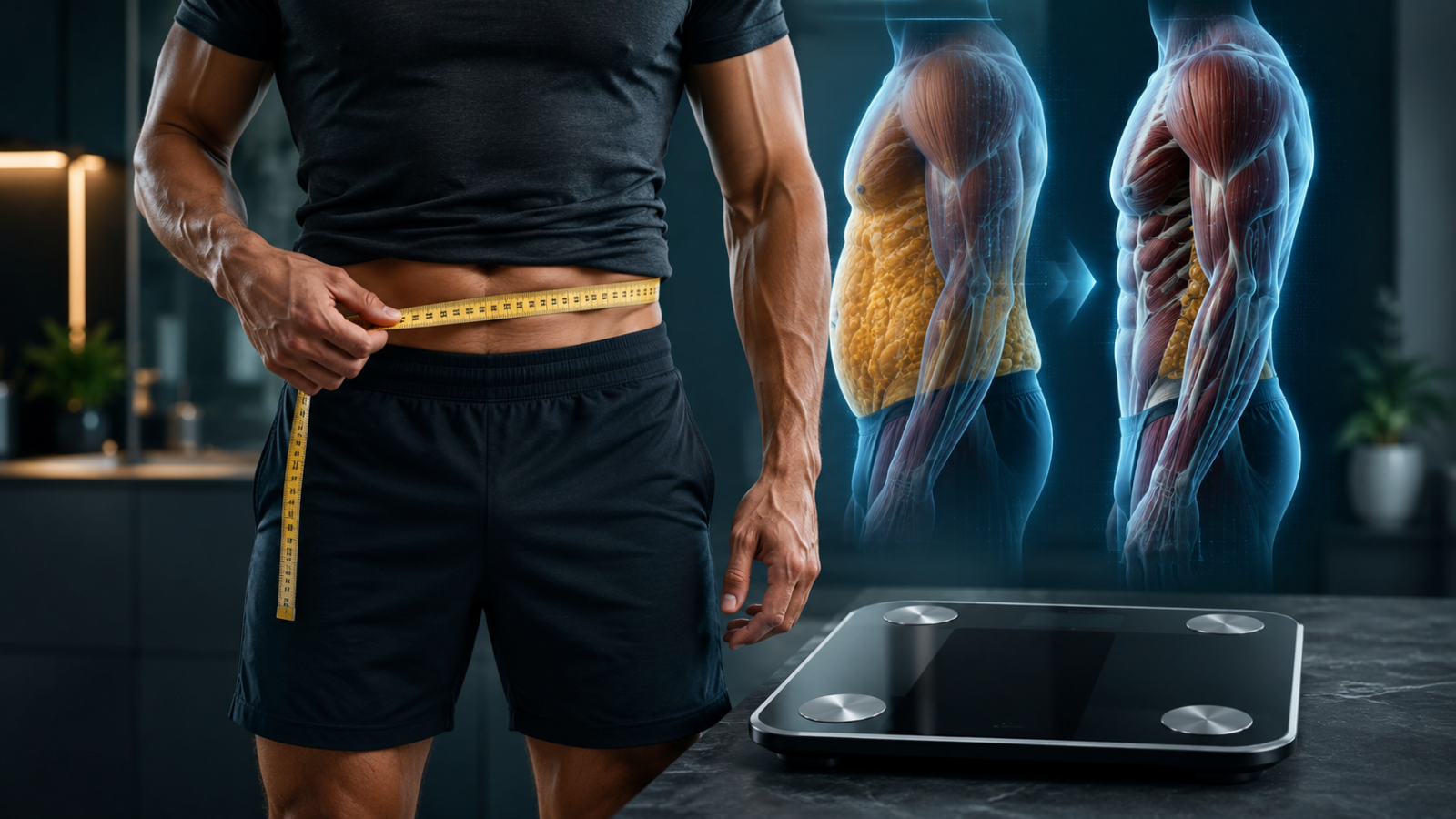
But what if your waist is smaller? What if your clothes fit better? What if you are stronger in the gym, less hungry between meals, and visibly leaner?
This is where one of the biggest misunderstandings in health and fitness creates unnecessary frustration:
Weight loss and fat loss are not the same thing.
Weight loss means the total number on the scale decreased. That change can come from body fat, muscle, water, glycogen, digestive contents, or a combination of all five.
Fat loss is more specific. It means you reduced stored body fat.
For most adults trying to improve their health, appearance, strength, and long-term function, the real goal is rarely to become lighter at any cost.
The better goal is usually:
Lose excess fat. Preserve as much muscle as possible. Improve metabolic health. Build a result you can maintain.
That distinction matters even more for adults in their 30s, 40s, and 50s, when muscle preservation, hormone changes, sleep quality, recovery, medications, and metabolic health can all affect what happens during a weight loss phase.
The bathroom scale can still be useful. It is just not qualified to tell the whole story.
Let’s break down what the number actually means.
What Is the Difference Between Weight Loss and Fat Loss?
The simplest explanation is this:
Weight loss
Weight loss is a reduction in total body mass.
The scale includes the combined weight of:
- Body fat
- Skeletal muscle and other lean tissue
- Body water
- Glycogen, the stored form of carbohydrate
- Bone
- Organs
- Food and waste in the digestive tract
When your body weight changes, the scale cannot identify which compartment changed.
Fat loss
Fat loss refers specifically to a reduction in fat mass.
That can include changes in:
- Subcutaneous fat, stored beneath the skin
- Visceral fat, stored around internal organs
- Total body fat mass
- Body fat percentage
This difference is more than semantics. Research on intentional weight reduction shows that losing body weight can also involve losing fat-free mass. The exact proportion varies substantially based on the individual, the size of the calorie deficit, starting body composition, diet, physical activity, protein intake, age, and other factors.
A simple comparison
| Weight Loss | Fat Loss |
|---|---|
| Measures total body weight | Measures reduction in fat mass |
| Can include water loss | Focuses on stored body fat |
| Can include muscle loss | Ideally preserves lean mass |
| Often changes quickly | Usually requires longer-term trends |
| Easy to measure with a scale | Better assessed with multiple metrics |
| A lower number is not always a better result | Better body composition may occur with modest scale change |
The scale tells you how heavy you are at that moment.
It does not tell you what you are made of.
Why the Scale Can Be So Misleading
Body weight is dynamic.
You are not a sealed laboratory specimen living under perfectly controlled conditions, tragic as that may be for spreadsheet enthusiasts. Your body responds to food intake, fluid balance, training, hormones, digestion, sleep, stress, and medication.
That means scale weight can change even when body fat has barely moved.
Here are some of the biggest reasons.
1. Water Retention Can Hide Fat Loss
Your body contains a substantial amount of water, and fluid balance changes constantly.
Temporary water retention can be affected by:
- Sodium intake
- Carbohydrate intake
- Menstrual cycle changes
- Hard training
- Travel
- Alcohol
- Poor sleep
- Stress
- Heat exposure
- Certain medications
- Changes in hydration
Imagine that you lose some body fat during a week but temporarily retain more water.
The scale may remain unchanged.
You could be making real progress while the number appears stuck.
This is one reason a single weigh-in should never be treated as a final verdict.
2. Carbohydrate Intake Changes Glycogen and Water
Your body stores carbohydrate as glycogen, primarily in skeletal muscle and the liver.
Changes in carbohydrate intake can change glycogen storage and the water associated with that stored fuel.
This helps explain why someone may see a rapid initial decrease in body weight after sharply reducing carbohydrates or calories. Some of that early movement may reflect changes in glycogen, water, and digestive contents rather than an equally dramatic reduction in body fat.
The reverse can happen too.
Eat more carbohydrates after several low-carbohydrate days and the scale may increase even though you did not suddenly gain a large amount of body fat overnight.
This is normal physiology, not evidence that your metabolism filed for bankruptcy.
3. Strength Training Can Temporarily Increase Scale Weight
Resistance training is one of the most useful tools during fat loss, but it can make short-term scale interpretation confusing.
A challenging workout can contribute to temporary changes in:
- Local inflammation
- Muscle repair
- Fluid distribution
- Glycogen storage
At the same time, a well-designed resistance training program may help preserve or build lean mass.
That creates a possible scenario where:
- Fat mass decreases
- Lean mass is maintained or increases
- Body measurements improve
- The scale changes very little
A major systematic review found that resistance training is particularly valuable for improving or preserving lean mass, while resistance training combined with calorie restriction can reduce body fat.
This is why someone can look noticeably leaner at nearly the same body weight.
Their body composition changed even when total mass did not change dramatically.
4. Your Menstrual Cycle Can Change Scale Weight
For women, scale weight can fluctuate across the menstrual cycle.
Changes in reproductive hormones can affect:
- Fluid retention
- Appetite
- Bowel habits
- Food intake
- Training performance
- Perceived bloating
That does not mean fat loss has stopped.
A better strategy is to compare longer-term trends rather than reacting to one isolated measurement.
For example, comparing similar phases of consecutive cycles may provide more useful context than comparing Monday morning with Thursday evening and declaring a metabolic emergency.
5. Food Has Physical Weight
This one is painfully simple and still causes enormous confusion.
Food and fluid entering your body have mass.
A larger meal can increase scale weight before the nutrients have any meaningful relationship to long-term changes in body fat.
Similarly:
- A late dinner
- More dietary fiber
- Constipation
- Increased fluid intake
- A restaurant meal
can all influence the next morning’s number.
The scale cannot distinguish between stored fat and the burrito currently making its way through your digestive system.
A limitation of modern technology, apparently.
Can You Lose Fat Without Losing Weight?
Yes.
This can happen through body recomposition, meaning fat mass decreases while lean mass is maintained or increases.
Consider a simplified example.
A person starts at:
- 180 pounds total weight
- 60 pounds fat mass
- 120 pounds fat-free mass
Several months later:
- 180 pounds total weight
- 52 pounds fat mass
- 128 pounds fat-free mass
The scale says:
No weight loss.
Body composition says:
8 pounds less fat and 8 pounds more fat-free mass.
That is a dramatically different outcome.
Real-world body composition changes are rarely this mathematically neat, because humans insist on being biologically complicated. Still, the example shows why scale weight alone can miss meaningful progress.
Can You Lose Weight Without Losing Much Fat?
Also yes.
This is the part aggressive diet marketing tends to whisper.
A rapid decline in scale weight may include:
- Water
- Glycogen
- Digestive contents
- Fat mass
- Lean tissue
The fact that the scale moved quickly does not prove that every pound came from body fat.
Weight-loss research has long recognized that intentional weight reduction may include loss of fat-free mass. The amount varies widely, which is precisely why muscle-preserving strategies matter.
This becomes especially important when someone uses:
- Severe calorie restriction
- Very low protein intake
- No resistance training
- Excessive cardio without adequate recovery
- Repeated crash diets
- Rapid weight-loss approaches without appropriate monitoring
A person can become lighter and simultaneously become weaker.
That is not the outcome most people actually want.
Why Preserving Muscle Matters During Fat Loss
Muscle is not cosmetic decoration.
Skeletal muscle contributes to:
- Physical strength
- Mobility
- Glucose disposal
- Exercise capacity
- Independence with aging
- Recovery
- Daily function
- Overall body composition
This is one reason a successful fat-loss plan should not focus exclusively on maximizing the speed of scale reduction.
For adults over 35, this becomes particularly relevant. A program that repeatedly sacrifices muscle to force a lower number on the scale may create a very different long-term outcome from a program designed to reduce fat while supporting strength and lean mass.
Resistance training is central here.
In March 2026, the American College of Sports Medicine highlighted its updated resistance training guidance, emphasizing that consistent participation matters enormously and that moving from no resistance training to regular resistance training can provide meaningful benefit.
You do not need to become a competitive bodybuilder.
You need to give your body a reason to keep the tissue you want to keep.
The Scale Is Useful, But Use It Correctly
This article is not an argument to throw away your scale.
The scale can provide useful data.
The mistake is asking one metric to answer a question it cannot answer.
A better weighing strategy
When appropriate for your mental and emotional wellbeing:
- Weigh under similar conditions.
- Use the same scale.
- Measure at roughly the same time of day.
- Morning measurements are often easier to standardize.
- Look at weekly or multiweek trends.
- Avoid overreacting to individual readings.
For example, these numbers:
- Monday: 181.2 pounds
- Tuesday: 180.6 pounds
- Wednesday: 182.0 pounds
- Thursday: 180.9 pounds
- Friday: 180.4 pounds
- Saturday: 181.5 pounds
- Sunday: 180.7 pounds
are more useful as a trend than as seven separate emotional events.
Your body is not failing every time the line moves upward.
7 Better Ways to Track Fat-Loss Progress
A stronger measurement system combines several indicators.
1. Weekly Average Body Weight
Daily scale measurements can be noisy.
A weekly average can help smooth some of that noise and make the broader trend easier to see.
The point is not obsessive tracking.
The point is context.
If daily weighing increases anxiety or encourages harmful behavior, use a less frequent approach with a qualified professional.
2. Waist Circumference
Waist circumference can provide useful information about changes in abdominal size.
Track it consistently:
- Same location
- Same tape measure
- Same body position
- Similar time of day
- Similar conditions
A shrinking waist with relatively stable body weight may indicate meaningful body composition progress.
3. Progress Photos
Take photos under consistent conditions:
- Same lighting
- Same distance from camera
- Same clothing
- Same posture
- Front, side, and back views
Compare every four weeks rather than every four hours.
Visible body composition changes often become clearer in photographs than in daily mirror checks.
4. Clothing Fit
Ask practical questions:
- Is your waistband looser?
- Do shirts fit differently around the midsection?
- Are clothes looser at the waist but similar at the shoulders?
- Have you changed belt notches?
Clothing fit is not a laboratory measurement, but trends can be informative.
5. Strength and Training Performance
Track movements relevant to your program.
Examples include:
- Squat variations
- Rows
- Presses
- Deadlift variations
- Step-ups
- Carries
- Repetition performance
During a calorie deficit, maintaining strength can often be a useful sign that the program is doing more than simply making you smaller.
Strength should still be interpreted in context because sleep, stress, training fatigue, injury, and calorie intake can influence performance.
6. Body Composition Testing
Several technologies attempt to estimate body composition.
Options include:
- Dual-energy X-ray absorptiometry, often called DXA
- Bioelectrical impedance analysis, or BIA
- Air displacement plethysmography
- Skinfold measurements
- More advanced imaging methods in clinical or research settings
Each method has limitations.
DXA can provide estimates of fat mass, lean soft tissue, and bone-related measures, while other methods vary in accessibility and precision. Research reviews emphasize that body composition methods are not interchangeable and should be interpreted according to the technology and testing conditions used.
For repeated testing, consistency matters.
Use:
- The same device when possible
- Similar hydration conditions
- Similar time of day
- Similar food and exercise conditions
A consumer smart scale can be useful for trends, but do not confuse a highly specific body fat percentage displayed to one decimal place with perfect accuracy. The machine has confidence. Biology may not share it.
7. Health and Metabolic Markers
The best weight-loss outcome is not simply a smaller body.
Depending on your history and clinical needs, a healthcare professional may evaluate markers such as:
- Blood pressure
- Hemoglobin A1c
- Fasting glucose
- Lipid profile
- Triglycerides
- Apolipoprotein B, or ApoB
- Liver markers
- Thyroid markers when indicated
- Hormone markers when symptoms justify testing
These measurements do not directly prove fat loss, but they can provide a broader view of health than body weight alone.
At 1st Optimal, this is part of why we focus on advanced testing and individualized context rather than treating every person with the same generic calorie target.
How to Prioritize Fat Loss Instead of Just Weight Loss
The goal is not to avoid all weight loss.
For many people with excess body fat, reducing total body weight may be medically appropriate and beneficial.
The goal is to improve the quality of the weight-loss process.
Here is what that usually involves.
1. Create an Appropriate Energy Deficit
Fat loss generally requires sustained conditions that encourage the body to use stored energy.
But more restriction is not automatically better.
An unnecessarily aggressive deficit can make it harder to:
- Train effectively
- Recover
- Consume adequate protein
- Meet micronutrient needs
- Maintain energy
- Preserve lean tissue
- Adhere to the plan
The appropriate deficit depends on the individual.
Body size, starting body composition, health status, medications, activity, goals, and rate of progress all matter.
2. Prioritize Adequate Protein
Protein becomes especially important when calories are reduced.
A 2024 systematic review and meta-analysis of adults with overweight or obesity found that higher protein intake helped reduce declines in muscle mass during weight loss interventions.
Your target should be individualized based on factors including:
- Body size
- Lean mass
- Age
- Training
- Total calorie intake
- Medical history
- Kidney function when clinically relevant
Practical protein sources may include:
- Eggs
- Greek yogurt
- Cottage cheese
- Fish
- Poultry
- Lean meat
- Tofu
- Tempeh
- Legumes
- High-quality protein supplements when useful
The answer is not necessarily to drink four shakes and develop a personality centered around chicken breast.
It is to create a realistic plan that consistently meets your needs.
3. Use Resistance Training
Resistance training sends a powerful signal that your body still needs strength and muscle.
For many adults, a basic program can include:
- Squat or leg press patterns
- Hip hinge patterns
- Rows
- Pulldowns
- Presses
- Split squats or step-ups
- Loaded carries
- Appropriate core training
Current public health guidance also recommends muscle-strengthening activity for adults, alongside aerobic physical activity.
4. Keep Cardio, But Stop Treating It as Punishment
Cardiovascular exercise can support:
- Heart health
- Fitness
- Energy expenditure
- Work capacity
- Mood
- Weight management
The Centers for Disease Control and Prevention notes that physical activity can support weight management and that combining activity with dietary changes can contribute to an energy deficit.
Useful options include:
- Walking
- Cycling
- Swimming
- Incline treadmill work
- Rowing
- Recreational sports
- Moderate-intensity aerobic training
- Higher-intensity work when appropriate
The best approach is usually not:
Cardio versus strength training.
It is:
Use both strategically.
5. Protect Sleep and Recovery
Healthy weight management is not just a food-and-exercise equation.
The CDC includes sleep and stress management as parts of a healthy approach to weight loss.
Poor sleep can make a fat-loss phase harder by affecting:
- Hunger
- Food choices
- Training quality
- Recovery
- Energy
- Adherence
You cannot always eliminate stress.
You can stop pretending recovery is optional.
Weight Loss vs. Fat Loss After 40
Midlife deserves special attention because body composition does not exist in isolation.
Adults between 35 and 55 may be navigating changes involving:
- Perimenopause
- Menopause
- Sleep disruption
- Lower physical activity
- Reduced training consistency
- Loss of strength
- High work stress
- Caregiving demands
- Changes in testosterone
- Changes in appetite
- Insulin resistance
- Thyroid disorders
- Medication effects
This does not mean every stubborn pound is caused by hormones.
It also does not mean hormones are irrelevant.
For women, the menopause transition can coincide with meaningful changes in symptoms and fat distribution. For men, symptoms such as loss of strength, reduced libido, fatigue, or changes in body composition may justify a broader clinical evaluation rather than automatically blaming age.
The correct approach is not to diagnose yourself from social media.
It is to evaluate the full picture.
What About GLP-1 Medications and Fat Loss?
Glucagon-like peptide-1, or GLP-1, based therapies have changed modern obesity treatment.
But they also make the distinction between weight loss and body composition especially important.
When someone loses a significant amount of weight, the total change may not come exclusively from fat mass. Lean mass can also decline during substantial weight reduction.
That does not mean GLP-1 medications are inherently bad or that every reduction in measured lean mass equals pure skeletal muscle loss. “Lean mass” includes more than muscle, and body composition data require careful interpretation.
It does mean the treatment plan should consider:
- Adequate nutrition
- Protein intake
- Resistance training
- Strength
- Rate of weight loss
- Symptoms
- Appropriate clinical monitoring
The goal should not simply be to make the scale fall as fast as possible.
The better goal is to improve health while protecting the tissues and capabilities you will need later.
4 Common Scenarios Where the Scale Gets It Wrong
Scenario 1: “My weight has not changed, but my clothes fit better.”
Possible explanation:
- Fat mass decreased
- Lean mass was maintained or increased
- Waist circumference decreased
- Body composition improved
Better next step: Review waist measurements, photos, training performance, and longer-term weight trends.
Scenario 2: “I lost 12 pounds quickly, but I feel weaker.”
Possible explanation:
The total loss may include a combination of:
- Fat
- Water
- Glycogen
- Lean tissue
Better next step: Review calorie intake, protein, training, rate of loss, recovery, and clinical factors.
Faster is not automatically better.
Scenario 3: “I lost weight quickly at first, then the scale stopped.”
Possible explanation:
Early weight reduction may have included changes in water, glycogen, and digestive contents. The later trend may better reflect the slower reality of tissue change.
Better next step: Evaluate the multiweek trend before making aggressive changes.
Scenario 4: “The scale jumped after one restaurant meal.”
Possible explanation:
Short-term changes in:
- Sodium
- Carbohydrate intake
- Fluid balance
- Food volume
- Digestive contents
may be contributing.
Better next step: Return to your normal routine and assess the trend.
Do not turn one dinner into a 72-hour punishment campaign involving starvation and a treadmill.
What Does Successful Fat Loss Actually Look Like?
A high-quality fat-loss phase may include:
- A gradual downward trend in average body weight
- Reduced waist circumference
- Improved clothing fit
- Preserved strength
- Adequate energy
- Better dietary consistency
- Sustainable training
- Improved health markers when relevant
- A plan you can maintain
Not every metric will improve every week.
Progress is rarely linear.
The better question is not:
“Did the scale go down today?”
Ask:
“Over the last four to eight weeks, is my body composition, health, performance, or behavior moving in the right direction?”
That question is far more useful.
Frequently Asked Questions
Is fat loss better than weight loss?
For many people, improving body composition by reducing excess fat while preserving lean mass is a more useful goal than simply making total body weight as low as possible.
However, individual goals and medical needs differ. Someone with obesity may appropriately track total weight reduction alongside body composition and health markers.
Why am I losing inches but not weight?
Possible reasons include:
- Losing fat while maintaining lean mass
- Gaining some muscle
- Temporary water retention
- Changes in fat distribution
- Normal scale variability
Track waist circumference, photos, clothing fit, training performance, and longer-term weight trends.
Can I gain weight while losing fat?
Yes.
If fat mass decreases while lean mass increases enough to offset that loss, total body weight may stay the same or increase.
This is more plausible in certain situations, including some newer resistance-training participants and people returning to structured training after time away.
Why does my weight change so much from day to day?
Short-term body weight can be influenced by:
- Hydration
- Sodium
- Carbohydrates
- Menstrual cycle changes
- Food volume
- Bowel movements
- Training
- Travel
- Alcohol
- Medications
Focus on trends rather than isolated numbers.
How often should I weigh myself during fat loss?
There is no universal schedule.
Some people benefit from frequent standardized measurements and weekly averages. Others do better with weekly or less frequent weighing.
The best method should provide useful data without worsening anxiety, obsessive behavior, or disordered eating patterns.
What is the best way to know whether I am losing body fat?
Use multiple measurements:
- Body weight trend
- Waist circumference
- Progress photos
- Clothing fit
- Strength
- Body composition testing when appropriate
No single method is perfect.
A combination gives you a much clearer picture.
The Bottom Line: Stop Letting One Number Define Your Progress
Weight loss and fat loss are not interchangeable.
The scale measures total body mass. It cannot tell you whether a change came from fat, muscle, water, glycogen, or digestive contents.
That is why the number can mislead you in both directions.
You can:
- Lose fat without much scale change
- Lose weight without losing as much fat as expected
- Gain temporary water while making progress
- Become smaller while maintaining weight
- Become lighter while also losing strength and lean tissue
The goal is not to ignore the scale.
The goal is to put it in its proper place.
For most adults seeking better health and body composition, a stronger strategy is to combine:
- Appropriate nutrition
- Adequate protein
- Resistance training
- Cardiovascular activity
- Sleep
- Recovery
- Consistent measurement
- Medical evaluation when symptoms or risk factors justify it
At 1st Optimal, we help high-achieving adults look beyond a single number and evaluate the bigger picture, including body composition, metabolic health, hormones, lifestyle, advanced lab data, nutrition, and medically guided weight-loss options when appropriate.
Explore 1st Optimal’s personalized weight-loss care to learn how a more individualized approach can help you pursue fat loss while supporting muscle, performance, energy, and long-term health.
Because the goal should not be to become the lightest possible version of yourself.
It should be to become healthier, stronger, more capable, and better equipped for the decades ahead.
References and Further Reading
- Weight Loss Composition is One-Fourth Fat-Free Mass: A Critical Review and Critique of This Widely Cited Rule
- Resistance Training Effectiveness on Body Composition and Body Weight Outcomes in Individuals With Overweight and Obesity Across the Lifespan
- Kokura Y, et al. Enhanced Protein Intake on Maintaining Muscle Mass in Adults With Overweight or Obesity Aiming for Weight Loss
- Centers for Disease Control and Prevention. Physical Activity and Your Weight and Health
- American College of Sports Medicine. Updated Resistance Training Guidelines