

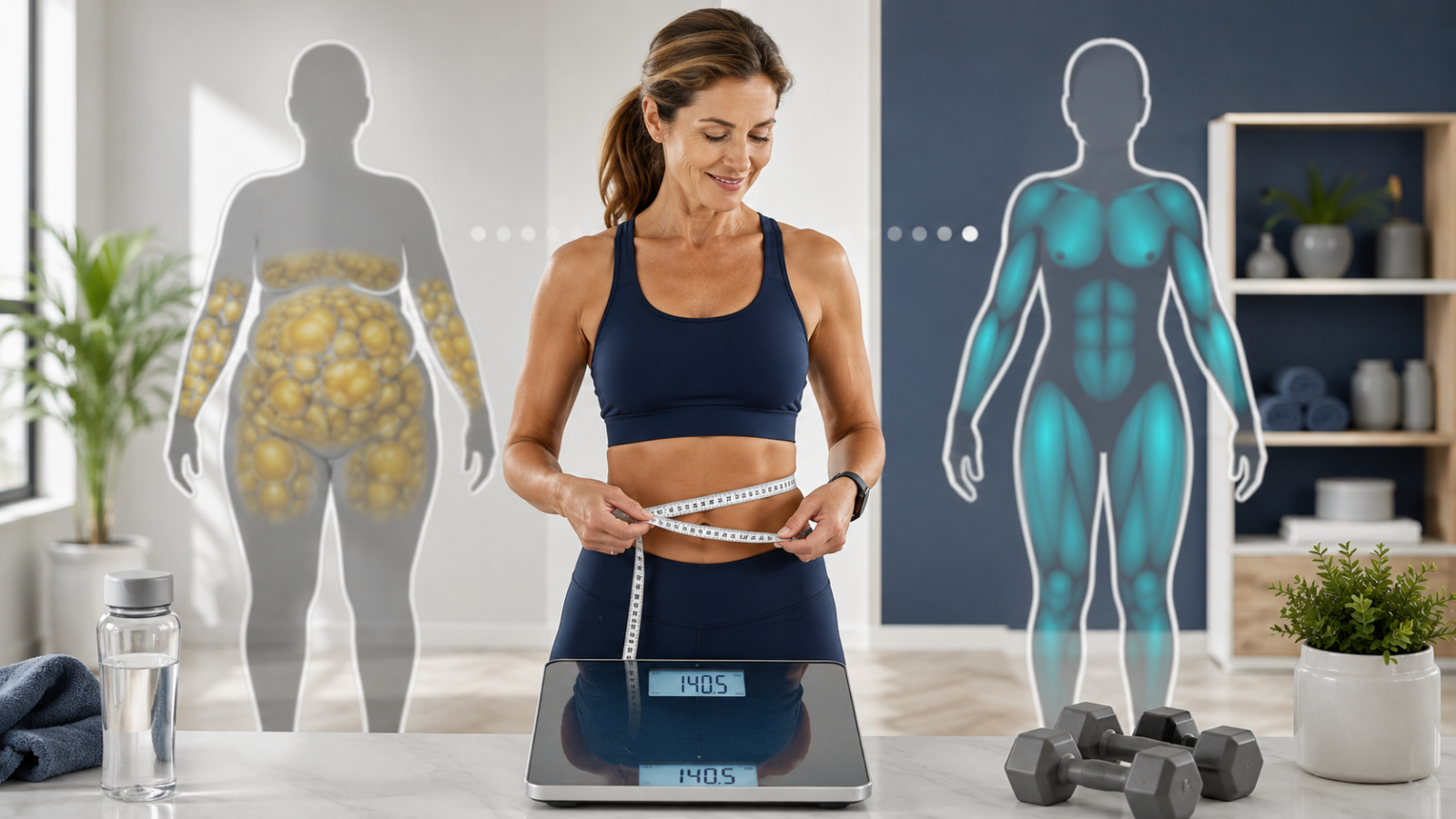
If you’ve ever stepped on the scale after weeks of eating better and exercising only to see little or no change, you’re not alone.
Many people assume weight loss and fat loss are the same thing. They aren’t.
In fact, focusing only on the number on the scale may hide real progress. You could be losing body fat, building muscle, improving your metabolism, and becoming healthier while your weight barely changes.
Understanding the difference between weight loss and fat loss can completely change how you measure success.
Weight Loss and Fat Loss Are Not the Same
Weight loss simply means your total body weight has decreased.
That number includes everything in your body:
- Fat
- Muscle
- Water
- Glycogen (stored carbohydrate)
- Food in your digestive tract
- Bone and organs
The scale cannot tell you which of these changed.
Fat loss specifically refers to reducing body fat while preserving as much lean tissue as possible.
From a health standpoint, fat loss is usually the better goal.
What Causes Your Weight to Change?
Your body weight naturally fluctuates every day.
It is completely normal to see changes of 2 to 6 pounds within 24 hours without gaining or losing any body fat.
Common reasons include:
Water Retention
Salt intake, carbohydrate intake, hydration, hormones, travel, exercise, inflammation, and certain medications all influence water balance.
Glycogen Storage
Every gram of glycogen stored in muscle is accompanied by approximately 3 to 4 grams of water.
After eating more carbohydrates, your weight may increase even though body fat has not changed.
Likewise, after several days of lower carbohydrate intake, the scale often drops quickly because glycogen and water decrease.
This is one reason many diets appear to “work” during the first week.
Food Volume
Simply having more food inside your digestive system temporarily increases body weight.
Hormonal Changes
Women commonly retain more water during different phases of the menstrual cycle.
Stress hormones such as cortisol may also contribute to temporary fluid retention in some people.
Muscle Gain
Resistance training combined with adequate protein can increase lean muscle mass.
Muscle is beneficial tissue.
If you gain muscle while losing fat, your body composition improves even if the scale changes very little.
Why Losing Fat Matters More Than Losing Weight
Body fat serves important functions.
It protects organs, stores energy, and produces hormones.
However, excessive body fat, especially visceral fat surrounding internal organs, is associated with increased risk of:
- Type 2 diabetes
- High blood pressure
- Cardiovascular disease
- Fatty liver disease
- Sleep apnea
- Chronic inflammation
- Insulin resistance
Reducing excess body fat often improves these risk factors, even when total body weight changes only modestly.
Research consistently shows that preserving muscle while reducing fat leads to better long-term metabolic health, physical function, and weight maintenance.
Why the Scale Can Be Misleading
The scale measures only gravitational force.
It does not measure health.
Consider these examples.
Person A
Lost 20 pounds
- 12 pounds muscle
- 8 pounds fat
Person B
Lost 10 pounds
- 10 pounds fat
- Preserved muscle
Although Person A lost more weight, Person B achieved the healthier outcome.
Maintaining muscle supports:
- Resting metabolism
- Physical strength
- Balance
- Bone health
- Blood sugar regulation
- Healthy aging
This becomes especially important after age 35 when natural muscle loss begins to accelerate.
Body Composition Matters More
Body composition describes how much of your body consists of:
- Fat mass
- Lean muscle
- Bone
- Water
Improving body composition often means:
- Lower body fat percentage
- More lean muscle
- Better strength
- Improved metabolic health
This is why two people can weigh exactly the same but have dramatically different health profiles.
Better Ways to Measure Progress
Instead of relying only on the scale, monitor multiple markers.
Waist Circumference
Waist measurement is one of the strongest simple indicators of abdominal fat and cardiometabolic risk.
Measure consistently at the same location every few weeks.
Progress Photos
Monthly photos often reveal changes the scale misses.
Take photos under similar lighting and clothing.
Clothing Fit
Many people notice looser clothing before meaningful scale changes occur.
Strength
Increasing strength during a fat-loss program often indicates muscle preservation.
Energy Levels
Improved sleep, better recovery, and higher daily energy often reflect meaningful improvements in health.
Body Fat Measurements
Methods include:
- DEXA scan (Dual-energy X-ray Absorptiometry)
- Bioelectrical impedance analysis (BIA)
- Skinfold measurements
- 3D body scanning
Each has limitations, but tracking trends over time is often more useful than focusing on one measurement.
Why Rapid Weight Loss Isn’t Always Better
Quick weight loss often comes from:
- Water
- Glycogen
- Muscle tissue
The faster muscle is lost, the greater the decline in resting metabolic rate.
This can make long-term weight maintenance more difficult.
Successful fat loss generally emphasizes:
- High protein intake
- Resistance training
- Adequate sleep
- Sustainable calorie deficits
- Regular physical activity
The goal is to lose fat while keeping muscle.
Common Reasons the Scale Stalls
Many people assume a plateau means fat loss has stopped.
Sometimes that’s true.
Often it isn’t.
Possible reasons include:
- Increased muscle mass
- Water retention after exercise
- Menstrual cycle changes
- High sodium intake
- Travel
- Stress
- Inconsistent weigh-in times
- Constipation
This is why weekly averages are often more useful than daily weigh-ins.
Functional Medicine Looks Beyond the Scale
At 1st Optimal, we focus on improving health, not simply lowering body weight.
That may include evaluating:
- Nutrition quality
- Protein intake
- Resistance training
- Sleep
- Stress management
- Thyroid function
- Testosterone
- Estrogen
- Progesterone
- Cortisol
- Insulin resistance
- Advanced metabolic markers
For some individuals, medications such as GLP-1 receptor agonists may also be appropriate when combined with lifestyle interventions and medical supervision.
The goal is sustainable fat loss while preserving metabolic health.
Frequently Asked Questions
Can I lose fat without losing weight?
Yes.
This is common when building muscle through resistance training while reducing body fat.
Why did I gain three pounds overnight?
Most overnight changes are water, glycogen, food volume, or normal fluctuations rather than body fat.
Should I weigh myself every day?
Daily weigh-ins can be useful if you focus on weekly averages rather than individual numbers.
If they increase anxiety, weekly measurements may be a better option.
Is BMI enough?
Body Mass Index (BMI) is a useful screening tool but cannot distinguish between muscle and fat.
Body composition provides more meaningful information.
Final Thoughts
The scale tells only one small part of your story.
Real progress isn’t defined by losing the most weight. It’s defined by improving your body composition, preserving muscle, reducing excess body fat, and building habits that support long-term health.
If your clothes fit better, your waist is smaller, your strength is improving, and your energy is higher, you’re moving in the right direction, even if the scale doesn’t change as quickly as you’d hoped.
Focus on becoming healthier, not simply lighter.