
Knee pain usually isn’t just a knee problem.
Hip pain usually isn’t just a hip problem.
And back pain often starts long before your back starts screaming at you.
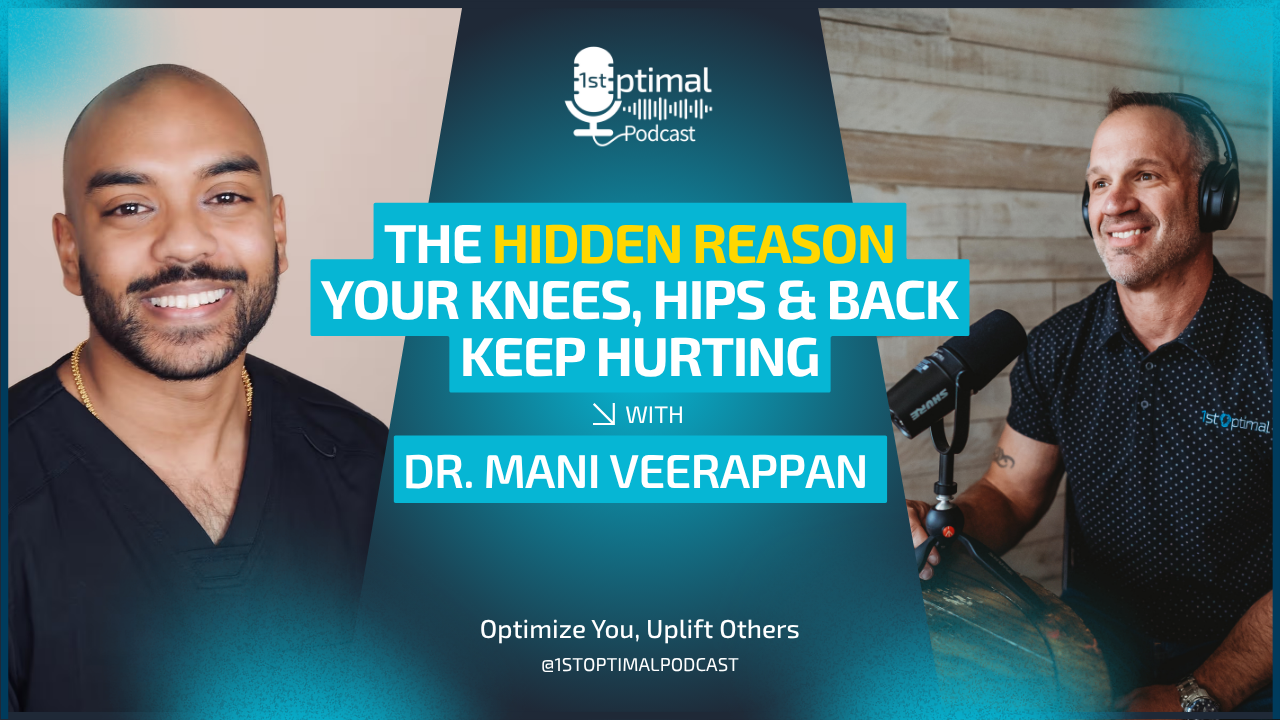
In this episode of the 1st Optimal Podcast, Joe Miller sits down with Dr. Mani Veerappan, a performance physical therapist and the Clinical Director at Thera Performance Lab in Lake Orion, Michigan.
The conversation breaks down why pain often shows up in one area while the real issue starts somewhere else in the body.
They cover movement mechanics, mobility, strength training, dry needling, glute activation, foot mechanics, and why overprotecting your joints can make your body less resilient over time.
If your knees, hips, or back keep flaring up even though you stretch, rest, or modify your workouts, this episode will help you understand what may be missing.
Why Pain Is Often a Symptom, Not the Root Cause
Most people seek help only when something hurts.
But according to Dr. Mani, the area that hurts is not always the area causing the problem.
A painful knee may be reacting to poor squat mechanics, limited ankle mobility, weak foot control, or poor hip stability.
A tight back may be compensating for hips that don’t move well.
A strained groin may lead to changes in gait, loading, and knee mechanics.
The body works as a chain. When one link stops doing its job, another area has to compensate.
That compensation can work for a while. Then, eventually, pain shows up.
Why Traditional Care Can Miss the Bigger Picture
Dr. Mani explains that traditional insurance-based care often focuses on the painful area.
If your knee hurts, the session may be centered around the knee.
If your shoulder hurts, the shoulder gets treated.
That model can be helpful in certain situations, especially after surgery, acute injury, or major medical events. But it may not always be ideal for people who want to return to high-level training, sports, running, jiu-jitsu, golf, lifting, or simply moving better in daily life.
Performance therapy looks at the whole system.
That means evaluating the foot, ankle, knee, hip, pelvis, spine, and movement patterns together.
The goal is not just to reduce pain.
The goal is to restore function, build capacity, and help the body tolerate movement again.
The Problem With Overprotecting Your Body
One of the strongest points in the episode is this:
Overprotecting your joints can make you more fragile.
Dr. Mani compares it to wearing a back brace when you don’t need one.
If your body always relies on braces, wraps, highly cushioned shoes, or external support, it may never fully learn how to stabilize, absorb force, and produce force on its own.
That doesn’t mean braces, belts, wraps, or supportive shoes are bad.
They have a place.
But if you use them as a default instead of addressing the underlying weakness or movement issue, your body may become less adaptable over time.
The goal is resilience.
One bad rep, awkward step, or imperfect movement should not take you out for six weeks.
Mobility vs. Stretching: What Most People Miss
A lot of people stretch because they feel tight.
But Dr. Mani makes an important distinction:
Stretching targets muscle tissue.
Mobility targets how joints move.
For example, tight hips may not always need more hip flexor stretching. Sometimes the pelvis, hip joint, ankle, or foot needs better motion and better control.
Mobility should not just feel passive.
In many cases, you should feel muscles turning on during mobility work.
That’s the difference between simply “loosening up” and preparing your body to perform.
A good mobility routine does not need to take 30 minutes.
For most people, Dr. Mani recommends something closer to 5 to 10 minutes when it is specific, intentional, and tied to the workout or sport ahead.
Why Your Foot Matters More Than You Think
One of the most practical parts of the episode is the discussion around the foot.
The foot is the first thing that hits the ground.
It has to absorb force, create force, stabilize the body, and communicate with the rest of the kinetic chain.
If the foot does not move well or cannot control pressure, the ankle, knee, hip, and back may all compensate.
Dr. Mani explains how pressing through the big toe can help activate the arch, posterior tibialis, adductors, and glute medius.
Translation: your big toe can affect your glutes.
The human body, in a stunning act of overengineering, made the toe connected to everything.
This is why barefoot work, single-leg movements, calf raises, and foot awareness can be powerful tools when used correctly.
Knee Pain Is Often a Hip, Ankle, or Foot Problem
The knee is mainly a hinge joint.
It bends and straightens, with a small amount of rotation.
Because it has fewer movement options than the hip, ankle, and foot, it often becomes the victim instead of the source of the problem.
Dr. Mani gives an example of a patient with knee pain who struggled with downhill walking.
The issue was not just the knee.
It was the way the body handled squat mechanics, pelvic position, and movement control.
Once the squat pattern improved, the knee felt better.
That matters because many people attack knee pain with knee sleeves, rest, ice, or isolated exercises.
Sometimes that helps short term.
But if the movement pattern is still broken, the pain often returns.
Why Runners Need More Than Running
Running looks simple.
But mechanically, it is basically repeated single-leg hopping.
That means runners need strength, coordination, landing mechanics, and the ability to handle force.
Dr. Mani explains that before someone returns to running, they should be able to jump, land, and tolerate impact.
He also talks about the importance of sprinting as a skill.
Not everyone needs to train like a sprinter.
But maintaining the ability to produce a short burst of speed can help preserve nervous system output, coordination, and athletic capacity as we age.
For runners, mobility work and dynamic warm-ups can also act as a system check.
If something feels off before the run, that is useful information.
It is better to catch the warning sign during warm-up than at mile 60 of an ultramarathon.
Why Bodybuilding-Style Training Isn’t Always Enough
Traditional bodybuilding training can build muscle.
No argument there.
But it may not always build better movement.
Machines, isolated movements, and single-plane exercises can help with hypertrophy, but they may not improve rotation, mobility, stability, or real-world athletic function.
Dr. Mani explains that someone who wants to look good, feel strong, and move well may need more than traditional bodybuilding patterns.
That could include:
- Rotational movements
- Hinge patterns
- Squat variations
- Kettlebell work
- Banded movements
- Single-leg training
- Mobility and stability work
This is especially important for adults in their 30s, 40s, and 50s who want to keep training hard without constantly getting hurt.
Looking strong is great.
Moving strong is better.
The 3 Movement Patterns Dr. Mani Likes to Check
If someone wants to evaluate how their body is moving, Dr. Mani highlights three useful patterns:
1. Squat Pattern
A squat shows how the ankles, knees, hips, pelvis, and trunk work together.
There is no single perfect squat.
Some people squat better with feet turned out. Others do better with feet more forward.
But your body should have the capacity to tolerate different squat positions without pain or collapse.
2. Hinge Pattern
The hinge shows how well you load the hips, hamstrings, glutes, and spine.
Dr. Mani likes kickstand Romanian deadlifts because they teach the hinge pattern while also challenging single-leg control.
They reveal weaknesses that a traditional bilateral deadlift may hide.
3. Calf Raise
Calf raises are underrated.
They test the foot, ankle, calf, and ability to create propulsion.
They also show how pressure is distributed through the foot.
If someone only feels the outside of the calf or foot during a calf raise, that may reveal a loading issue worth addressing.
Why Isometrics Can Help With Activation
Isometric exercises involve holding a position instead of moving through reps.
Dr. Mani explains that isometrics can be especially helpful when someone struggles to feel a muscle working.
For example, if you hold a position for 20 to 30 seconds, the nervous system has more time to recognize and recruit the target muscle.
That can make the following movement more effective.
Isometrics can also increase blood flow, reduce the “shock factor” of jumping into heavy work, and help the brain feel safer before loading the tissue.
This is why a smart warm-up is not just about getting sweaty.
It is about preparing the nervous system.
Dry Needling and Nervous System Feedback
Joe and Dr. Mani also discuss dry needling.
Dry needling is one of several tools Dr. Mani may use, along with cupping, soft tissue work, scraping, mobility drills, and exercise.
The purpose is not just pain relief.
In some cases, dry needling can help the brain reconnect with muscles that are not activating well.
Joe describes areas where he could strongly feel the needling and other areas where he felt almost nothing.
Dr. Mani explains that both responses matter.
A strong sensation may show nervous system sensitivity.
No sensation may suggest that the area is not communicating or activating well.
The follow-up matters most.
After creating input through dry needling, Dr. Mani loads the tissue with movement so the body can learn how to use that area again.
Smarter Strength Training Progression
Another key topic is how to progress strength training without constantly irritating the body.
Dr. Mani explains that big jumps in weight should usually happen during planned testing weeks, not randomly because you feel good on a Tuesday.
A smarter progression looks at:
- Sets
- Reps
- Load
- Movement quality
- Pain or discomfort
- Warm-up response
- Recovery
- Training goal
For most people, slow and predictable progress wins.
You want to be strong at each weight before jumping to the next one.
That is not as exciting as throwing plates on the bar and hoping your joints negotiate with physics.
But it works better long term.
Mobility, Stability, Then Power
Dr. Mani breaks training progression into a simple framework:
First, mobility.
Then, stability.
Then, power and intensity.
If you cannot access a range of motion, you need mobility.
If you can access it but cannot control it, you need stability.
Once you can move well and control the pattern, you can add more load, speed, and sport-specific work.
For athletes, that final layer becomes performance-specific.
For runners, it may include jumping, landing, sprinting, and pace control.
For lifters, it may include progressive overload, squat variations, hinges, and load management.
For golfers, it may include hip rotation, foot pressure, and rotational power.
For adults who want to stay healthy, it means building a body that can move well in more than one direction.
The Best Exercises Are the Ones That Match Your Body
Dr. Mani makes it clear that there is no single perfect program for everyone.
A back squat is not bad.
A front squat is not magic.
A kettlebell goblet squat is not automatically better.
The right movement depends on the person, their goals, their limitations, and how their body responds.
For some people, a front squat may feel better because it encourages bracing, keeps the torso more upright, and reduces shoulder stress.
For others, a back squat may be appropriate.
The key is not forcing your body into a movement just because it is popular.
The key is finding the right entry point, building capacity, and progressing with intent.
When Should You See a Performance Therapist?
You do not need to wait until you are injured.
In fact, Dr. Mani argues that one of the best times to see a performance therapist is before pain becomes a major problem.
That may be especially useful if:
- You keep getting the same injury
- Your knee, hip, or back pain keeps returning
- You feel limited in certain movements
- One side feels weaker than the other
- You train hard but feel like your body is breaking down
- You want to return to running, lifting, golf, jiu-jitsu, or sport
- You want a professional to assess your movement patterns
Pain is one reason to get help.
Performance is another.
Prevention may be the most overlooked reason of all.
Final Takeaway
Your body is connected.
That sounds obvious, but most people still treat pain like it lives in isolation.
Knee pain may start at the foot.
Back tightness may come from poor hip mechanics.
Glute activation may be affected by your big toe.
And stretching more may not fix a joint that does not move well or a muscle your nervous system does not know how to recruit.
The goal is not to avoid movement.
The goal is to build a body that can handle movement.
That means better mobility, better stability, smarter loading, and more awareness of how your body responds.
If your knees, hips, or back keep hurting, the answer may not be more rest.
It may be learning how to move better.
Connect with Dr. Mani
Website: conciergemobilitydoctor.com
Instagram: @concierge.mobility.doctor
Facebook: Concierge Mobility Doctor
Follow Thera Performance Lab
Website: thera-performancelab.com
Instagram: @thera_performancelab
Facebook: THERAperformancelab
TikTok: @theraperformancelab
LinkedIn: thera-performance-lab
YouTube: @THERA_performancelab
Ready to Take the Next Step?
Ready to begin your own fitness journey and take control of your health? Book your free consultation with 1st Optimal today and let’s explore how personalized coaching and expert-led strategies can help you achieve your health goals!
🔗 Listen to the full episode on your favorite platform:
🎧 Spotify | Apple Podcasts | Amazon Music | Google Podcasts
📺 Watch it on YouTube: