
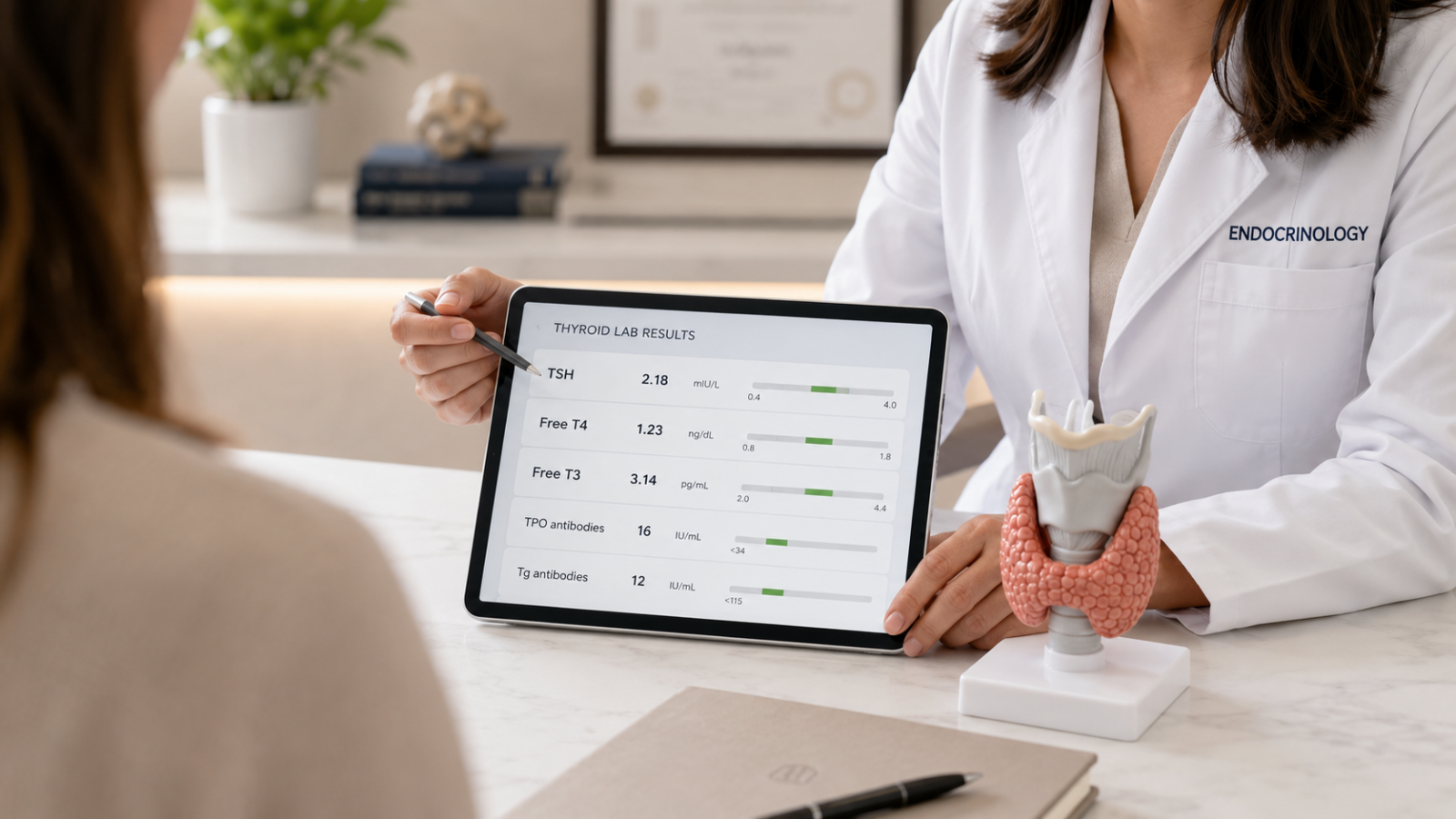
A thyroid-stimulating hormone test, better known as TSH, is often the first blood test ordered when someone reports fatigue, weight changes, constipation, anxiety, hair thinning, cold intolerance, heart palpitations, or menstrual changes.
TSH is sensitive, widely available, and useful for identifying many cases of primary hypothyroidism and hyperthyroidism. But it is a signal made by the pituitary gland, not the thyroid hormone acting in your tissues. In some situations, TSH alone can leave important questions unanswered.
Free T4, Free T3, and thyroid antibodies can help clarify whether the thyroid is producing enough hormone, whether excess hormone is present, whether the pituitary-thyroid relationship looks abnormal, and whether an autoimmune condition such as Hashimoto’s thyroiditis or Graves’ disease may be involved.
The goal is not to order the largest possible thyroid panel. The goal is to choose the right tests for the clinical question.
What Does TSH Actually Measure?
TSH is produced by the pituitary gland, a small gland at the base of the brain. It acts like a signaling hormone. When the pituitary senses that circulating thyroid hormone is low, it generally releases more TSH to stimulate the thyroid. When thyroid hormone is high, the pituitary usually reduces TSH output.
This feedback loop makes TSH an effective screening test for primary thyroid dysfunction, meaning a problem that begins within the thyroid itself. The American Thyroid Association considers TSH the best initial test for thyroid function in most people.
Common patterns include:
- High TSH with low Free T4: Overt primary hypothyroidism
- High TSH with normal Free T4: Possible subclinical hypothyroidism
- Low TSH with high Free T4 or T3: Hyperthyroidism
- Low TSH with normal Free T4 and Free T3: Possible subclinical hyperthyroidism
For most adults without suspected pituitary disease, guidelines support starting with TSH and adding Free T4 or Free T3 when the TSH result is outside the laboratory reference range. When TSH is elevated, Free T4 is generally added. When TSH is low, both Free T4 and Free T3 may be appropriate.
A “normal” TSH does not explain every symptom or rule out every uncommon thyroid disorder. Results must be interpreted alongside symptoms, medications, pregnancy status, recent illness, medical history, and the original reason for testing.
When Free T4 Matters
Thyroxine, or T4, is the primary hormone produced by the thyroid. Most circulating T4 is attached to transport proteins. Free T4 measures the portion that is not bound to those proteins and is available to enter tissues.
Free T4 is often the most useful test to pair with TSH because it helps show whether the thyroid is producing an appropriate amount of hormone. It can also provide essential context when TSH and symptoms do not appear to match.
1. When TSH Is Elevated
An elevated TSH suggests the pituitary is asking the thyroid to work harder.
Free T4 helps determine how far the process has progressed:
- Elevated TSH with normal Free T4 may fit subclinical hypothyroidism.
- Elevated TSH with low Free T4 supports overt primary hypothyroidism.
This distinction matters because treatment decisions may depend on the degree of TSH elevation, symptoms, age, pregnancy goals, cardiovascular risk, previous thyroid treatment, and the presence of thyroid antibodies.
A single mildly abnormal result is not always enough for a permanent diagnosis. Clinicians may repeat testing before deciding whether treatment is needed. NICE recommends considering symptoms, underlying thyroid disease, previous thyroid treatment, and thyroid antibodies when evaluating subclinical hypothyroidism.
2. When TSH Is Low
A low TSH may suggest that the thyroid is producing too much hormone, but Free T4 helps determine whether overt hyperthyroidism is present.
A low TSH with high Free T4 supports overt hyperthyroidism. A low TSH with normal Free T4 may require Free T3 testing because some people develop T3-predominant hyperthyroidism, where T3 rises before T4.
Low TSH can also reflect medication effects, pregnancy, acute illness, pituitary dysfunction, or laboratory assay interference. The result should therefore be interpreted as part of a pattern, not as a diagnosis by itself.
3. When Pituitary Disease Is Possible
This is one of the most important reasons not to rely on TSH alone.
In central hypothyroidism, the problem originates in the pituitary gland or hypothalamus rather than the thyroid. TSH may be low, normal, or only mildly elevated even when Free T4 is low.
The Endocrine Society recommends measuring both TSH and Free T4 when central hypothyroidism is suspected. A low Free T4 with an inappropriately low, normal, or mildly elevated TSH in someone with pituitary disease can support the diagnosis.
This pattern matters in people with known pituitary disease, pituitary surgery, head trauma, radiation exposure, multiple pituitary hormone deficiencies, or other signs of pituitary dysfunction.
4. When Symptoms Persist During Treatment
TSH remains the primary monitoring test for most adults taking levothyroxine for primary hypothyroidism. However, Free T4 can add context when symptoms continue despite a TSH result within the laboratory reference range.
NICE recommends considering Free T4 alongside TSH in adults who continue to have hypothyroid symptoms after starting levothyroxine.
That does not mean every persistent symptom is thyroid-related or that the medication dose should automatically rise.
Fatigue, brain fog, weight gain, low mood, and poor exercise tolerance can also relate to anemia, iron deficiency, sleep apnea, perimenopause, medication effects, inadequate nutrition, chronic stress, or metabolic dysfunction.
Free T4 can help confirm whether TSH and circulating T4 make sense together before the evaluation expands beyond the thyroid.
5. During Pregnancy or Estrogen Use
Pregnancy and estrogen-containing medications can increase thyroid-binding proteins. This can change total T4 and total T3 measurements even when thyroid function remains stable.
Free hormone measurements may provide more useful information in these situations. However, pregnancy requires trimester-specific interpretation and clinician guidance. Thyroid tests during pregnancy should not be interpreted using a generic adult range copied from a patient portal.
When Free T3 Matters
Triiodothyronine, or T3, is the more biologically active thyroid hormone. The thyroid produces some T3 directly, but much of it comes from the conversion of T4 into T3 in tissues.
Free T3 testing sounds like it should always be central to thyroid evaluation. In practice, its usefulness is more specific.
Free T3 Is Most Helpful When Hyperthyroidism Is Suspected
Free T3 or total T3 can help when TSH is low and Free T4 is normal.
In some cases of early or T3-predominant hyperthyroidism, T3 becomes elevated before Free T4 rises. T3 can also help evaluate the severity of confirmed hyperthyroidism.
Symptoms that may raise concern for hyperthyroidism include:
- Racing or irregular heartbeat
- Tremor
- Heat intolerance
- Unintentional weight loss
- Frequent bowel movements
- Muscle weakness
- Anxiety or agitation
- Difficulty sleeping
A T3 result should still be interpreted with TSH, Free T4, medications, symptoms, and the suspected cause. The American Thyroid Association notes that T3 testing is most useful for diagnosing or assessing hyperthyroidism.
Free T3 Is Usually Less Helpful for Diagnosing Hypothyroidism
T3 is often the last thyroid hormone measurement to become abnormal in hypothyroidism.
A person can have high TSH and low Free T4 while the T3 level remains within the laboratory reference range. For that reason, a normal Free T3 does not rule out hypothyroidism.
Routine T3 testing is also generally not recommended for adjusting levothyroxine treatment in primary hypothyroidism. Free T3 assays may be less reliable than TSH and Free T4 assays, so a precise-looking result still requires cautious interpretation.
Illness, Calorie Restriction, and Medications Can Affect T3
T3 may fall during acute or severe illness, significant calorie restriction, and other forms of physiologic stress. This pattern does not always mean the thyroid itself has failed.
Medications can also affect thyroid hormone production, conversion, binding, or measurement. An isolated low Free T3 should not be treated as a diagnosis by itself.
NICE advises against routine thyroid testing during an unrelated acute illness unless thyroid dysfunction is specifically suspected because illness can temporarily alter results.
Which Thyroid Antibodies Matter?
Thyroid antibody tests do not primarily measure thyroid function. They help identify whether the immune system is reacting against thyroid tissue or thyroid receptors.
The major antibody tests include:
- Thyroid peroxidase antibodies, or TPO antibodies
- Thyroglobulin antibodies, or Tg antibodies
- TSH receptor antibodies, or TRAb
- Thyroid-stimulating immunoglobulin, or TSI
Each test answers a different question.
TPO Antibodies: When Hashimoto’s Is Suspected
Thyroid peroxidase is an enzyme involved in thyroid hormone production. TPO antibodies are commonly associated with Hashimoto’s thyroiditis, an autoimmune condition that can gradually damage the thyroid and lead to hypothyroidism.
TPO antibody testing may be useful when TSH is elevated, Hashimoto’s thyroiditis is suspected, a goiter or ultrasound evidence of inflammation is present, subclinical hypothyroidism is being evaluated, or pregnancy planning changes the clinical decision.
Positive TPO antibodies can support an autoimmune cause, but they do not tell you how well the thyroid is functioning today. TSH and Free T4 provide that information.
A person can have positive TPO antibodies with normal TSH and Free T4. In that situation, thyroid hormone treatment is not automatically required.
Periodic thyroid-function monitoring may be appropriate because autoimmune inflammation can increase the likelihood of developing hypothyroidism over time. The American Thyroid Association states that people with elevated antibodies but normal thyroid function generally do not need thyroid hormone solely because the antibodies are present.
Once TPO antibodies have helped establish the diagnosis, repeatedly measuring the antibody level usually does not help monitor thyroid function or guide levothyroxine dosing. NICE recommends measuring TPO antibodies in certain adults with elevated TSH but advises against repeating the test routinely.
Thyroglobulin Antibodies: When They Add Context
Thyroglobulin is a protein made by thyroid cells. Thyroglobulin antibodies can occur in Hashimoto’s thyroiditis and other autoimmune thyroid conditions.
Tg antibody testing may add information when Hashimoto’s is strongly suspected but TPO antibodies are negative, or when thyroglobulin is being used after thyroid cancer treatment.
Tg antibodies can interfere with the interpretation of thyroglobulin as a thyroid-cancer marker. That is a separate use from evaluating routine thyroid function.
Like TPO antibodies, Tg antibody levels generally should not be used as a daily scorecard for symptoms, diet quality, supplement effectiveness, or thyroid medication dosing. Detecting antibodies can help identify autoimmune thyroid disease, but TSH and Free T4 remain the primary measurements of current thyroid function.
TRAb and TSI: When Graves’ Disease Is Suspected
Graves’ disease is an autoimmune cause of hyperthyroidism. In Graves’ disease, antibodies interact with the TSH receptor and stimulate the thyroid to produce excess hormone.
TRAb measures antibodies directed against the TSH receptor. TSI is designed to detect the stimulating activity associated with Graves’ disease.
These tests may matter when Graves’ disease is suspected, the cause of hyperthyroidism is unclear, a radioactive iodine uptake scan is unavailable or inappropriate, remission or relapse risk is being assessed, or pregnancy creates concern about antibody transfer to the fetus.
A positive TRAb or TSI result can confirm Graves’ disease in the right clinical setting. The American Thyroid Association notes that antibody testing can establish the diagnosis without further testing when the result is positive and the clinical pattern is consistent with Graves’ disease.
These antibodies have a different role from TPO and Tg antibodies, which are more closely associated with autoimmune thyroid damage and Hashimoto’s thyroiditis.
Common Thyroid Lab Patterns
| TSH | Free T4 | Free T3 | Possible Interpretation |
|---|---|---|---|
| High | Low | Normal or low | Overt primary hypothyroidism |
| High | Normal | Usually normal | Possible subclinical hypothyroidism |
| Low | High | High or normal | Overt hyperthyroidism |
| Low | Normal | High | Possible T3-predominant hyperthyroidism |
| Low or normal | Low | Variable | Possible central hypothyroidism, severe illness, medication effect, or assay issue |
| Normal | Normal | Normal | Primary thyroid dysfunction is less likely, but other causes of symptoms may need evaluation |
| Any discordant pattern | Unexpected | Unexpected | Consider medication timing, supplements, acute illness, assay interference, or repeat testing |
These patterns are educational, not diagnostic. Reference ranges differ by laboratory, age, pregnancy status, medication use, and clinical context.
When a “Normal TSH” Deserves a Second Look
For most healthy adults, a normal TSH makes common primary thyroid dysfunction less likely. It should not end clinical reasoning when the history suggests a different problem.
Additional evaluation may be reasonable when:
- Pituitary disease is suspected
- Symptoms are significant and persistent
- Pregnancy or postpartum status changes interpretation
- Thyroid-affecting medications are involved
- Results conflict with symptoms
- A goiter, neck mass, tenderness, or compressive symptoms are present
- Previous tests show a meaningful change over time
- Another autoimmune condition increases clinical suspicion
Symptoms of thyroid dysfunction may also overlap with perimenopause and menopause. NICE specifically notes that thyroid symptoms can be mistaken for menopausal symptoms.
The answer is not always more thyroid labs. It may be better to repeat testing under improved conditions, review medications, assess sleep and nutrition, check for anemia or iron deficiency, or investigate another system.
How to Prepare for More Accurate Thyroid Testing
Thyroid results can be distorted by timing, supplements, medications, acute illness, and laboratory methods.
Before testing:
- Share all prescriptions, over-the-counter products, hormones, and supplements with the clinician.
- Ask whether thyroid medication should be taken before or after the blood draw.
- Discuss biotin. High doses can distort TSH, Free T4, T3, and thyroglobulin in some laboratory assays.
- Avoid interpreting tests drawn during an unrelated acute illness unless thyroid dysfunction is suspected.
- Use the same laboratory when comparing changes over time.
- Repeat an unexpected result before a major treatment decision when the clinical situation allows.
Biotin is particularly important because it is commonly included in hair, skin, and nail supplements. In one study summarized by the American Thyroid Association, 10,000 micrograms of biotin produced falsely low TSH and falsely elevated Free T4 and total T3 with certain laboratory methods. The ATA suggested stopping biotin for at least three to five days before testing in that context.
The appropriate interval may depend on the dose, laboratory method, and clinician instructions. Never stop a prescribed medication without guidance from the clinician managing it.
What About Reverse T3?
Reverse T3 is an inactive metabolite related to T3. It can change during illness and physiologic stress, which has led to interest in using it to diagnose poor thyroid conversion or guide thyroid treatment.
Major thyroid guidance does not support reverse T3 as a routine test for diagnosing hypothyroidism in otherwise healthy, non-hospitalized adults. The American Thyroid Association states that reverse T3 does not help determine whether hypothyroidism is present in this population and is not considered clinically useful for routine diagnosis.
More testing is not automatically more precise. Sometimes it is simply more data competing for attention.
A Smarter Thyroid Evaluation Is Targeted, Not Maximal
A thoughtful thyroid workup asks whether the gland is underactive or overactive, whether the pattern suggests a thyroid or pituitary problem, whether autoimmunity is likely, and whether medication, pregnancy, illness, or assay interference is affecting the result.
For many patients, TSH is an excellent first test.
Free T4 becomes important when TSH is abnormal, symptoms persist during treatment, pregnancy changes interpretation, or pituitary disease is possible.
Free T3 has a narrower role and is most useful when hyperthyroidism is suspected, especially when TSH is low and Free T4 remains normal.
Thyroid antibodies help identify the cause, particularly Hashimoto’s thyroiditis or Graves’ disease, but they do not replace measurements of actual thyroid function.
A broader evaluation may also include iron status, blood count, blood sugar regulation, reproductive hormones, nutrient markers, sleep health, medication effects, and other factors based on the patient’s symptoms and history.
Frequently Asked Questions
Can you have thyroid symptoms with a normal TSH?
Yes, but the symptoms may or may not come from the thyroid.
A normal TSH makes common primary thyroid dysfunction less likely. Free T4 may be appropriate when pituitary disease, pregnancy, medication effects, laboratory interference, or conflicting symptoms are concerns.
Other causes of fatigue, weight change, hair loss, mood changes, and brain fog should also be evaluated.
Should everyone get a complete thyroid panel?
No. Testing should match the clinical question.
Ordering TSH, Free T4, Free T3, multiple antibodies, reverse T3, and other markers for every patient can produce incidental findings without improving care.
A complete panel may be appropriate in selected cases, but more testing should have a clear purpose.
Do positive TPO antibodies mean I need thyroid medication?
Not necessarily.
Positive TPO antibodies can support Hashimoto’s thyroiditis, but treatment depends mainly on thyroid function, symptoms, pregnancy considerations, and clinical history.
People with positive antibodies and normal TSH and Free T4 often need monitoring rather than immediate thyroid hormone treatment.
Is Free T3 the most important thyroid test?
Not usually.
Free T3 can be useful in suspected hyperthyroidism, but it is less reliable and may remain normal in hypothyroidism. TSH and Free T4 generally provide more useful information for diagnosing and monitoring primary hypothyroidism.
How often should thyroid labs be repeated?
The interval depends on the abnormality, symptoms, pregnancy status, medication changes, and treatment stage.
Testing too soon can be misleading because TSH may take several weeks to stabilize. NICE recommends waiting at least six weeks before repeating thyroid-function tests for worsening or new symptoms in most situations.
The Bottom Line
TSH is a powerful screening tool, but it is not the entire thyroid evaluation.
Free T4 helps determine how much thyroid hormone is available and becomes especially important when TSH is abnormal, pituitary disease is possible, or symptoms persist during treatment.
Free T3 has a narrower role and is most useful when hyperthyroidism is suspected.
Thyroid antibodies help identify autoimmune causes such as Hashimoto’s thyroiditis and Graves’ disease, but they do not measure current thyroid function.
The best thyroid-testing strategy is not the largest panel. It is the smallest set of tests that accurately answers the clinical question, interpreted alongside symptoms, medical history, medication use, and the broader health picture.
At 1st Optimal, we look beyond isolated numbers. Our functional healthcare approach combines advanced blood work, clinical history, symptoms, nutrition, hormone health, metabolic markers, and personalized follow-up to help patients understand what their results may mean and what to address next.
Ready to understand what your thyroid results may be telling you? Schedule a consultation with 1st Optimal to review your symptoms, health history, and laboratory findings with a qualified provider.
Educational only. This article does not diagnose, treat, or replace personalized medical advice.
