
Most people treat all fat like it’s the same problem. The body disagrees. Where fat is stored changes everything about its health impact.
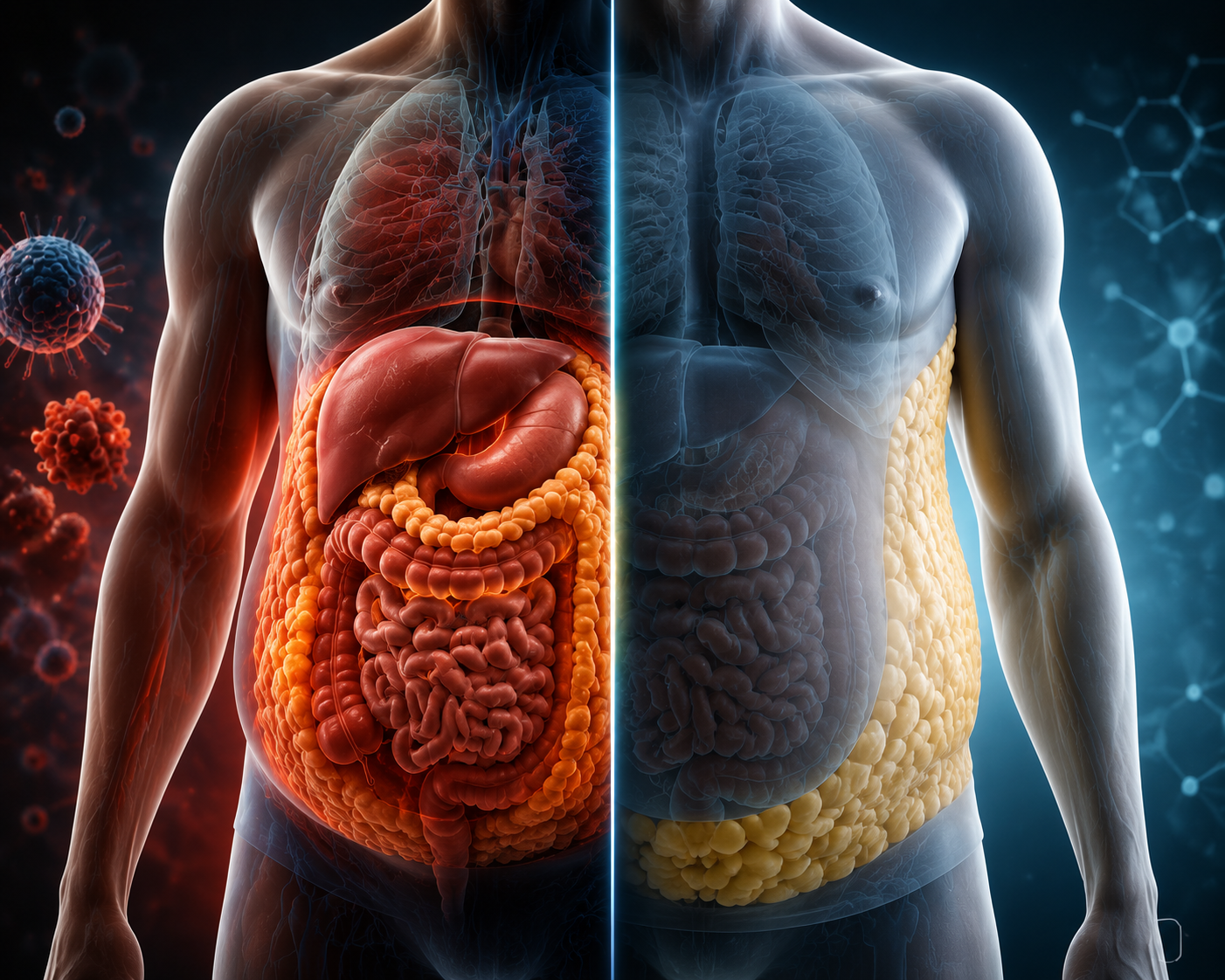
Visceral fat and subcutaneous fat are not interchangeable. One is mostly a storage layer. The other behaves like a metabolic troublemaker wrapped around your organs.
What Is Subcutaneous Fat?
Subcutaneous fat sits directly under the skin. It’s the fat you can pinch on your stomach, thighs, or arms.
Key functions:
- Energy storage reserve
- Insulation and temperature regulation
- Mechanical cushioning
- Relatively stable and less metabolically active
In normal ranges, subcutaneous fat is not strongly linked to disease risk. It is more about aesthetics and overall body composition.
What Is Visceral Fat?
Visceral fat is deeper. It sits inside the abdominal cavity and surrounds organs like the liver, pancreas, and intestines.
You don’t see it directly. But your metabolism feels it constantly.
Key characteristics:
- Located around internal organs
- Highly metabolically active
- Releases inflammatory cytokines
- Strongly linked to insulin resistance
This is the fat associated with “skinny on the outside, unhealthy on the inside.”
Why Visceral Fat Is More Harmful
Visceral fat is not passive storage. It actively changes how your body functions.
Health risks linked to excess visceral fat:
- Type 2 diabetes and insulin resistance
- Cardiovascular disease
- Non-alcoholic fatty liver disease (NAFLD)
- Chronic systemic inflammation
- Hormonal disruption (cortisol, insulin, sex hormones)
- Higher risk of metabolic syndrome
It consistently predicts disease risk better than body weight or BMI alone.
Is Subcutaneous Fat Bad?
Not really in moderate amounts.
Subcutaneous fat:
- Does not drive inflammation at the same level
- Acts as a safer energy buffer
- Can even be protective in certain metabolic conditions
But excessive amounts, especially with poor diet and inactivity, can still contribute to insulin resistance over time.
Why Visceral Fat Builds Up
This type of fat is strongly driven by metabolic and hormonal signals, not just calories.
Common causes:
- Chronic stress and elevated cortisol
- Poor sleep quality
- High sugar and refined carbohydrate intake
- Alcohol intake
- Sedentary lifestyle
- Insulin resistance
- Hormonal changes (menopause, low testosterone)
This is why abdominal fat often increases even when body weight barely changes.
How to Measure Visceral Fat
You can’t accurately assess it by appearance alone.
Better options:
- DEXA scan (most accurate clinical tool)
- MRI or CT scan (gold standard)
- Waist-to-height ratio screening
- Bioimpedance scales (trend tracking only)
A waist-to-height ratio above 0.5 is often a red flag for elevated visceral fat.
How to Reduce Visceral Fat
The good news: visceral fat responds quickly to lifestyle changes.
1. Strength training
Improves insulin sensitivity and increases muscle-driven metabolism.
2. Protein-first nutrition
Supports satiety and preserves lean mass.
3. Stable blood sugar
Reduces insulin spikes that promote fat storage.
4. Sleep optimization
Poor sleep increases cortisol and fat storage signals.
5. Stress reduction
Chronic cortisol is one of the strongest drivers of visceral fat.
6. Clinical support when needed
GLP-1 therapy, thyroid optimization, testosterone or estrogen balancing can improve metabolic flexibility under medical supervision.
Hormones and Fat Distribution
Hormones strongly determine where fat is stored.
- Low testosterone in men increases abdominal fat
- Estrogen decline in women shifts fat toward the midsection
- High cortisol promotes central fat storage
This is why identical diets can produce completely different body shapes.
Bottom Line
Visceral fat is the more dangerous form of body fat. It is metabolically active, inflammatory, and closely tied to chronic disease risk.
Subcutaneous fat is far less harmful and often neutral in moderate amounts.
Health optimization is not just about weight loss. It is about reducing visceral fat while preserving muscle and metabolic function.